Why Legal Notice Is Important in Court – Complete Guide Everyone Must Know
This article is published by The Legal Warning India and written by Advocate Uday Singh.
In India, most people approach courts only after a dispute becomes serious. However, what many people do not realise is that a legal notice often decides the fate of a case even before it reaches court.
Whether it is:
- Money recovery
- Salary non-payment
- Property dispute
- Builder delay
- Online fraud
- Tenant-landlord issue
a properly drafted legal notice plays a crucial role.
Still, many people ask:
“Legal notice kya hota hai? Court me iska kya importance hai? Aur kya bina legal notice ke case file ho sakta hai?”
This article answers all these questions in simple language with legal clarity.
What Is a Legal Notice?
A legal notice is a formal written communication sent by one party to another, informing them about:
- A legal grievance
- Demand for action or payment
- Consequences of non-compliance
It is usually sent through an advocate and clearly mentions that legal action will be taken if the issue is not resolved within a specified time.
Why Legal Notice Is So Important Before Going to Court?
A legal notice is not just a formality. Courts attach serious importance to it.
1. Shows Your Serious Legal Intention
Legal notice proves that the aggrieved party genuinely tried to resolve the dispute before approaching court.
2. Opportunity Given to Opposite Party
Court expects that the opposite party should get a fair chance to respond.
3. Strengthens Your Case from Day One
If notice is ignored or denied without reason, courts may draw adverse inference.
4. Many Disputes Settle at Notice Stage
In practice, a large number of cases get resolved after receiving a strong advocate-drafted legal notice.
Is Legal Notice Mandatory Before Filing Case?
The answer depends on the type of case.
Legal Notice is Mandatory In:
- Government related cases
- Certain civil recovery matters
- Contractual disputes (practically)
Legal Notice is Not Strictly Mandatory But Strongly Recommended In:
- Money recovery cases
- Salary disputes
- Property matters
- Tenant-landlord disputes
- Business disputes
Important: Even when not mandatory, absence of legal notice can weaken your case.
How Courts View Legal Notice?
Courts examine:
- Whether notice was sent
- How detailed and clear it was
- Whether reply was given
- Conduct of parties after notice
If the opposite party ignores a legal notice without justification, courts often treat it as:
- Lack of bona fide intention
- Admission by silence (in some cases)
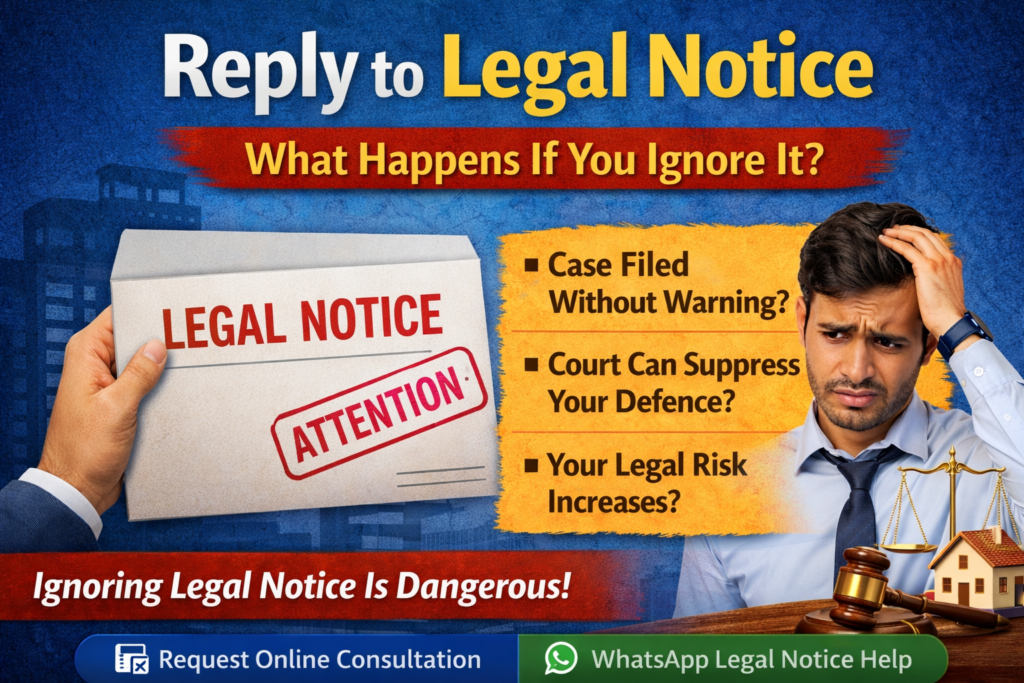
What Happens If Legal Notice Is Ignored?
Ignoring a legal notice is a serious mistake.
- Your case becomes stronger
- Interest and costs may be awarded
- Defence credibility reduces
Many people think silence protects them – legally, it usually does the opposite.
Importance of Advocate-Drafted Legal Notice
A legal notice drafted by an experienced advocate:
- Uses correct legal language
- Mentions relevant laws
- Creates pressure without threats
- Becomes strong documentary evidence
Poorly drafted notices or WhatsApp messages do not have the same legal value.
Common Situations Where Legal Notice Is Extremely Effective
- Salary not paid by employer
- Builder delaying possession
- Security deposit not returned
- Money given to friend not returned
- Online payment recovery
Related Reading:
Common Mistakes People Make
- Sending abusive or threatening messages
- Not keeping proof of notice delivery
- Delaying notice for months or years
- Copy-paste notice without legal facts
Prevention & Practical Advice
- Send notice early
- Keep all documents ready
- Consult an advocate
- Do not rely only on oral talks
Frequently Asked Questions (FAQs)
Q. Can I send legal notice without advocate?
Yes, but advocate-drafted notices carry more legal weight.
Q. How much time is given in legal notice?
Usually 7–30 days depending on matter.
Q. Can notice be sent by email or WhatsApp?
Yes, but traditional modes are still preferred.
This article is for general legal information and awareness purposes only. It does not constitute legal advice or solicitation. Communication is purely informational, in compliance with Bar Council of India Rule 36.