
Property Encroachment by Neighbour – Legal Remedies & Civil Suit Explained in India
This article is published by The Legal Warning India and written by Advocate Uday Singh.
Property disputes are among the most common and emotionally charged civil cases in India. One of the biggest problems faced by landowners is property encroachment by neighbour. This usually starts silently — a wall slightly extended, a boundary shifted, or open land slowly occupied.
Over time, the encroachment becomes permanent, and the owner is left wondering:
“Neighbour ne meri property par kabza kar liya – ab legal remedy kya hai?”
This article explains, in detail, what property encroachment means, how Indian courts view it, and what legal action you can take to protect your land.
What Is Property Encroachment?
Property encroachment means unauthorised occupation or use of another person’s land without legal right or consent.
Encroachment can happen through:
- Illegal construction
- Boundary wall extension
- Occupation of open land
- Blocking access or pathway
- Gradual land grabbing
Encroachment can be on:
- Residential property
- Agricultural land
- Ancestral property
- Commercial plots
Why Property Encroachment Cases Are Very Common in India?
- Unclear boundaries
- Poor demarcation records
- Oral family arrangements
- Absentee landowners
- Delay in taking legal action
Encroachers rely on delay and silence of the real owner.
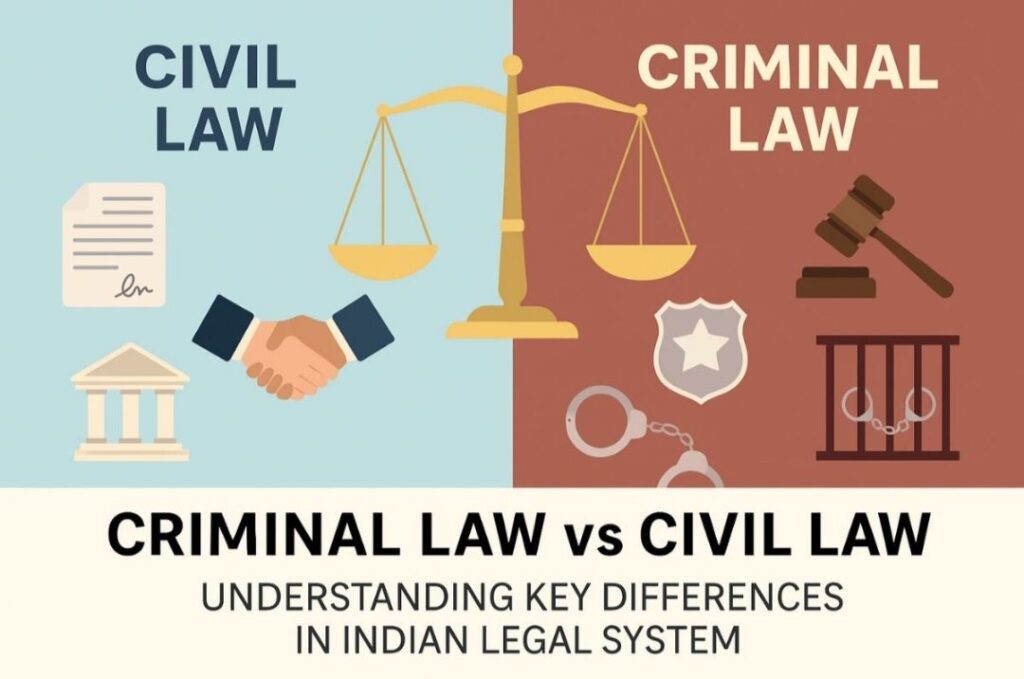
Is Property Encroachment a Civil or Criminal Matter?
In most cases, property encroachment is a civil dispute.
However, it may take criminal colour if:
- Force or threat is used
- Forgery of documents is involved
- Intentional land grabbing is evident
Generally, courts advise civil remedies first.
First Step – Verify Ownership & Boundary
Before taking action, the property owner should collect:
- Sale deed / title deed
- Revenue records
- Site plan / map
- Municipal or panchayat records
Clear documentation is the backbone of an encroachment case.
Legal Remedies Available Against Property Encroachment
1. Legal Notice to Encroacher
The first legal step is sending a legal notice demanding removal of encroachment.
A proper notice:
- Asserts ownership
- Mentions illegal occupation
- Demands removal within time
- Warns of civil suit
Many disputes resolve at notice stage itself.
2. Suit for Permanent Injunction
If encroachment is ongoing or threatened, a permanent injunction suit can be filed.
Court may restrain the neighbour from:
- Further construction
- Interfering with possession
3. Suit for Mandatory Injunction
When encroachment has already occurred, a mandatory injunction may be filed to:
- Remove illegal construction
- Restore original position
4. Demarcation Through Court or Authority
Courts often order land demarcation through revenue officials to clearly establish boundaries.
5. Civil Suit for Possession
If encroachment has resulted in loss of possession, a suit for possession may be required.
What If Neighbour Claims Adverse Possession?
Encroachers often take the defence of adverse possession.
However, adverse possession requires:
- Continuous possession
- For prescribed long period
- Open and hostile possession
Mere illegal occupation does not automatically give ownership.
What Happens If You Delay Action?
Delay is the biggest enemy in encroachment cases.
- Encroacher strengthens position
- Evidence becomes weak
- Defence of adverse possession may arise
Early legal action is critical.
Common Mistakes Property Owners Make
- Ignoring initial encroachment
- Only verbal objections
- No legal notice
- No boundary verification
- Waiting for years
Prevention Tips for Property Owners
- Regularly inspect property
- Clearly demarcate boundaries
- Install boundary walls/fencing
- Document any interference
- Act legally at first sign
Internal Legal Reading (Recommended)
Frequently Asked Questions (FAQs)
Q. Can police remove encroachment?
Generally no, unless court order or criminal offence exists.
Q. Can construction be demolished?
Yes, through court order in mandatory injunction.
Q. Is legal notice compulsory?
Not mandatory, but strongly recommended.
This article is for general legal information and awareness purposes only. It does not constitute legal advice or solicitation. Communication is purely informational, in compliance with Bar Council of India Rule 36.