
No Written Contract, Only Purchase Order – Can MSME or Vendor Recover Payment in India?
This article is published by The Legal Warning India and written by Advocate Uday Singh.
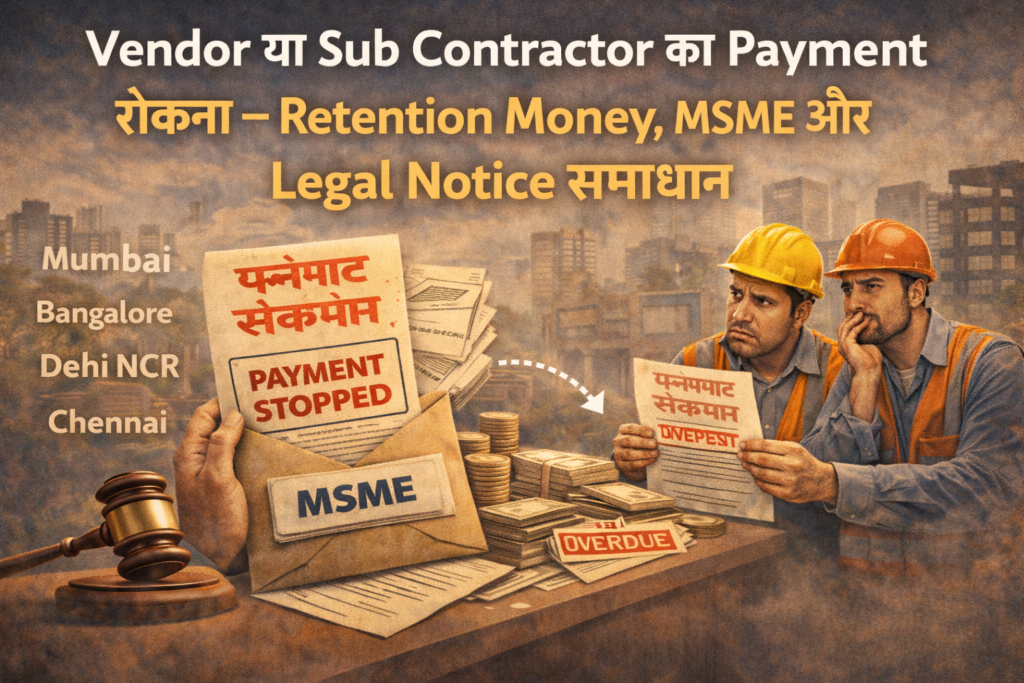
In India, a very large number of MSME vendors, suppliers, service providers and sub-contractors work without signing a detailed written agreement.
Instead, work is awarded through a Purchase Order (PO), email confirmation, WhatsApp instruction, or work order.
The real problem starts when:
- Work is completed
- Goods or services are delivered
- Invoice is raised
but the company refuses to release payment by saying:
“There is no signed contract, so payment is not payable.”
This raises a very serious and common legal question:
“If there is no written contract and only a purchase order, can payment still be recovered legally?”
The short answer is: YES.
This article explains how and why.
Is a Written Contract Mandatory Under Indian Law?
No. Indian contract law does not say that a contract must always be in writing.
A contract can be:
- Written
- Oral
- Implied from conduct
If there is offer, acceptance and consideration, a legally enforceable contract exists — even without a formal agreement.
What Is the Legal Value of a Purchase Order (PO)?
A purchase order is a commercial document that clearly shows:
- Scope of work or supply
- Rates and quantities
- Delivery / execution terms
- Payment terms
Courts in India consistently hold that a purchase order is sufficient proof of contractual relationship.
Common Situations Where Payment Is Denied
- Only PO issued, no agreement signed
- Email approval but no stamp/signature
- Work done based on WhatsApp instructions
- Vendor removed after delivery
- Accounts department refusing payment
These excuses do not automatically defeat a payment claim.
What Evidence Can Prove the Contract?
Courts rely on the entire transaction trail, not just one document.
Valid evidence includes:
- Purchase Order / Work Order
- Emails confirming scope or rates
- WhatsApp instructions from officials
- Delivery challans / GRN
- Invoices and GST filings
- Site photographs / completion proof
- Partial payments made earlier
Conduct of the company is extremely important.
First Legal Step – Sending a Legal Notice
When payment is withheld on the ground of “no contract”, the first legal step is issuing a legal notice.
A proper legal notice should:
- Refer to PO and transaction details
- Mention completed work / supply
- Specify outstanding amount
- Demand payment within a fixed time
- Warn of civil and commercial action
Many companies release payments after receiving a legally drafted notice.
Legal Remedies Available Without a Written Contract
1. Civil Suit for Recovery of Money
A vendor or contractor can file a recovery suit based on PO and execution proof.
2. Commercial Court (High-Value Transactions)
Commercial courts handle business disputes even without formal contracts.
3. MSME Remedies (If Registered)
MSME vendors enjoy additional statutory protection against delayed payments.
How Courts View “No Contract” Defences
Courts examine:
- Whether work/supply actually happened
- Whether company benefited from it
- Whether objections were raised timely
- Whether defence is an afterthought
Courts do not allow unjust enrichment by denying payment for accepted work.
Common Mistakes Vendors Make
- Not preserving PO and emails
- Accepting oral denials silently
- Delaying legal notice
- Not maintaining GST / delivery records
How Vendors Can Protect Themselves in Future
- Always get PO or email confirmation
- Preserve communication trail
- Raise invoices promptly
- Act legally at the first sign of delay
Related Articles
- Sub Contractor Ka Paisa Atak Gaya? Legal Notice aur Court Solution
- Labour Thekedar Ka Bill Clear Nahi Ho Raha? Legal Rights aur Recovery Process
- Running Bill (RA Bill) Not Cleared – Legal Remedies
- Sub-Contractor Terminated After Work Completion – Payment Recovery
Frequently Asked Questions (FAQs)
Q. Can payment be recovered only on PO?
Yes, if work or supply is proved.
Q. Is stamp or signature mandatory?
Not always, conduct and acceptance matter.
Q. Is legal notice compulsory?
Not mandatory, but strongly advisable.
This article is for general legal information and awareness purposes only. It does not constitute legal advice or solicitation. Communication is purely informational, in compliance with Bar Council of India Rule 36.