This article is published by The Legal Warning India and written by Advocate Uday Singh.
NDPS Act in India – Arrest, Bail, Quantity Classification & Legal Remedies Explained
The NDPS Act (Narcotic Drugs and Psychotropic Substances Act) is one of the strictest criminal laws in India.
A single allegation under this Act can result in:
- Immediate arrest
- Long police custody or judicial custody
- Severe restrictions on bail
- Presumption against the accused
Many NDPS cases involve serious procedural lapses, illegal search, or false implication.
This article explains how the NDPS Act works, what rights an accused has, and what legal remedies are available.
Information is based on NDPS Act provisions, Supreme Court interpretations, and publicly available legal sources.
What Is the NDPS Act?
The NDPS Act regulates:
- Possession
- Consumption
- Sale and purchase
- Transportation
- Manufacture of narcotic drugs and psychotropic substances
Offences under the NDPS Act are treated as serious crimes against society.
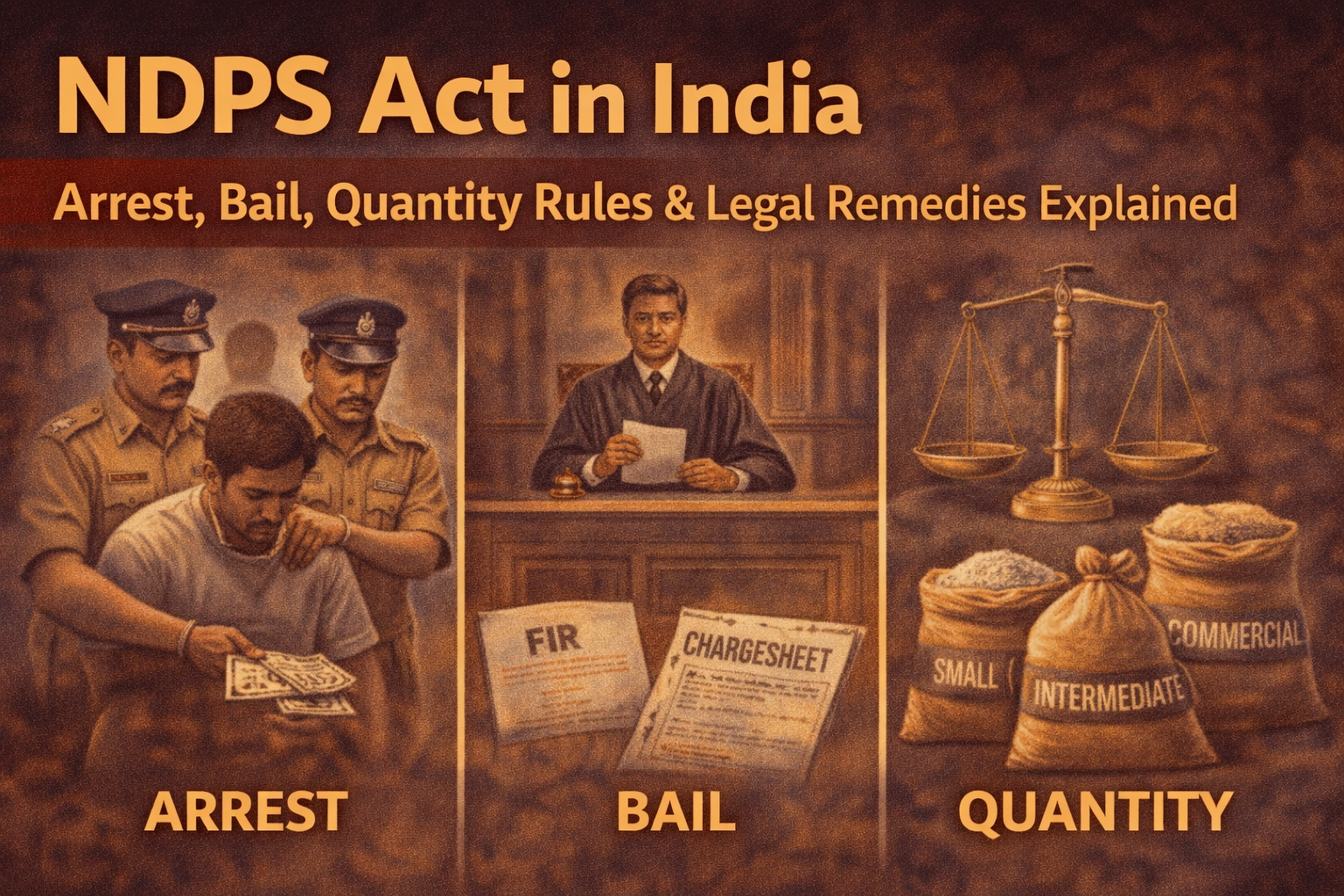
Quantity Matters – Small, Intermediate & Commercial Quantity
NDPS offences are classified based on quantity:
- Small Quantity – comparatively lesser punishment
- Intermediate Quantity – moderate punishment
- Commercial Quantity – extremely severe punishment
Bail rules change drastically once commercial quantity is involved.
Arrest Under NDPS Act – What Police Must Follow
Police must strictly comply with procedural safeguards:
- Legal search and seizure
- Compliance with mandatory provisions
- Proper documentation and sealing of samples
- Timely production before Magistrate
Violation of procedure can weaken the prosecution case.
Bail Under NDPS Act – Why It Is Difficult
NDPS Act places stringent conditions on bail, especially in commercial quantity cases:
- Court must be satisfied that accused is not guilty
- Court must believe accused will not commit offence again
However, bail is not impossible and depends on facts, quantity, and compliance of law.
Common Grounds Used in NDPS Defence
- Illegal search and seizure
- Violation of mandatory provisions
- False implication
- Contradictions in recovery and documentation
- Delay in sending samples for examination
NDPS cases are technical and procedure-driven.
Role of Chargesheet in NDPS Cases
Chargesheet must be filed within prescribed time. Delay may give rise to:
- Statutory bail
- Challenge to continued detention
Each stage of investigation matters.
NDPS vs False Implication
There are reported instances where NDPS law is misused:
- Planting of substance
- Forcing recovery on accused
- Using NDPS pressure for extortion
Courts have repeatedly held that strict compliance with law is mandatory.
Related Legal Awareness Articles
When Is Immediate Legal Guidance Necessary?
Immediate legal guidance may be required when:
- Arrest has taken place under NDPS Act
- Commercial quantity is alleged
- Search or recovery appears doubtful
- Bail is being repeatedly rejected
Early legal strategy often impacts the entire case.
Need legal guidance? You may choose to connect for general consultation and information.
▶ Request Online Consultation
▶ Request WhatsApp Consultation
Disclaimer: This article is for general legal information and awareness purposes only. It does not constitute legal advice or solicitation. Communication is purely informational, in compliance with Bar Council of India Rule 36.