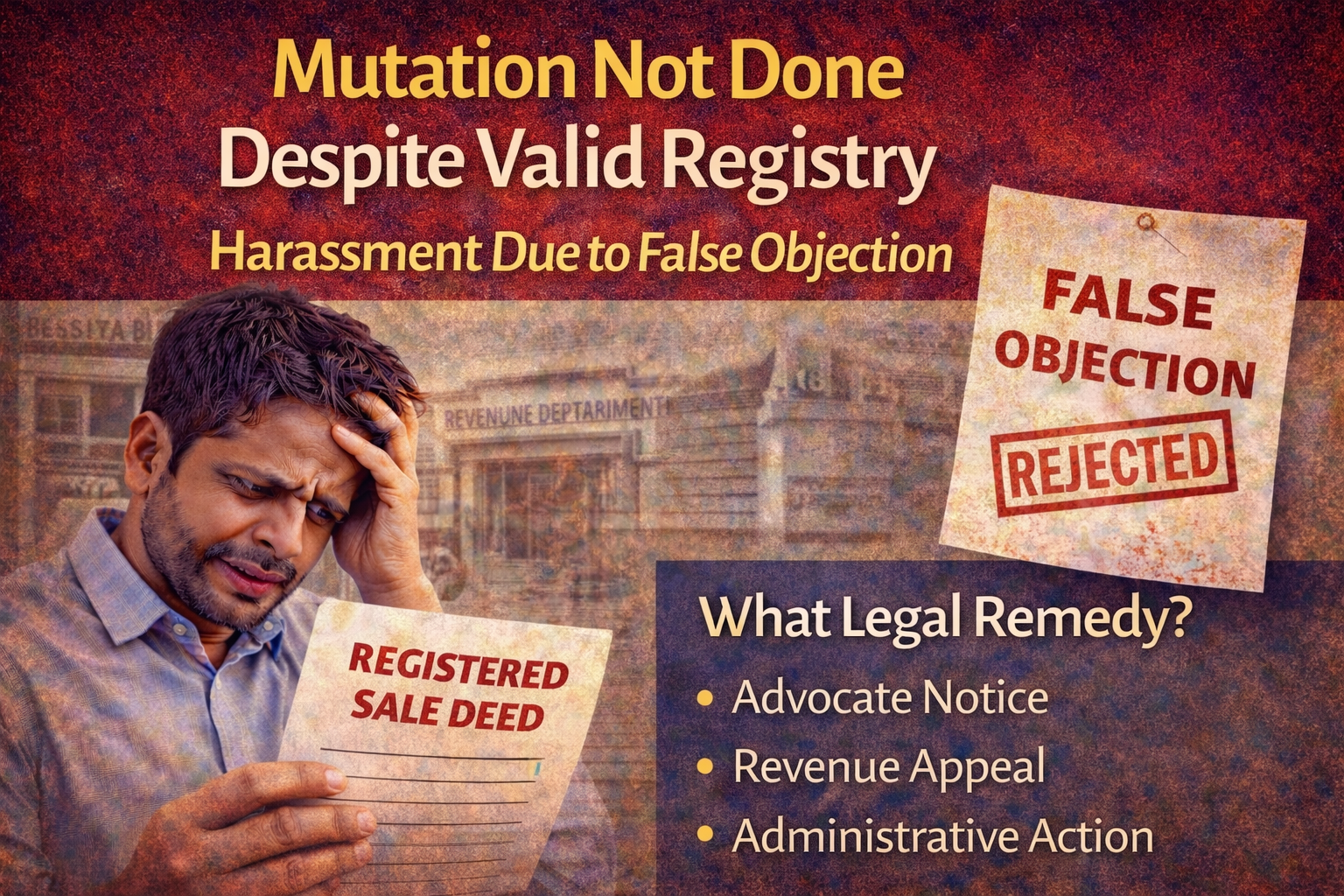
Mutation Not Done Despite Valid Registry – Legal Remedy Against False Objection (India)
This article is published by The Legal Warning India and written by Advocate Uday Singh.
One of the most common and frustrating property problems in India is when mutation is not carried out despite a valid registered sale deed.
The situation becomes worse when officials delay the process citing false or frivolous objections (farzi aapatti).
Property owners often ask:
“Registry valid hai, paisa poora diya gaya, phir mutation kyun nahi ho raha?”
This article explains the legal position, common reasons for delay, and step-by-step remedies when mutation is blocked due to fake objections.
What Is Mutation and Why Is It Important?
Mutation is the process of recording the transfer of ownership in revenue or municipal records.
It does not create ownership but officially recognizes it.
Mutation is essential for:
- Property tax payment
- Government records
- Electricity and water connection
- Future sale or loan
- Avoiding disputes
Is Mutation Mandatory After Registry?
Yes.
Once a sale deed is registered:
- Ownership is legally transferred
- Mutation should normally follow
- Revenue officials cannot deny mutation arbitrarily
Registry is a strong legal document.
Common Reasons Given for Mutation Delay
Authorities usually cite the following reasons:
- Objection filed by third party
- Pending civil dispute (even without stay)
- Boundary or khasra mismatch
- Old revenue entries
- Incomplete paperwork
However, not every objection is legally valid.
What Is a False or Frivolous Objection (Farzi Aapatti)?
A false objection generally involves:
- No title document supporting objection
- No court stay order
- Old or irrelevant claims
- Objection filed only to harass or delay
Revenue authorities often misuse objections to delay mutation unlawfully.
Legal Position: Can Mutation Be Stopped Due to Objection?
Important Legal Principle:
If there is:
- No injunction or stay order from court
- No prima facie title with objector
Then:
- Mutation cannot be indefinitely withheld
- Authorities must decide mutation on merits
Courts have repeatedly held that mutation proceedings are summary in nature.
Step-by-Step Remedy When Mutation Is Blocked
Step 1: File Written Reply to Objection
- Deny false claims clearly
- Attach registered sale deed
- Demand proof from objector
Step 2: Demand Speaking Order
Ask the authority to pass a written, reasoned order instead of keeping the matter pending.
Step 3: Legal Notice Through Advocate
A legal notice puts pressure and creates official accountability.
Step 4: Approach Higher Revenue Authority
- SDM / Tehsildar
- Additional Collector
- District Collector
Step 5: Judicial Remedy (If Required)
Where harassment continues, legal remedies may be invoked.
Can Officials Be Held Accountable?
Yes.
Officials are bound to:
- Decide mutation within reasonable time
- Not act on irrelevant objections
- Follow due process
Arbitrary delay violates principles of administrative law.
Common Mistakes Property Owners Make
- Relying only on verbal follow-ups
- Not filing written replies
- Ignoring fake objections
- Not taking legal assistance early
Delay strengthens the harasser, not the owner.
Why Advocate Drafted Reply & Notice Matters
A professionally drafted reply:
- Exposes fake objections
- Demands legal accountability
- Speeds up mutation
- Prevents future litigation
Most mutation disputes resolve once legal pressure is applied.
Frequently Asked Questions (FAQs)
Q. Can mutation be denied even after registry?
No, unless there is a valid court order.
Q. Is civil case enough to stop mutation?
No, only stay or injunction can stop mutation.
Q. How long should mutation take?
Usually 15–45 days, depending on state rules.
This article is for general legal information and awareness purposes only. It does not constitute legal advice or solicitation. Communication is purely informational, in compliance with Bar Council of India Rule 36.