This article is published by The Legal Warning India and written by Advocate Uday Singh.
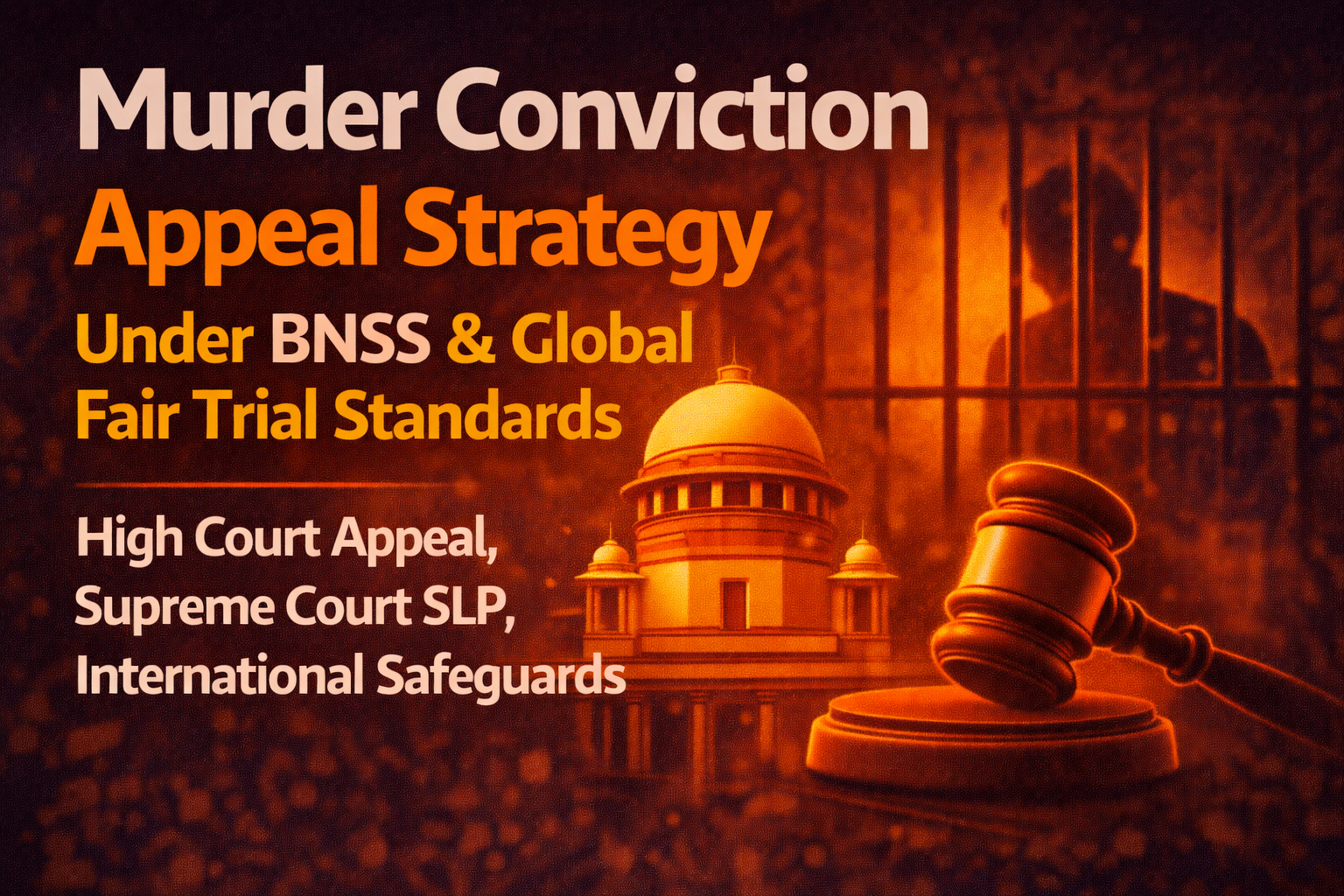
Murder Conviction Appeal Strategy Under BNSS & Global Fair Trial Standards – Complete Legal Roadmap
A conviction for murder is one of the most serious outcomes in criminal law.
However, even after conviction, the legal process does not end.
Under Indian law (now transitioning from CrPC to the Bharatiya Nagarik Suraksha Sanhita, 2023 – BNSS) and global fair trial principles, multiple appellate safeguards exist to prevent miscarriage of justice.
This article explains the post-conviction appeal strategy from Session Court to Supreme Court, including comparative global standards.
1️⃣ Legal Framework – From CrPC to BNSS (2023)
India’s criminal procedure historically operated under CrPC, 1973.
With the introduction of BNSS 2023, procedural reforms focus on:
- Time-bound trials
- Digital records & evidence management
- Victim rights strengthening
- Improved appellate transparency
However, the fundamental right to appeal after conviction remains intact.
2️⃣ First Stage – Appeal to High Court
After a Sessions Court convicts in a murder case:
- Appeal lies before the High Court.
- The High Court re-appreciates evidence.
- Both factual and legal errors can be examined.
Important grounds often include:
- Contradictions in witness testimony
- Forensic inconsistencies
- Chain of circumstantial evidence incomplete
- Violation of procedural safeguards
- Improper appreciation of benefit of doubt
Related reading:
Life Imprisonment Appeal Process Explained
3️⃣ Sentence Suspension During Appeal
Under appellate jurisdiction, courts may consider:
- Suspension of sentence
- Bail during appeal
This depends on:
- Nature of evidence
- Length of custody
- Likelihood of delay in appeal disposal
4️⃣ Supreme Court – Special Leave Petition (SLP)
If the High Court confirms conviction, remedy lies in:
- Special Leave Petition (SLP)
- Criminal Appeal before Supreme Court
The Supreme Court primarily examines:
- Substantial question of law
- Misapplication of legal principles
- Violation of constitutional safeguards
5️⃣ Death Penalty Cases – Higher Safeguards
In capital punishment cases:
- High Court confirmation is mandatory.
- Review Petition is available.
- Curative Petition may be filed.
- Mercy Petition before Governor/President.
Comparative understanding:
Death Penalty vs Life Imprisonment – Legal Difference
6️⃣ BNSS & Digital Evidence Strategy
Under modern reforms, digital evidence plays a central role:
- Call Detail Records (CDR)
- CCTV footage
- Electronic communication logs
- Forensic data chain integrity
Appeal strategy must critically analyze admissibility and reliability of such material.
7️⃣ International Fair Trial Standards
Globally recognized standards include:
- Right to fair trial (Article 14 ICCPR)
- Presumption of innocence
- Right to effective legal representation
- Proportional sentencing doctrine
Courts worldwide emphasize that capital punishment must meet “rarest of rare” type standards and strict scrutiny.
8️⃣ Common Strategic Errors in Appeals
- Copy-paste appeal without judgment analysis
- Ignoring medical contradictions
- Failure to challenge procedural lapses
- Delay in filing appeal
Effective appeal requires detailed scrutiny of trial court reasoning.
9️⃣ Possibility of Conviction Alteration
In some cases, appellate courts may:
- Convert murder (Section 302 IPC equivalent under new code) to culpable homicide
- Reduce sentence
- Grant acquittal on benefit of doubt
🔟 Long-Term Remedies
- Remission policies
- Parole & furlough
- Compassionate grounds petitions
Conclusion
A murder conviction is severe, but appellate safeguards under Indian law and global standards ensure multiple layers of judicial scrutiny.
The transition toward BNSS strengthens procedural efficiency, but appellate rights remain constitutionally protected.
Strategic, evidence-based appeal preparation is critical.
Disclaimer: This article is for general legal information and awareness purposes only. It does not constitute legal advice or solicitation. Communication is purely informational, in compliance with Bar Council of India Rule 36.