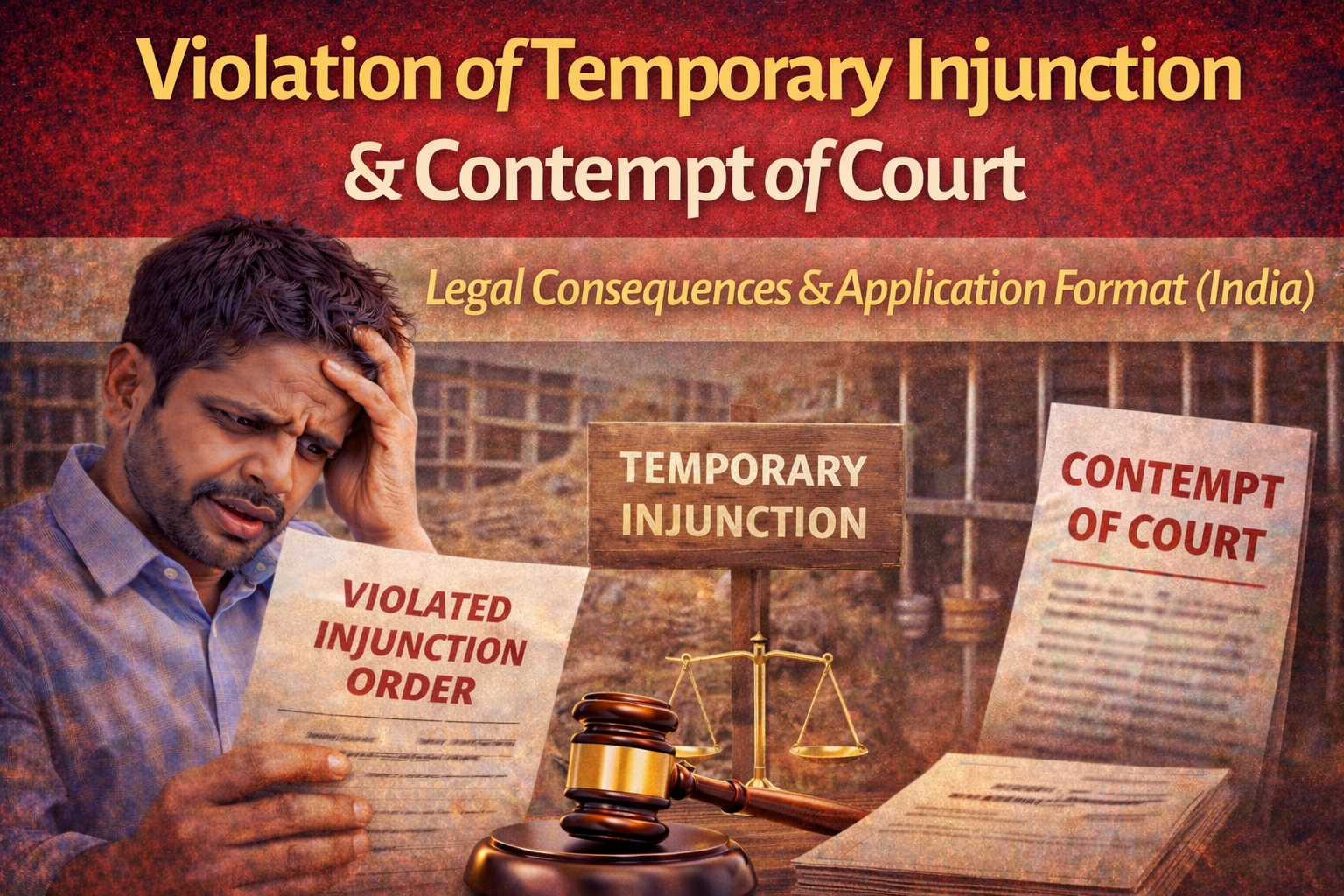
Violation of Temporary Injunction & Contempt of Court – Legal Consequences, Remedy & Application Format (India)
This article is published by The Legal Warning India and written by Advocate Uday Singh.
In civil and property disputes, courts frequently grant temporary injunction orders to maintain status quo. However, one of the most serious mistakes parties make is violating an injunction order—sometimes knowingly, sometimes unknowingly.
Once a temporary injunction is violated, the issue is no longer just a civil dispute. It can escalate into contempt of court proceedings, which carry serious legal consequences.
The most common questions people ask are:
“What happens if an injunction order is violated?”
“Can I be punished for contempt of court?”
This article explains the complete legal position in India regarding injunction violation, contempt proceedings, remedies available, and practical application format.
What Is a Temporary Injunction?
A temporary injunction is an interim order passed by a civil court under Order 39 Rules 1 & 2 of the Code of Civil Procedure (CPC), restraining a party from:
- Selling or transferring property
- Changing possession
- Raising construction
- Interfering with peaceful possession
The objective is to preserve the subject matter until final adjudication.
What Constitutes Violation of Injunction?
Injunction violation occurs when a party:
- Acts contrary to court directions
- Knowingly disobeys the injunction
- Creates third-party rights despite restraint
- Continues construction despite prohibition
- Assists or facilitates violation indirectly
Even indirect or partial violation can attract legal action.
Is Injunction Violation a Serious Offence?
Yes.
Violation of injunction is treated as:
- Disobedience of court order
- Contempt of court
- Abuse of judicial process
Courts take injunction violations very seriously because they undermine the authority of the judiciary.
Legal Provision for Action – Order 39 Rule 2A CPC
The primary provision dealing with injunction violation is Order 39 Rule 2A CPC.
Under this rule, the court may:
- Attach the property of the violator
- Detain the violator in civil prison
- Restore the status quo
- Pass coercive orders to enforce compliance
This provision acts as a deterrent against misuse of injunction orders.
Difference Between Injunction Violation & Contempt of Court
- Order 39 Rule 2A CPC – Specific to civil injunctions
- Contempt of Courts Act, 1971 – Broader jurisdiction for wilful disobedience
In many cases, courts treat injunction violation as civil contempt.
Who Can File Application for Injunction Violation?
The aggrieved party (usually the plaintiff) can file an application before the same court which granted the injunction.
The application must clearly show:
- Existence of valid injunction order
- Knowledge of order by violator
- Specific acts of violation
- Supporting evidence
Illustrative Format – Application Under Order 39 Rule 2A CPC
(Illustrative format for legal awareness only. Actual drafting depends on facts.)
IN THE COURT OF ___________

Civil Suit No. ____ of 20__

Plaintiff: ___________
Versus
Defendant: ___________

APPLICATION UNDER ORDER 39 RULE 2A CPC
FOR ACTION AGAINST VIOLATION OF INJUNCTION

Most Respectfully Submitted:

1. That this Hon’ble Court granted a temporary injunction
   vide order dated ______ restraining the defendant from ______.

2. That the defendant had full knowledge of the injunction order.

3. That despite the injunction, the defendant has willfully
   violated the order by ____________.

4. That the violation is deliberate and amounts to contempt
   of court.

PRAYER:
It is respectfully prayed that this Hon’ble Court may kindly:
a) Take action under Order 39 Rule 2A CPC,
b) Attach the property of the defendant,
c) Restore status quo,
d) Pass appropriate orders in the interest of justice.

Place:
Date:
Applicant/Plaintiff
Through Counsel
What Evidence Is Required to Prove Violation?
- Certified copy of injunction order
- Proof of service / knowledge
- Photographs / videos of violation
- Witness statements
- Revenue / municipal records
Strong evidence significantly increases success.
What Defences Are Commonly Taken by Respondents?
- Lack of knowledge of injunction
- No intentional violation
- Act done prior to injunction
- Misinterpretation of order
Court examines intention and conduct carefully.
Can Violation Lead to Cancellation of Injunction?
Yes.
If plaintiff himself violates injunction or misuses it, the court may:
- Vacate the injunction
- Impose costs
- Pass adverse findings
Relationship With Order 39 Rule 4 CPC
If an injunction is wrongly granted or misused, the respondent may simultaneously file:
- Application under Order 39 Rule 4 CPC to vacate injunction
Related Reading:
Common Mistakes Parties Make
- Ignoring injunction believing it is temporary
- Continuing construction secretly
- Creating third-party rights
- Not documenting violation properly
Injunction violation can destroy your entire case.
Frequently Asked Questions (FAQs)
Q. Can I be jailed for injunction violation?
Yes, in extreme cases civil imprisonment is possible.
Q. Can police help enforce injunction?
Police assistance may be sought through court directions.
Q. Is apology enough?
Only if violation was bona fide and immediately rectified.
This article is for general legal information and awareness purposes only. It does not constitute legal advice or solicitation. Communication is purely informational, in compliance with Bar Council of India Rule 36.