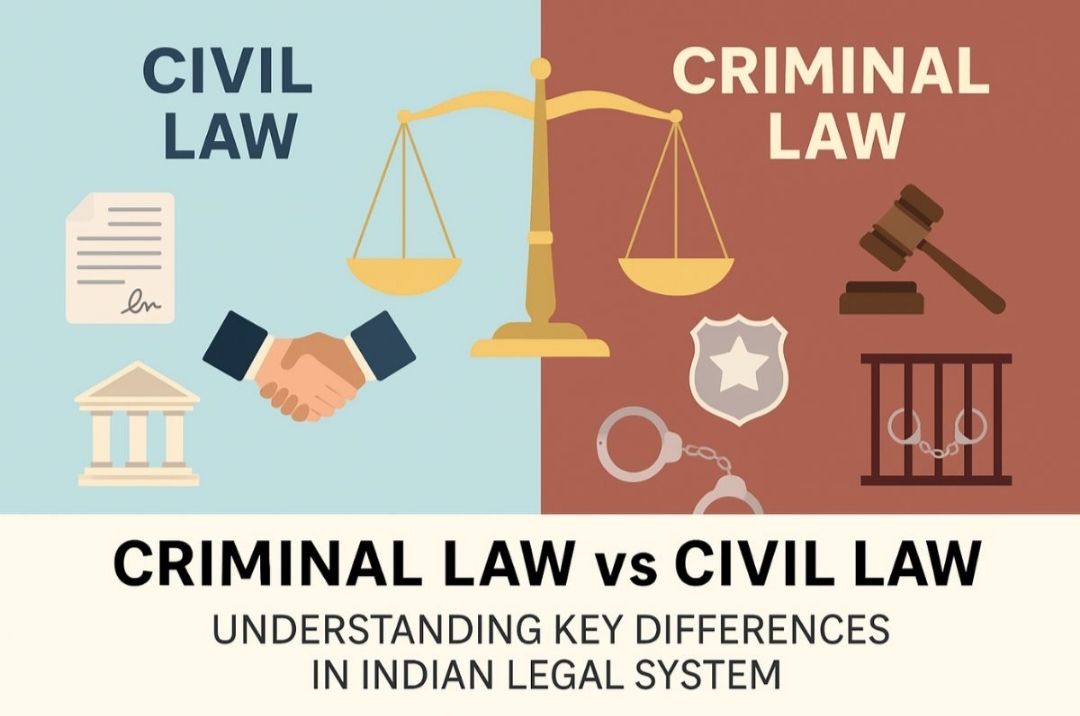
Difference Between Civil Recovery and Criminal Case in India
Many people face confusion while dealing with legal disputes related to money, property, or contractual obligations.
A common question is whether to file a civil recovery case or a criminal case.
This article explains the fundamental difference between civil recovery and criminal proceedings in India,
in a clear and practical manner for general legal awareness.
What Is a Civil Recovery Case?
A civil recovery case is filed to recover money, property, or to enforce a legal right arising out of a contract,
agreement, or financial obligation. Such cases are governed by civil laws such as the Code of Civil Procedure
and the Indian Contract Act.
Common Examples of Civil Recovery
- Recovery of loan or advance amount
- Money recovery based on written agreement or promissory note
- Business payment disputes
- Property possession and related civil disputes
The primary objective of a civil recovery case is compensation or recovery,
not punishment of the opposite party.
What Is a Criminal Case?
A criminal case is initiated when an act amounts to an offence under criminal law and affects society at large.
Criminal cases are governed by laws such as the Bharatiya Nyaya Sanhita (earlier IPC) and the Bharatiya Nagarik
Suraksha Sanhita (earlier CrPC).
Common Examples of Criminal Cases
- Cheque bounce cases under Section 138 NI Act
- Cheating and fraud
- Criminal breach of trust
- Forgery and misappropriation
The objective of a criminal case is punishment of the offender,
which may include imprisonment, fine, or both.
Key Differences Between Civil Recovery and Criminal Case
| Point of Difference | Civil Recovery Case | Criminal Case |
|---|---|---|
| Nature of Case | Private dispute | Offence against law and society |
| Main Objective | Recovery or compensation | Punishment of offender |
| Law Applied | Civil laws (CPC, Contract Act) | Criminal laws (BNS, BNSS, NI Act) |
| Burden of Proof | Preponderance of probability | Beyond reasonable doubt |
| Outcome | Money decree or relief | Conviction or acquittal |
| Imprisonment | Not applicable | May be awarded |
Can Civil and Criminal Cases Run Together?
Yes. In appropriate cases, both civil and criminal proceedings can run simultaneously.
For example, a cheque bounce matter may involve a criminal case under Section 138 NI Act
as well as a civil recovery suit for recovery of money.
Courts have consistently held that the existence of a civil remedy does not automatically
bar criminal proceedings if the ingredients of a criminal offence are made out.
Which Remedy Is Faster?
Criminal proceedings, especially cheque bounce cases, often move faster due to summary procedures.
Civil recovery suits may take longer because of detailed evidence and procedural stages.
The choice of remedy depends on the facts and objectives of the case.
Conclusion
Civil recovery and criminal cases serve different legal purposes.
Understanding their differences helps individuals choose the appropriate legal remedy
and avoid unnecessary complications. Each case must be evaluated on its own facts
before initiating legal proceedings.
Disclaimer:
This content is purely for informational and educational purposes only.
It does not constitute legal advice, solicitation, or advertisement under the Bar Council of India Rules.
No advocate–client relationship is created by reading or relying upon this information
unless formally agreed upon in writing.
Written By:
Uday Singh, Advocate
Practicing Advocate at High Court and District Courts
Prabhari (In-charge), Antarrashtriya Manavadhikar Association, Uttar Pradesh