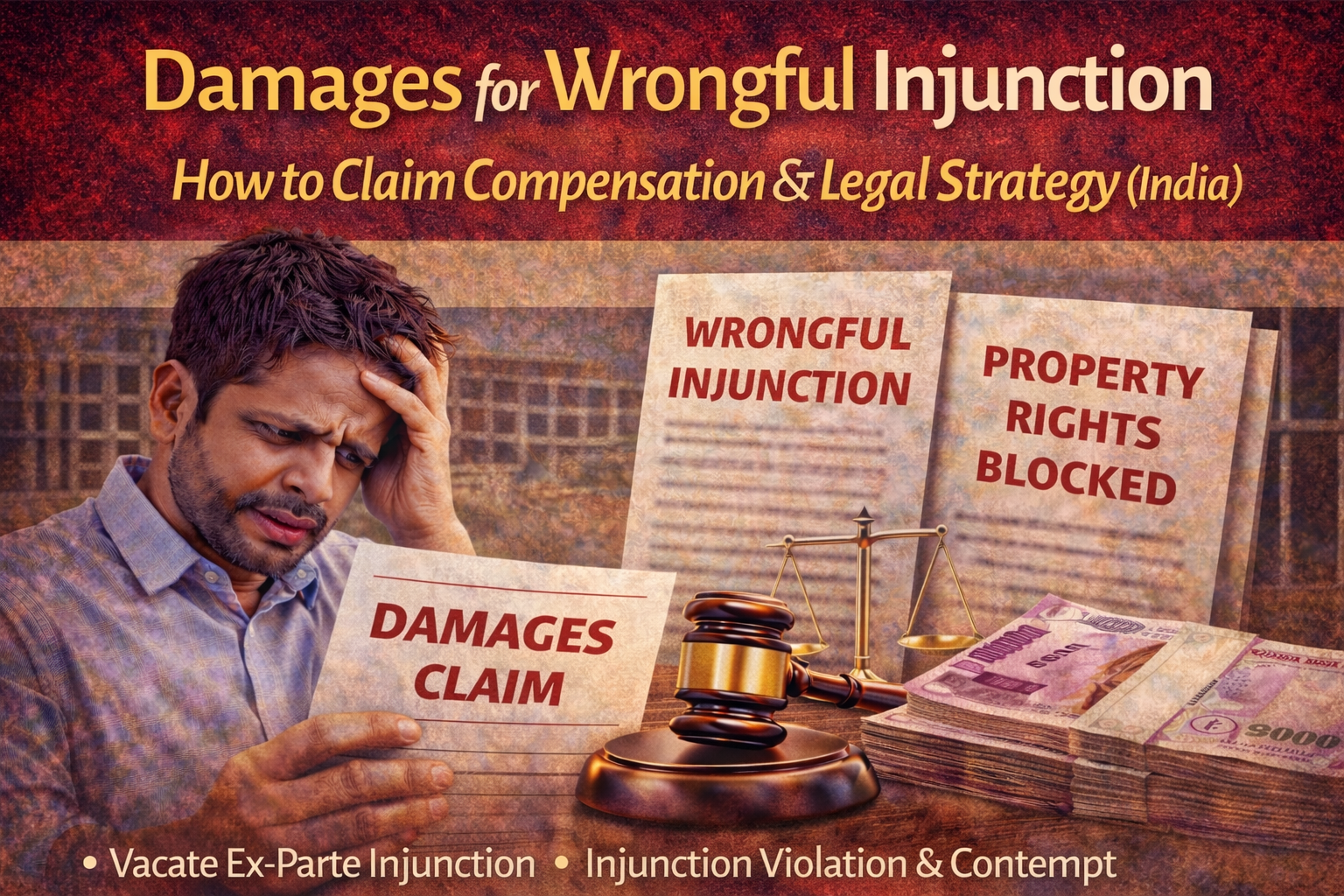
Damages for Wrongful Injunction – How to Claim Compensation & Legal Strategy (India)
This article is published by The Legal Warning India and written by Advocate Uday Singh.
In property disputes, temporary injunctions are often granted to maintain status quo. However, in many cases, injunctions are obtained on false pleadings, suppression of material facts, or misrepresentation. When such injunctions are later vacated, the affected party suffers significant loss.
This raises a critical legal question:
“If an injunction was wrongly granted, can the affected party claim damages or compensation?”
The answer is YES. Indian civil law recognizes the right to claim damages for wrongful injunction, subject to proof and proper legal strategy.
What Is a Wrongful Injunction?
A wrongful injunction is an interim court order that:
- Was obtained by suppression of facts
- Was granted without a prima facie case
- Caused unjust restraint on lawful property rights
- Was later vacated, modified, or held unjustified
Such injunctions result in loss of property use, business opportunity, or sale value.
Legal Basis for Claiming Damages for Wrongful Injunction
Though CPC does not use the phrase “wrongful injunction” explicitly, courts derive power to grant damages from:
- Principles of equity and justice
- Sections 35 and 35A CPC (Costs & compensatory costs)
- Inherent powers of court
- Doctrine against abuse of process
Courts have repeatedly held that law should not reward a party who misuses injunctions.
When Can Damages Be Claimed?
Damages may be claimed when:
- Injunction is vacated under Order 39 Rule 4 CPC
- Court records suppression or misrepresentation
- Plaintiff acted mala fide
- Respondent suffered quantifiable loss
Vacation of injunction is a key trigger.
Types of Damages Claimable
- Loss due to blocked sale of property
- Loss of rental income
- Business or commercial loss
- Legal expenses incurred
- Mental harassment (case-specific)
Courts assess damages conservatively, based on evidence.
Strategic Timing – When to Seek Damages
Damages can be claimed:
- At the time of vacating injunction
- During pendency of suit (interim relief)
- At final disposal of the suit
It is crucial to plead damages early in the written statement.
Relationship With Injunction Proceedings
Claims for damages are closely linked with injunction proceedings under:
- Order 39 Rule 4 CPC (vacating injunction)
- Order 39 Rule 2A CPC (violation or misuse)
Related Reading:
What Evidence Is Required to Prove Damages?
- Vacating order of injunction
- Proof of ownership / possession
- Sale agreements or offers blocked
- Rental agreements
- Financial statements or valuation reports
- Legal expense records
Documentary proof is critical.
Judicial Approach Toward Damages Claims
Indian courts are cautious but increasingly receptive where:
- Injunction was clearly misused
- Litigation was oppressive
- Loss is clearly established
Courts discourage speculative or exaggerated claims.
Common Mistakes Made by Litigants
- Not pleading damages in written statement
- Relying only on oral submissions
- Exaggerating losses
- Ignoring cost provisions
Damages are strategic, not automatic.
Frequently Asked Questions (FAQs)
Q. Can damages be claimed without a separate suit?
Yes, in appropriate cases within the same proceedings.
Q. Are damages different from costs?
Yes. Costs compensate litigation expenses; damages compensate loss.
Q. Is vacation of injunction mandatory?
Generally yes, to establish wrongful restraint.
This article is for general legal information and awareness purposes only. It does not constitute legal advice or solicitation. Communication is purely informational, in compliance with Bar Council of India Rule 36.