This article is published by The Legal Warning India and written by Advocate Uday Singh.
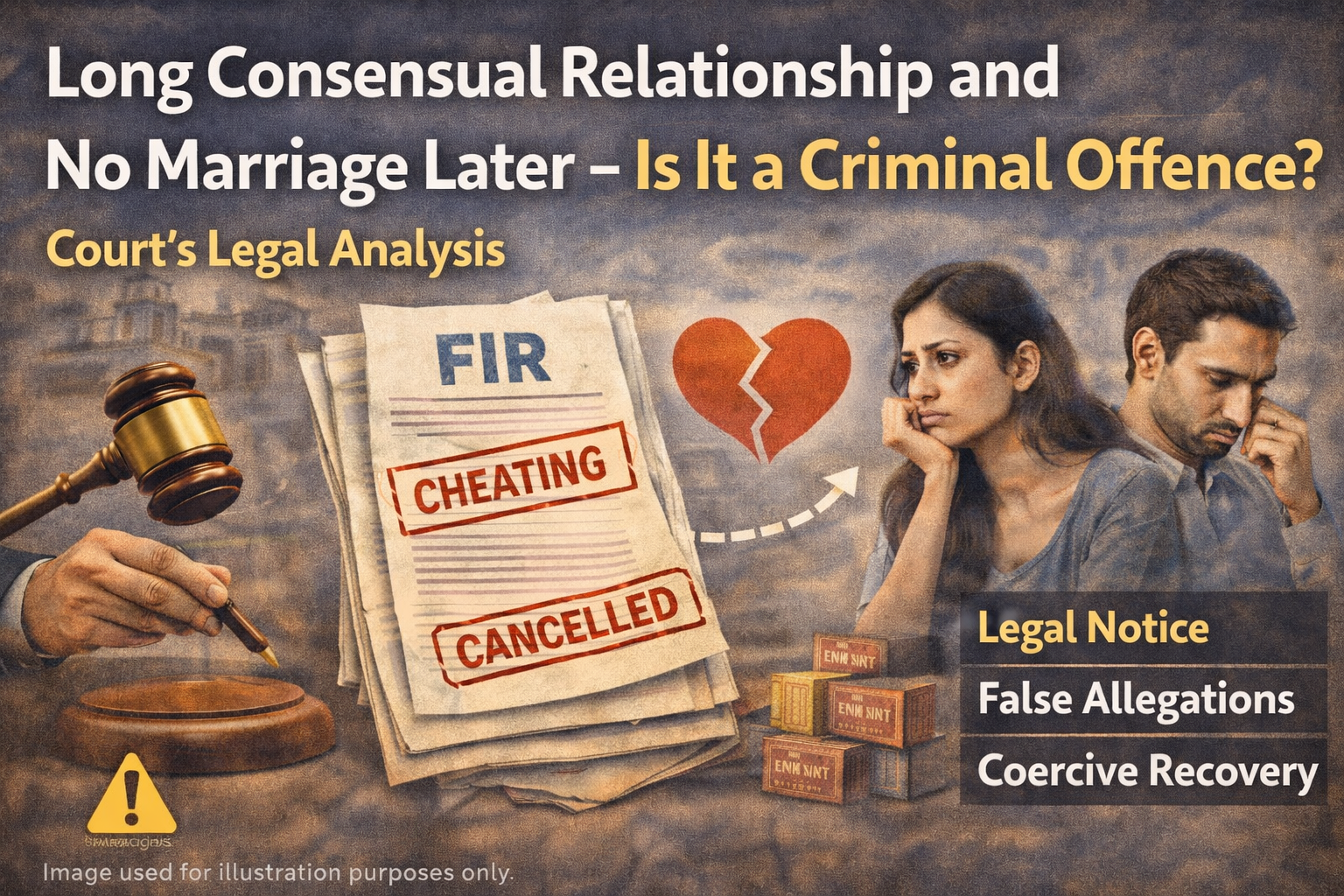
Long Consensual Relationship and No Marriage Later – Is It a Criminal Offence?
Introduction: Legal Meaning of the Recent Court Observation
A recent news report highlighted an important judicial observation that if two adults were in a long-term consensual relationship and later did not marry, such conduct by itself does not amount to a criminal offence.
This observation is significant in cases where, after a relationship breaks down, criminal complaints are filed alleging cheating or criminal intent solely on the basis that marriage did not take place.
This analysis explains the legal reasoning behind such observations and their practical implications. Information is based on news reports and publicly available sources.
Importance of Consent in Criminal Law
Under Indian law, consent plays a central role in determining criminal liability. When two adults voluntarily enter into a relationship of their own free will, such a relationship falls within the realm of personal liberty.
Courts have consistently held that a consensual relationship cannot later be converted into a criminal offence merely because it ended without marriage.
In many disputes, parties first issue a
legal notice before initiating proceedings
,
but the existence of a notice or allegation does not automatically establish criminality.
Promise to Marry vs. Criminal Cheating
A common allegation in such cases is that a false promise to marry was made. However, criminal cheating requires proof that:
- The intention to deceive existed from the very beginning
- The promise was false at the time it was made
- The deception caused wrongful loss or harm
A promise relating to a future event, such as marriage, does not amount to cheating unless dishonest intention at the inception is clearly established.
Balanced Judicial Approach
Courts have emphasized that criminal law should not be used to settle personal disputes arising out of failed relationships. Every breach of trust or emotional disappointment cannot be given a criminal colour.
This approach is consistent with judicial reasoning in other matters involving misuse of legal processes, including cases of
wrongful allegations without legal foundation
.
Misuse of FIRs and Judicial Safeguards
Judicial authorities have cautioned against the misuse of criminal proceedings as pressure tactics after relationships end. Where allegations are unsupported by evidence of criminal intent, courts have intervened to prevent abuse of process.
Such principles are also applied in disputes involving coercive recovery or unfair pressure, similar to issues discussed in cases of
unjustified withholding of lawful dues
.
Practical Implications
This legal position clarifies that:
- A consensual relationship between adults is not a crime
- Non-marriage after such a relationship is not automatically criminal
- Each case must be judged on its specific facts and evidence
Conclusion
A long consensual relationship followed by a decision not to marry does not, by itself, constitute a criminal offence. Criminal liability arises only where deception and dishonest intent from the outset are clearly proven.
This judicial approach reinforces the balance between individual autonomy and the proper use of criminal law, ensuring that personal choices are not unjustly criminalised.