
This article is published by The Legal Warning India and written by Advocate Uday Singh.
Arrest Without Warrant in Non-Serious Offences – What the Law Actually Allows
Arrest without a warrant remains one of the most misunderstood aspects of Indian criminal law.
In recent years, courts have repeatedly cautioned police against unnecessary arrests, especially in non-serious and routine offences.
Yet, citizens continue to face sudden arrests, police threats, and pressure tactics — often without clarity on whether such arrests are legally justified.
This article explains what the law actually allows, what it restricts, and how courts view arrest without warrant in non-serious offences.
Information is based on statutory provisions of criminal procedure law and publicly available judicial principles.
What Is Arrest Without Warrant?
An arrest without warrant means taking a person into custody without prior court approval.
Indian law permits such arrests only in limited circumstances and not as a routine investigative tool.
Arrest is meant to ensure investigation and trial — not to punish or intimidate.
What Are Non-Serious Offences?
Non-serious offences generally include cases where:
- The punishment is relatively limited
- The offence is not heinous or violent
- The accused is cooperating with investigation
- There is no immediate threat to public safety
In such cases, arrest is expected to be an exception, not the rule.
Does Law Allow Arrest Without Warrant in Non-Serious Offences?
The short answer is: only under strict conditions.
Police may arrest without warrant only if such arrest is:
- Necessary for proper investigation
- Required to prevent further offence
- Needed to ensure court appearance
- Essential to stop evidence tampering
Absent these factors, arrest becomes legally questionable.
Judicial Trend: Courts Discourage Routine Arrests
Higher courts have consistently emphasised that:
- Arrest should not be automatic after FIR
- Liberty of an individual is paramount
- Police must justify the need for arrest
Mechanical or pressure-based arrests have been repeatedly criticised.
Common Situations Where Arrest Is Often Misused
- Business or property disputes given criminal colour
- Family disputes escalated into police cases
- Pressure for compromise or settlement
- Cases where cooperation is already ensured
Courts increasingly scrutinise such arrests.
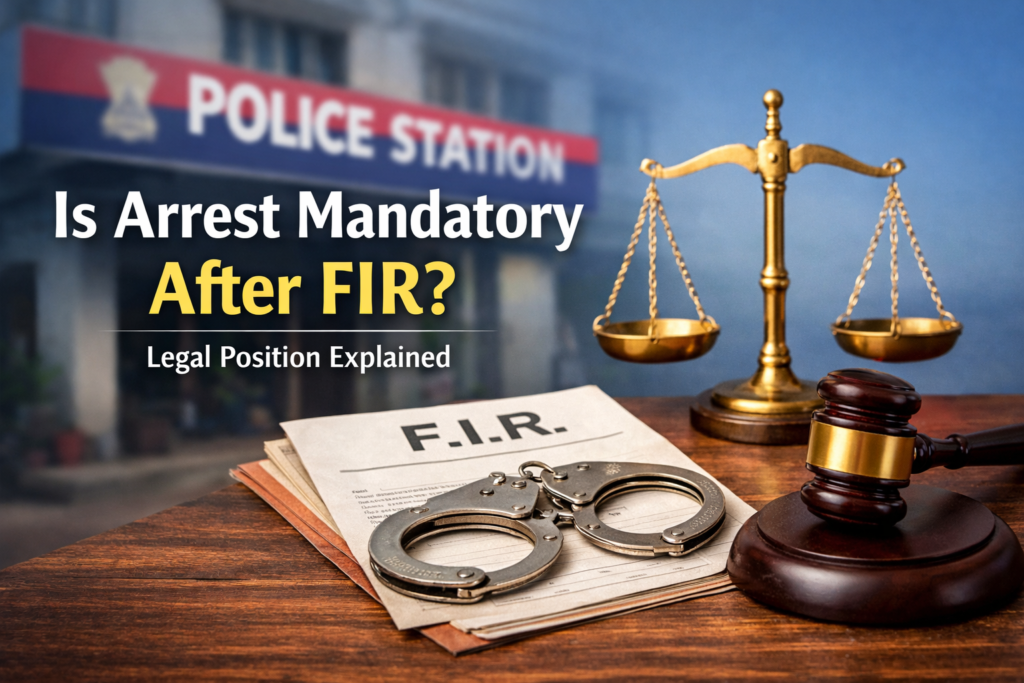
Is FIR Registration Enough to Arrest?
No.
Registration of FIR only initiates investigation.
It does not automatically justify arrest.
This distinction is crucial but often misunderstood.
What If Police Threaten Arrest Without Warrant?
Threatening arrest without satisfying legal requirements raises serious concerns.
Citizens are entitled to:
- Know the grounds of arrest
- Understand necessity behind custody
- Protection from arbitrary detention
Fear should never replace lawful procedure.
Related Legal Guidance
-
Police Station Call Without Notice – Legal Rights Explained
-
When Can FIR Be Filed in a Civil Dispute? Legal Reality
-
Police Asking for Compromise in Criminal Case – Legal Reality
Why This Issue Matters
Unlawful or unnecessary arrests:
- Damage personal liberty
- Create fear instead of justice
- Undermine public trust in law enforcement
Courts have repeatedly signalled the need for restraint and accountability.
Key Takeaway
Arrest without warrant in non-serious offences is not a free power.
It is legally permissible only when justified by necessity — not convenience, pressure, or routine practice.
Understanding this distinction empowers citizens to respond lawfully, not fearfully.
Need legal guidance? You may choose to connect for general consultation and information.
▶ Request Online Consultation
▶ Request WhatsApp Consultation
Disclaimer: This article is for general legal information and awareness purposes only. It does not constitute legal advice or solicitation. Communication is purely informational, in compliance with Bar Council of India Rule 36.