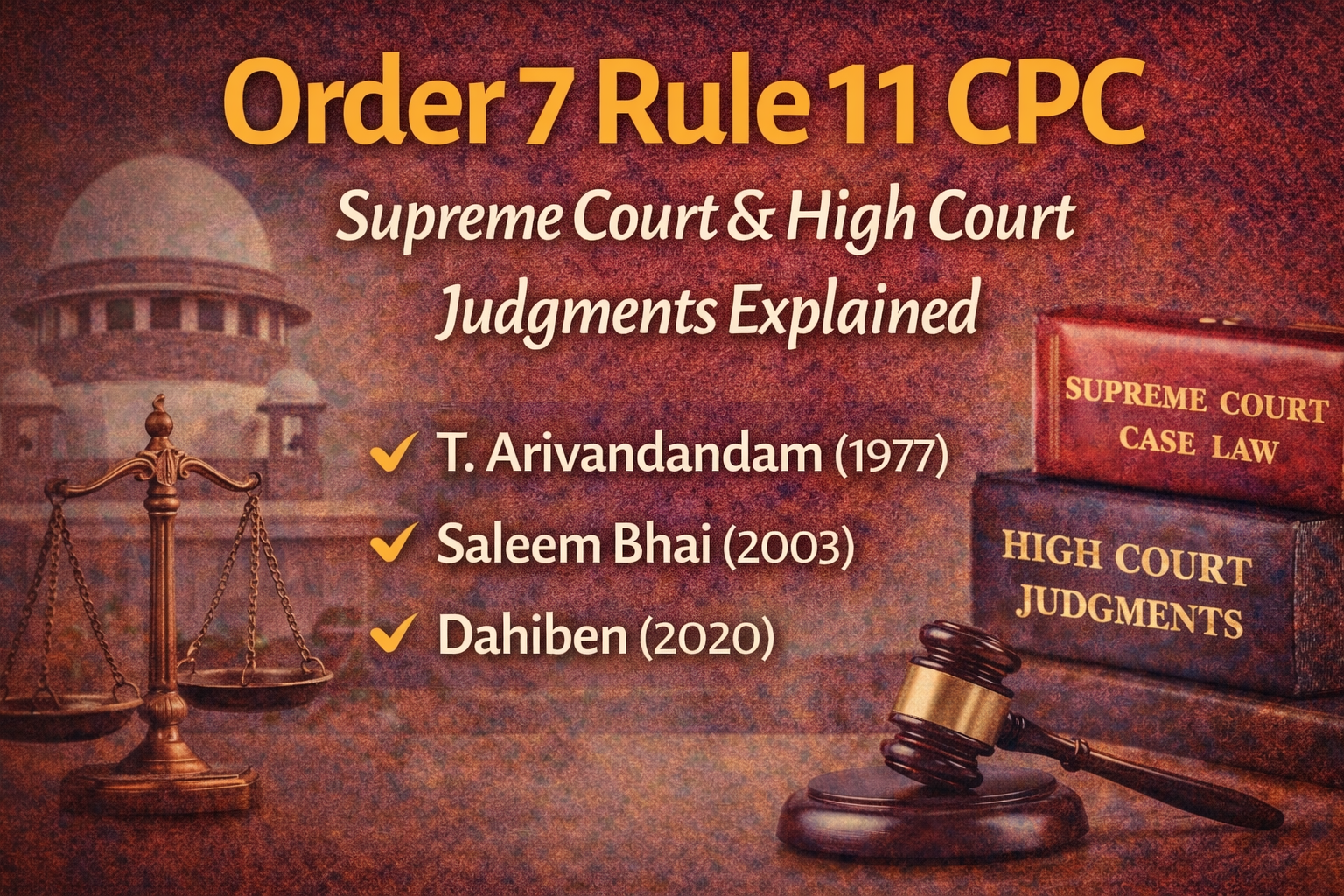
Order 7 Rule 11 CPC – Supreme Court & High Court Judgments Explained (India)
This article is published by The Legal Warning India and written by Advocate Uday Singh.
Order 7 Rule 11 of the Code of Civil Procedure, 1908 (CPC) is one of the most powerful provisions available to a defendant in civil litigation. It empowers courts to reject a plaint at the threshold if the suit is legally defective.
Indian courts—especially the Supreme Court—have repeatedly clarified the scope, limitations, and correct application of Order 7 Rule 11 CPC. This article explains the leading Supreme Court and High Court judgments, along with the legal principles settled by them.
Scope of Order 7 Rule 11 CPC – Judicial Overview
Courts have consistently held that:
- Order 7 Rule 11 CPC is a pre-trial remedy
- It prevents abuse of the judicial process
- It must be decided only on the basis of the plaint
- No evidence or defence pleadings are to be considered
Landmark Supreme Court Judgments on Order 7 Rule 11 CPC
1. T. Arivandandam v. T.V. Satyapal (1977) 4 SCC 467
Legal Principle:
The Supreme Court held that if a plaint is manifestly vexatious and does not disclose a clear right to sue, the court should reject it at the very outset.
Key Observation:
“If on a meaningful—not formal—reading of the plaint it is manifestly vexatious, the court should exercise its power under Order 7 Rule 11 CPC.”
This judgment laid the foundation for aggressive use of Order 7 Rule 11 against false litigation.
2. Saleem Bhai v. State of Maharashtra (2003) 1 SCC 557
Legal Principle:
The Supreme Court clarified that while deciding an application under Order 7 Rule 11 CPC, only the plaint averments are relevant. The defence of the defendant is completely irrelevant.
Importance:
This judgment prevents courts from mixing trial issues with threshold scrutiny.
3. Popat and Kotecha Property v. State Bank of India Staff Association (2005) 7 SCC 510
Legal Principle:
If a plaint discloses some cause of action, even weak or improbable, it cannot be rejected. However, clever drafting to create illusion of cause of action must be rejected.
This judgment balances genuine claims and false suits.
4. Church of Christ Charitable Trust v. Ponniamman Educational Trust (2012) 8 SCC 706
Legal Principle:
Suppression of material facts in the plaint itself is a valid ground for rejection under Order 7 Rule 11 CPC.
The Court emphasized that litigants must approach the court with clean hands.
5. Dahiben v. Arvindbhai Kalyanji Bhanusali (2020) 7 SCC 366
Legal Principle:
The Supreme Court held that if a suit is clearly barred by limitation from the plaint itself, it must be rejected under Order 7 Rule 11(d) CPC.
This is one of the most cited judgments in property disputes.
6. Madanuri Sri Rama Chandra Murthy v. Syed Jalal (2017) 13 SCC 174
Legal Principle:
The Court reiterated that courts must examine whether the plaint discloses a real cause of action or is merely drafted to harass the defendant.
Important High Court Judgments
7. Sopan Sukhdeo Sable v. Assistant Charity Commissioner (Bombay HC, 2004)
Principle: Order 7 Rule 11 must be used to terminate sham litigation at the earliest stage.
8. Hardesh Ores Pvt. Ltd. v. Hede & Company (Delhi High Court, 2007)
Principle: Limitation can be decided under Order 7 Rule 11 if it is apparent from the plaint.
Key Legal Principles Settled by Courts
- Only plaint averments matter
- No evidence is admissible
- Defence cannot be considered
- Limitation can be a ground for rejection
- Suppression of facts is fatal
- Clever drafting will not save false suits
Practical Strategy for Advocates
- Identify legal defects on the face of the plaint
- Do not rely on defence facts
- Focus on limitation, cause of action, and suppression
- File application at the earliest possible stage
Related Legal Reading
- Rejection of Plaint (Order 7 Rule 11 CPC) – Draft & Strategy
- Farzi Civil Case Kharij Kaise Karwaye – Legal Strategy
Conclusion
Order 7 Rule 11 CPC is not a technical provision—it is a powerful judicial filter. Supreme Court and High Court judgments make it clear that false, vexatious, and time-barred suits should not be allowed to proceed to trial.
Correct understanding and strategic use of these judgments can save years of litigation.
This article is for general legal information and awareness purposes only. It does not constitute legal advice or solicitation. Communication is purely informational, in compliance with Bar Council of India Rule 36.