This article is published by The Legal Warning India and written by Advocate Uday Singh.
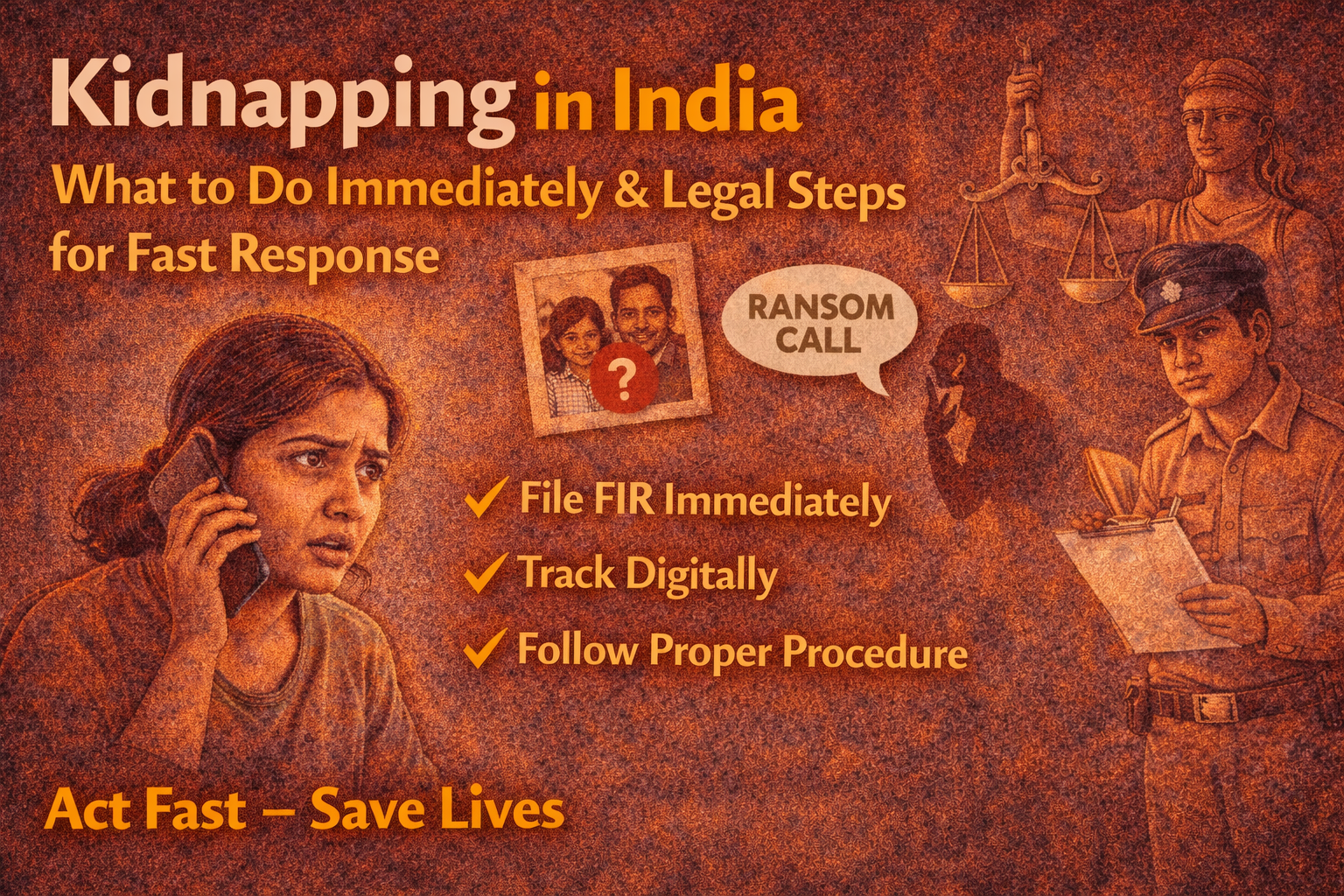
Kidnapping in India – Immediate Action, Legal Steps & Fast Response Guide
Kidnapping is one of the most serious and time-sensitive crimes under Indian law.
The first few hours after a kidnapping are critical and often decide the outcome.
Many families panic, waste time, or do not know the correct legal steps to take.
This article provides a complete A-to-Z legal and practical guide on what to do immediately if someone is kidnapped, and how fast legal response can help.
Information is based on Indian criminal law, police procedure, and publicly available legal standards.
What Is Kidnapping Under Indian Law?
Kidnapping is a criminal offence involving:
- Taking or detaining a person illegally
- Using force, deception, or coercion
- Removing a person from lawful guardianship or safety
Kidnapping of children, women, or for ransom is treated as a grave offence.
First 1–2 Hours: What Must Be Done Immediately
1️⃣ Do Not Delay – Contact Police Immediately
Do not wait for confirmation or ransom calls.
Immediate reporting saves lives.
- Go to the nearest police station
- Call emergency police numbers
- Provide last known location and time
2️⃣ FIR Registration Is Mandatory
Police are legally bound to register an FIR in kidnapping cases.
Delaying FIR registration can:
- Hamper investigation
- Reduce chances of recovery
- Destroy digital and CCTV evidence
No preliminary inquiry is required before FIR.
Key Information to Provide in FIR
- Name, age, and photograph of the missing person
- Last seen location and time
- Clothing and physical description
- Suspicion about any person (if any)
- Mobile number and digital activity
Accuracy and clarity are crucial.
Fast-Response Legal & Practical Steps
3️⃣ Activate Technical Tracking
Police can immediately initiate:
- Mobile phone tracking
- Call detail records (CDR)
- Location-based analysis
Early technical action often leads to faster recovery.
4️⃣ CCTV & Route Analysis
Request police to:
- Secure nearby CCTV footage
- Track public transport routes
- Check toll plazas and highways
CCTV footage is often overwritten within days — speed matters.
If Police Do Not Act Promptly
If police delay or refuse proper action:
- Approach senior police officers
- Submit written complaint
- Maintain documentary proof
Kidnapping cases demand urgency; delay is unacceptable.
Ransom Calls – Critical Dos and Don’ts
✔ What to Do
- Inform police immediately
- Preserve call recordings
- Follow police instructions strictly
✖ What Not to Do
- Do not negotiate independently
- Do not make payments without police guidance
- Do not alert kidnappers about police involvement
Role of Family and Media
While public awareness can help, uncontrolled publicity may:
- Alert kidnappers
- Increase risk to the victim
Media involvement should be coordinated with law enforcement.
Legal Consequences for Kidnapping
Kidnapping attracts:
- Severe criminal punishment
- Long-term imprisonment
- Special provisions in ransom cases
Courts treat such offences with utmost seriousness.
Common Mistakes Families Must Avoid
- Waiting before filing FIR
- Assuming the person will return
- Spreading unverified information
- Ignoring digital evidence
Related Legal Guidance
Conclusion
In kidnapping cases, speed is protection.
Immediate FIR, fast technical response, and coordinated legal action significantly increase recovery chances.
Delays, panic, or silence can cost precious time.
Need legal guidance? You may choose to connect for general consultation and information.
▶ Request Online Consultation
▶ Request WhatsApp Consultation
Disclaimer: This article is for general legal information and awareness purposes only. It does not constitute legal advice or solicitation. Communication is purely informational, in compliance with Bar Council of India Rule 36.