This article is published by The Legal Warning India and written by Advocate Uday Singh.
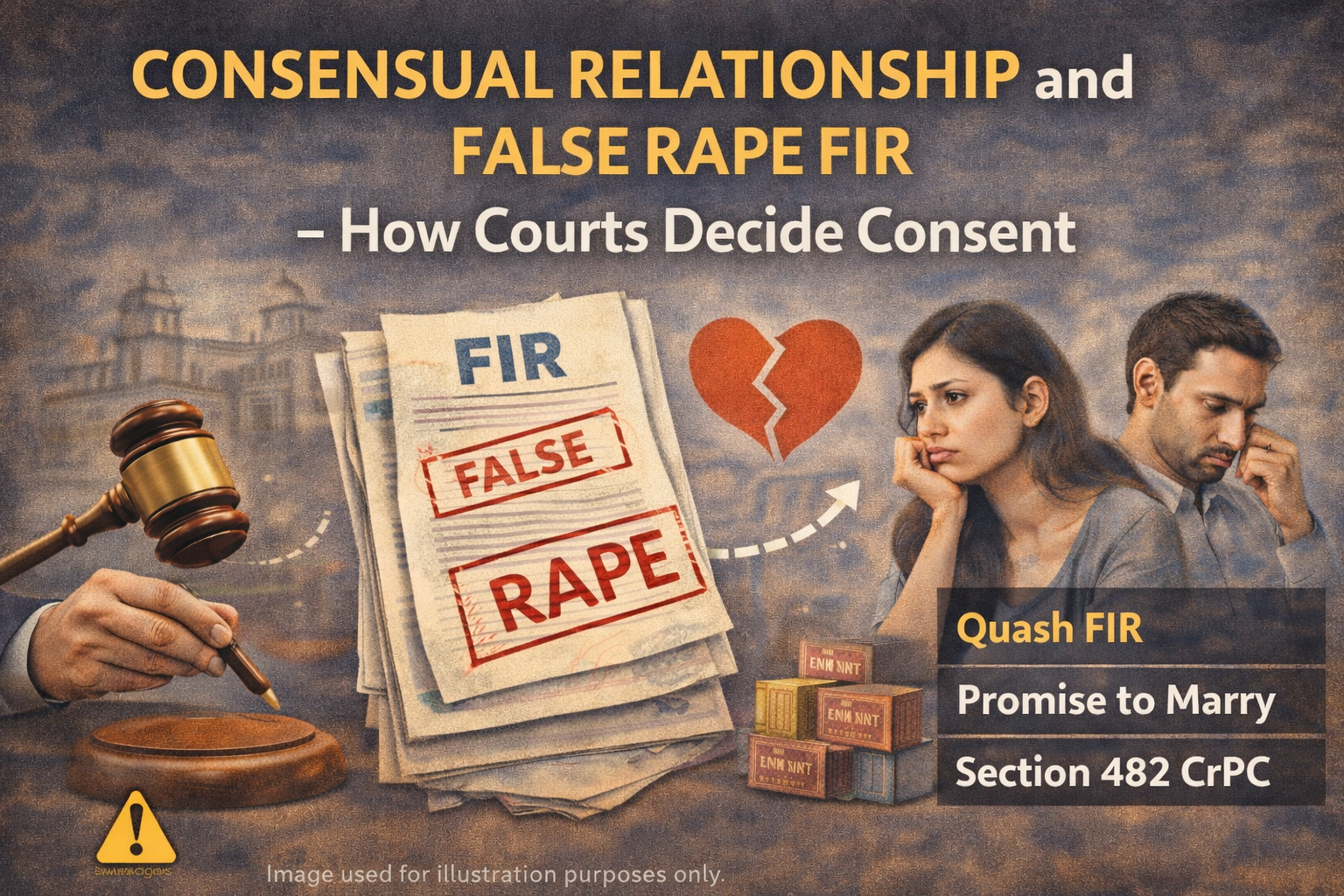
Consensual Relationship and False Rape FIR – How Courts Decide Consent
Introduction: Rising Cases of False FIR After Consensual Relationships
In recent years, courts across India have repeatedly dealt with cases where a consensual relationship later resulted in the registration of a rape FIR after the relationship broke down. Such cases raise a crucial legal question — when does consent remain valid, and when does it convert into an offence?
Indian criminal law places great importance on consent, but it also guards against misuse of serious penal provisions.
Information discussed herein is based on news reports and judicial observations available in the public domain.
Meaning of Consent Under Indian Criminal Law
Under Indian law, consent means an unequivocal voluntary agreement given by a person with full understanding of the act and its consequences. If a woman willingly enters into a physical relationship without force, threat, or deception, such consent is legally valid.
Courts have consistently held that consensual physical relations between adults do not constitute rape merely because the relationship later failed.
Promise to Marry and Allegations of Rape
A common allegation in such FIRs is that consent was obtained on the promise of marriage. However, courts carefully examine:
- Whether the promise was false from the very beginning
- Whether the accused had dishonest intention at inception
- Whether the relationship was long-term and voluntary
If the relationship continued for months or years with mutual consent, courts generally refuse to treat it as rape merely due to non-marriage later.
How Courts Identify False Rape FIRs
Judicial scrutiny focuses on surrounding circumstances, such as:
- Duration of the relationship
- Conduct of parties before and after the alleged incident
- Delay in filing FIR
- Existence of communication showing mutual consent
Where evidence suggests consensual participation, courts have intervened to prevent misuse of criminal law.
Role of High Courts in Quashing FIRs
High Courts, exercising inherent powers, have quashed FIRs where allegations were found to be an afterthought following a failed relationship. Criminal law is not meant to be used as a pressure tactic or tool of revenge.
In such cases, the remedy of FIR quashing becomes crucial to protect individual liberty.
Practical Legal Consequences for the Accused
A false rape FIR can lead to arrest, reputational damage, and prolonged litigation. Early legal intervention is critical to safeguard rights and prevent abuse of process.
Courts have emphasized that every emotional grievance cannot be converted into a criminal charge without legal foundation.
Conclusion: Consent Cannot Be Rewritten After Relationship Ends
A consensual relationship between adults does not become rape merely because the relationship later breaks down. Criminal liability arises only when deception, coercion, or absence of free consent is clearly established.
Courts continue to strike a balance between protecting genuine victims and preventing misuse of serious criminal provisions.