Rejection of Plaint (Order 7 Rule 11 CPC) – Draft, Grounds & Complete Legal Strategy
This article is published by The Legal Warning India and written by Advocate Uday Singh.
In Indian civil litigation, many suits are filed without any real legal foundation. Such cases are often instituted only to harass the defendant, block property transactions, or create pressure for settlement.
The Code of Civil Procedure, 1908 provides a powerful remedy to stop such litigation at the very beginning — Rejection of Plaint under Order 7 Rule 11 CPC.
This provision allows the court to reject a plaint without conducting a full trial, if the suit is legally defective.
What Is Rejection of Plaint under Order 7 Rule 11 CPC?
Order 7 Rule 11 CPC empowers the civil court to reject the plaint at the threshold stage if the suit suffers from fundamental legal defects.
It is a pre-trial remedy, meant to prevent abuse of the judicial process.
The court decides this application by looking only at the averments made in the plaint, not the defence or evidence.
Difference Between Rejection of Plaint and Dismissal of Suit
- Rejection of Plaint – Based on legal defects; decided at an early stage
- Dismissal of Suit – Based on merits; decided after trial
Order 7 Rule 11 CPC helps the defendant avoid unnecessary litigation.
Statutory Grounds under Order 7 Rule 11 CPC
A plaint can be rejected on the following grounds:
1. No Cause of Action
If the plaint does not disclose any cause of action, even if all facts are assumed to be true.
2. Suit Barred by Law
If the suit is barred by limitation or any statutory provision.
3. Undervalued Relief
If the plaintiff fails to correct the valuation despite court direction.
4. Insufficient Court Fees
If required court fees are not paid within time.
5. Suit Not Filed in Prescribed Manner
If mandatory procedural requirements are violated.
Most Common Grounds Used in False Civil Cases
- No real cause of action
- Clever drafting to create illusion of dispute
- Suppression of material facts
- Suit filed only to harass the defendant
- Time-barred claims
Courts strongly discourage such misuse of law.
When Should an Order 7 Rule 11 Application Be Filed?
- Before filing the written statement
- Along with the written statement
- At any stage before commencement of trial
Early filing increases the chances of success.
Important Legal Principles
- Only plaint averments are considered
- No evidence is examined
- Defence pleadings are irrelevant
- Application can be decided even if issues are framed
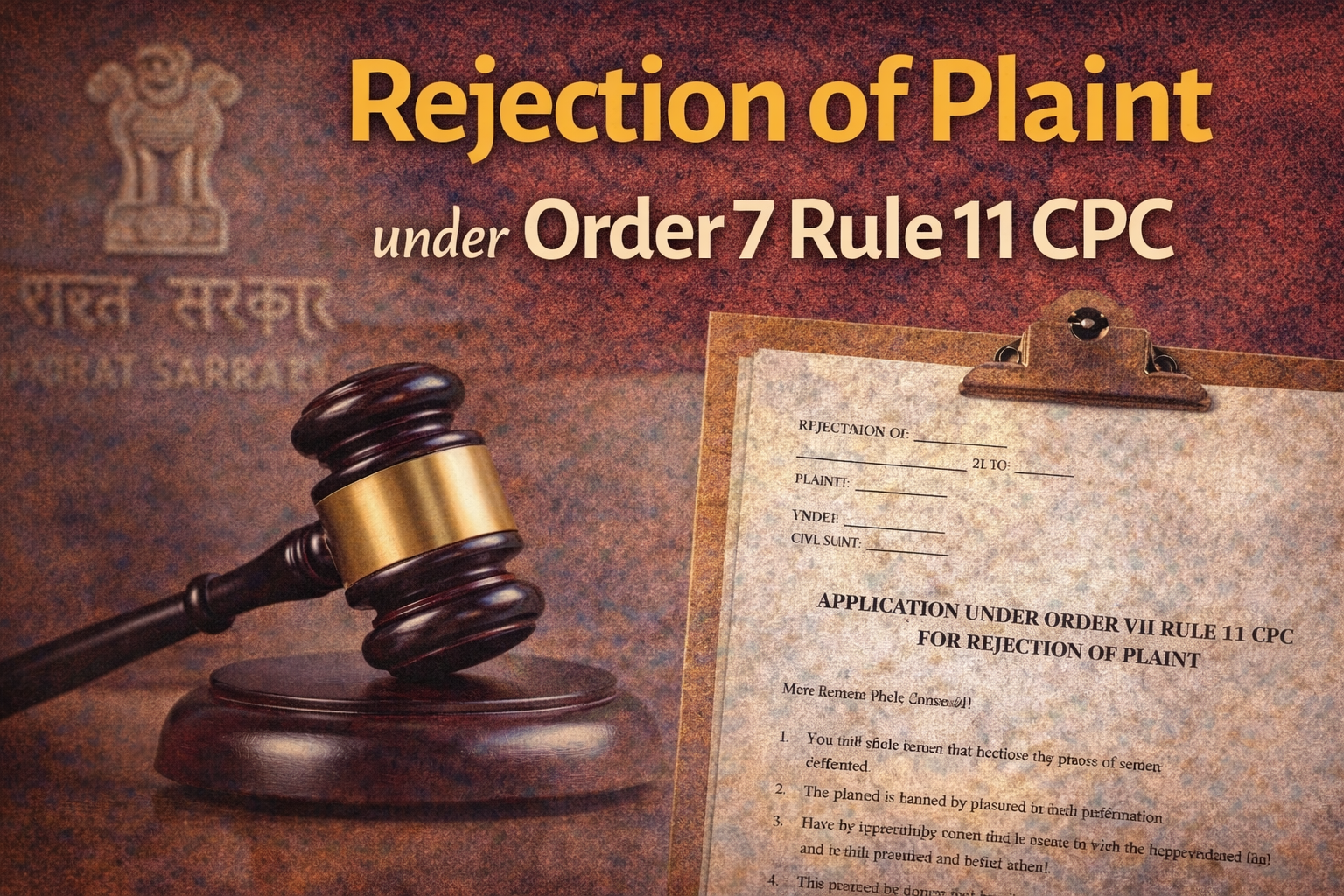
Illustrative Draft – Application under Order 7 Rule 11 CPC
(For legal awareness only. Actual drafting depends on case facts.)
IN THE COURT OF ___________

Civil Suit No. ____ of 20__

Plaintiff: ___________
Versus
Defendant: ___________

APPLICATION UNDER ORDER VII RULE 11 CPC
FOR REJECTION OF PLAINT

MOST RESPECTFULLY SHOWETH:

1. That the plaint does not disclose any cause of action
   against the defendant.

2. That the suit is barred by law and is not maintainable.

3. That the plaintiff has suppressed material facts and
   approached the Hon’ble Court with unclean hands.

4. That even if all averments in the plaint are taken as true,
   no relief can be granted to the plaintiff.

PRAYER:
It is therefore most respectfully prayed that the plaint be
rejected under Order VII Rule 11 CPC with costs.

Place:
Date:

Defendant
Through Counsel
Common Mistakes Defendants Make
- Discussing defence facts instead of plaint defects
- Relying on documents or evidence
- Filing application at a very late stage
Order 7 Rule 11 CPC is a legal, not factual, remedy.
Connection with False Civil Litigation
Order 7 Rule 11 CPC is the most effective remedy to challenge:
- False property cases
- Harassment suits
- Cases filed only to obtain injunctions
- Time-barred civil claims
Courts have repeatedly held that false litigation should be discouraged at the threshold.
Frequently Asked Questions (FAQs)
Q. Can the court reject the plaint even if injunction is granted?
Yes, if the plaint is legally defective.
Q. Is appeal allowed against rejection of plaint?
Yes, as per CPC provisions.
Q. Can evidence be looked into?
No. Only plaint averments are examined.
This article is for general legal information and awareness purposes only. It does not constitute legal advice or solicitation. Communication is purely informational, in compliance with Bar Council of India Rule 36.