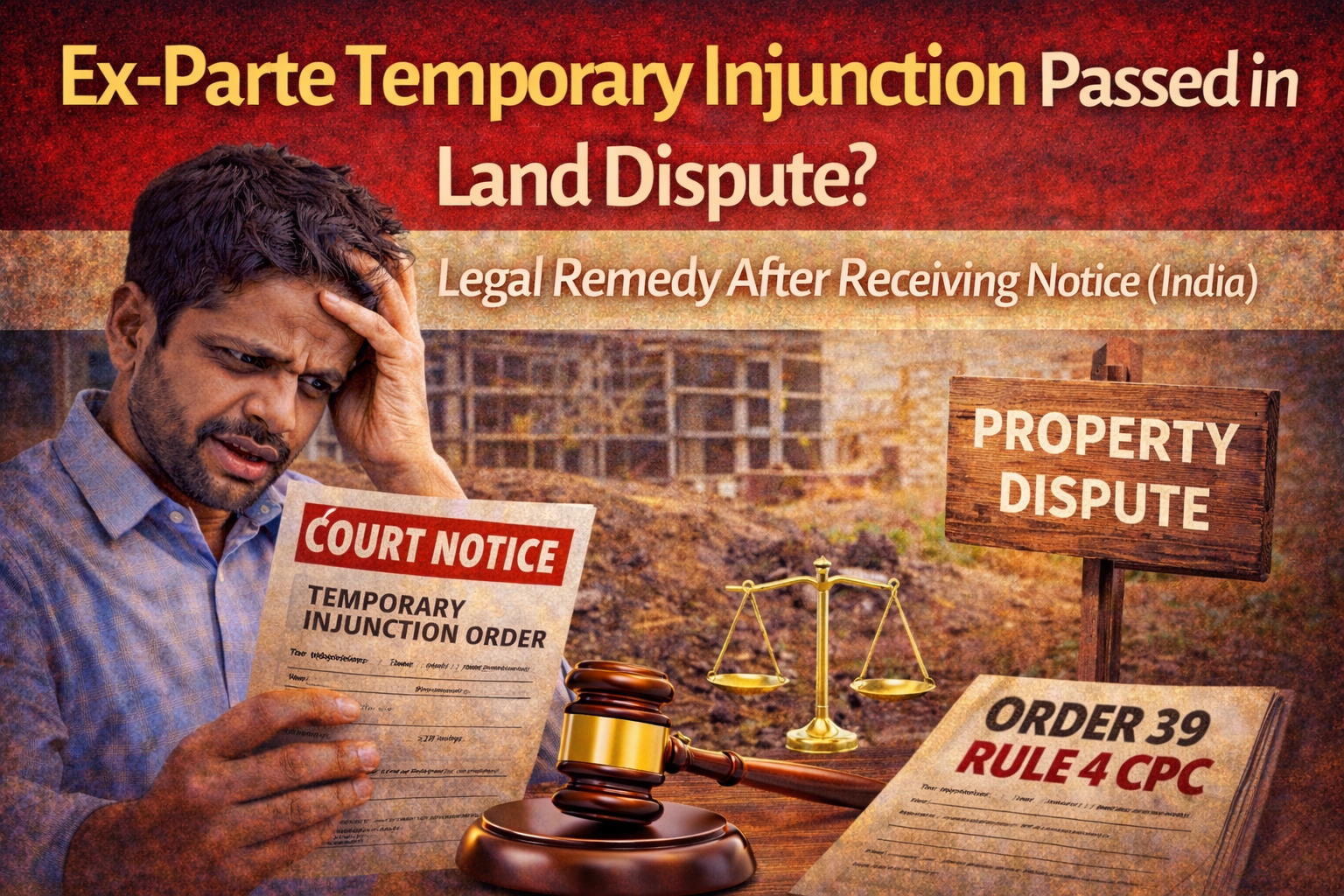
Ex-Parte Temporary Injunction Passed in Land Dispute? Legal Remedies After Receiving Notice (India)
This article is published by The Legal Warning India and written by Advocate Uday Singh.
In land and property disputes, one of the most shocking situations for a person is when a court passes an ex-parte temporary injunction without hearing them, and suddenly a court notice is received restraining sale, construction, possession, or interference with the property.
Most respondents panic and ask:
“Court ne bina sune ex-parte injunction de diya – ab kya karein?”
This article explains the complete legal position, remedies available to respondents, and how to challenge or vacate an ex-parte temporary injunction in a land dispute under Indian law.
What Is an Ex-Parte Temporary Injunction?
An ex-parte temporary injunction is an interim court order passed without hearing the opposite party, usually to prevent:
- Sale or transfer of land
- Construction or demolition
- Change of possession
- Creation of third-party rights
Such injunctions are generally passed under Order 39 Rules 1 & 2 of the Code of Civil Procedure (CPC), in urgent situations.
Why Do Courts Pass Ex-Parte Injunctions in Property Disputes?
Courts grant ex-parte injunctions only when:
- Urgency is shown
- Irreparable loss is claimed
- Prima facie case appears in favour of plaintiff
- Delay may defeat justice
However, courts are also cautious because ex-parte orders affect property rights without hearing the respondent.
Is Ex-Parte Injunction Permanent?
No.
An ex-parte injunction is:
- Temporary in nature
- Subject to confirmation, modification, or vacation
- Open to challenge by the respondent
It does not decide ownership or final rights.
What Should a Respondent Do After Receiving Ex-Parte Injunction Notice?
This stage is extremely crucial.
Immediate Steps:
- Do not violate the injunction order
- Collect property documents immediately
- Consult a civil property advocate
- Prepare response without delay
Violation of injunction can lead to contempt proceedings.
Legal Remedy – Application to Vacate / Set Aside Ex-Parte Injunction
The respondent has a statutory right to file an application under Order 39 Rule 4 CPC.
This application seeks:
- Vacating the ex-parte injunction
- Modification or restriction of the order
- Hearing both parties on merits
Courts are duty-bound to hear the respondent expeditiously.
Grounds to Challenge Ex-Parte Temporary Injunction
Common legal grounds include:
- Suppression of material facts by plaintiff
- No prima facie case
- No balance of convenience
- No irreparable loss
- False urgency created
- Respondent already in possession
- Title documents favour respondent
Courts frequently vacate injunctions granted by misrepresentation.
Can the Court Stay the Injunction Immediately?
Yes.
After filing the reply and application, the court may:
- Stay operation of ex-parte order
- Restrict its scope
- Fix early hearing
This depends on urgency and merits.
What If Plaintiff Misused Ex-Parte Injunction?
If injunction was obtained by:
- Concealment of facts
- False documents
- Misleading statements
The court may:
- Vacate injunction
- Impose costs
- Record adverse findings
Such conduct damages the plaintiff’s credibility.
Common Mistakes Respondents Make
- Ignoring court notice
- Violating injunction unknowingly
- Delaying filing of reply
- Relying only on oral arguments
Delay weakens defence.
Land Disputes Where Ex-Parte Injunctions Are Common
- Co-owner disputes
- Family property disputes
- Builder–landowner conflicts
- Possession disputes
- Sale agreement disputes
Related Legal Reading
Frequently Asked Questions (FAQs)
Q. Can ex-parte injunction be cancelled?
Yes, through application under Order 39 Rule 4 CPC.
Q. Can I sell property during injunction?
No. It may amount to contempt.
Q. How fast can court hear my application?
Courts usually give priority as property rights are involved.
This article is for general legal information and awareness purposes only. It does not constitute legal advice or solicitation. Communication is purely informational, in compliance with Bar Council of India Rule 36.