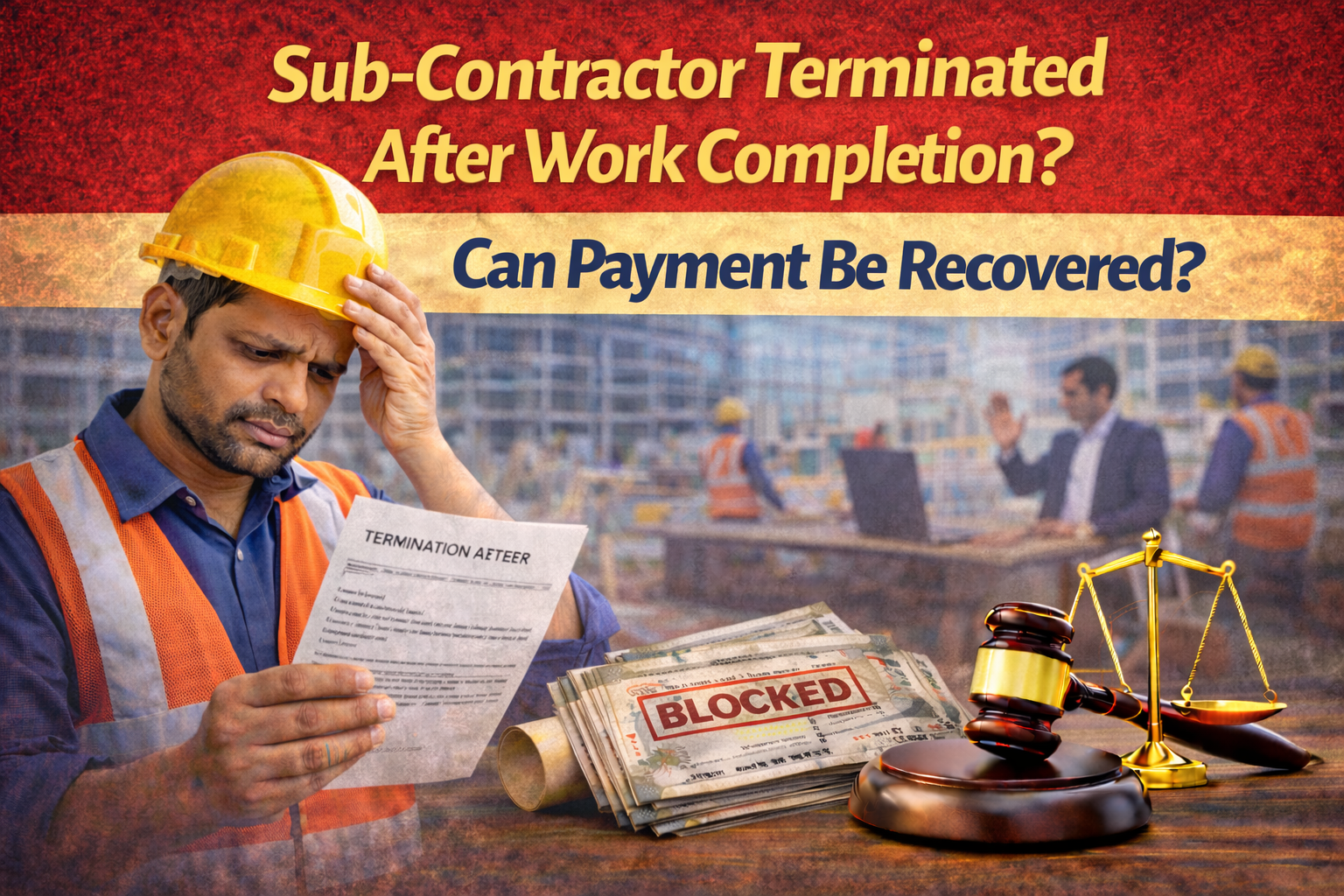
Sub-Contractor Terminated After Work Completion – Can Payment Be Recovered? (India)
This article is published by The Legal Warning India and written by Advocate Uday Singh.
In construction, infrastructure and EPC projects, it is increasingly common for sub-contractors to be terminated after completing substantial or entire work — often just before final payment. The work is executed, measurements are taken, and yet the main contractor or company issues a termination letter and withholds dues.
Typical statements include:
- “Contract terminated due to breach”
- “Performance not satisfactory”
- “Work stopped due to internal decision”
The most common and urgent question sub-contractors ask is:
“I was terminated after completing the work. Can I still recover my payment legally?”
This article explains the legal position in India, the remedies available, and how sub-contractors can recover dues even after termination.
What Does ‘Termination After Work Completion’ Mean?
Termination after work completion typically involves:
- Substantial or full work already executed
- Measurements/acceptance already recorded
- Invoices or RA bills raised
- Termination issued to avoid payment
Such termination is often challenged as arbitrary and mala fide.
Is Termination a Valid Ground to Deny Payment?
No. Termination of contract does not automatically wipe out payment obligations.
Indian courts consistently hold that:
- Payment for executed and accepted work must be made
- Termination cannot be used as a tool to avoid dues
- Disputes over quality/delay must be proved
Work done must be paid for.
Common Scenarios Where Payment Is Withheld
- Final bill raised after termination
- RA bills certified but unpaid
- Retention money withheld
- Security deposit adjusted without justification
These actions are legally challengeable.
Is a Written Agreement Mandatory to Recover Payment?
No. While a written contract strengthens the case, recovery is possible even without it.
Courts consider:
- Work orders / LOI / LOA
- Certified measurements (MB)
- RA bills, invoices
- Emails / WhatsApp approvals
- Site photographs and progress reports
- Engineer or supervisor confirmations
Execution and acceptance of work is the key.
First Legal Step – Sending a Legal Notice
The most effective first step after wrongful termination is issuing a legal notice.
A proper notice should:
- Detail the scope of work completed
- Mention amounts due (RA bills/final bill/retention)
- Refute baseless termination grounds
- Demand time-bound payment
- Intimate legal action on failure
Many companies release dues at this stage to avoid litigation.
Legal Remedies Available to Sub-Contractors
1. Civil Suit for Recovery of Money
Claiming outstanding dues, interest, and damages.
2. Commercial Court (High-Value Contracts)
For EPC and large infrastructure contracts.
3. MSME Remedies (If Registered)
MSME-registered sub-contractors may access statutory remedies for delayed payments.
How Courts Examine Termination Disputes
Courts typically assess:
- Whether termination was genuine or pretextual
- Stage of work completion
- Measurement and acceptance records
- Conduct of the terminating party
Courts do not allow unjust enrichment by withholding payment for completed work.
Common Mistakes Sub-Contractors Make
- Accepting termination silently
- Failing to document acceptance of work
- Not issuing a legal notice promptly
- Destroying site records after termination
How to Protect Yourself in Future Projects
- Ensure written acknowledgment of measurements
- Preserve site photos and approvals
- Keep payment milestones documented
- Act legally at the first sign of dispute
Related Articles
- Sub Contractor Ka Paisa Atak Gaya? Legal Notice aur Court Solution
- Labour Thekedar Ka Bill Clear Nahi Ho Raha? Legal Rights aur Recovery Process
- Experience Letter Denied After Resignation – Legal Remedy Explained
- Company Holding Full & Final Due to Absconding – Legal Position in India
Frequently Asked Questions (FAQs)
Q. Can payment be denied after termination?
No, payment for executed work cannot be denied solely due to termination.
Q. Is legal notice compulsory?
Not mandatory in every case, but strongly recommended.
Q. Can retention money be withheld?
Only as per contract terms and lawful justification.
This article is for general legal information and awareness purposes only. It does not constitute legal advice or solicitation. Communication is purely informational, in compliance with Bar Council of India Rule 36.