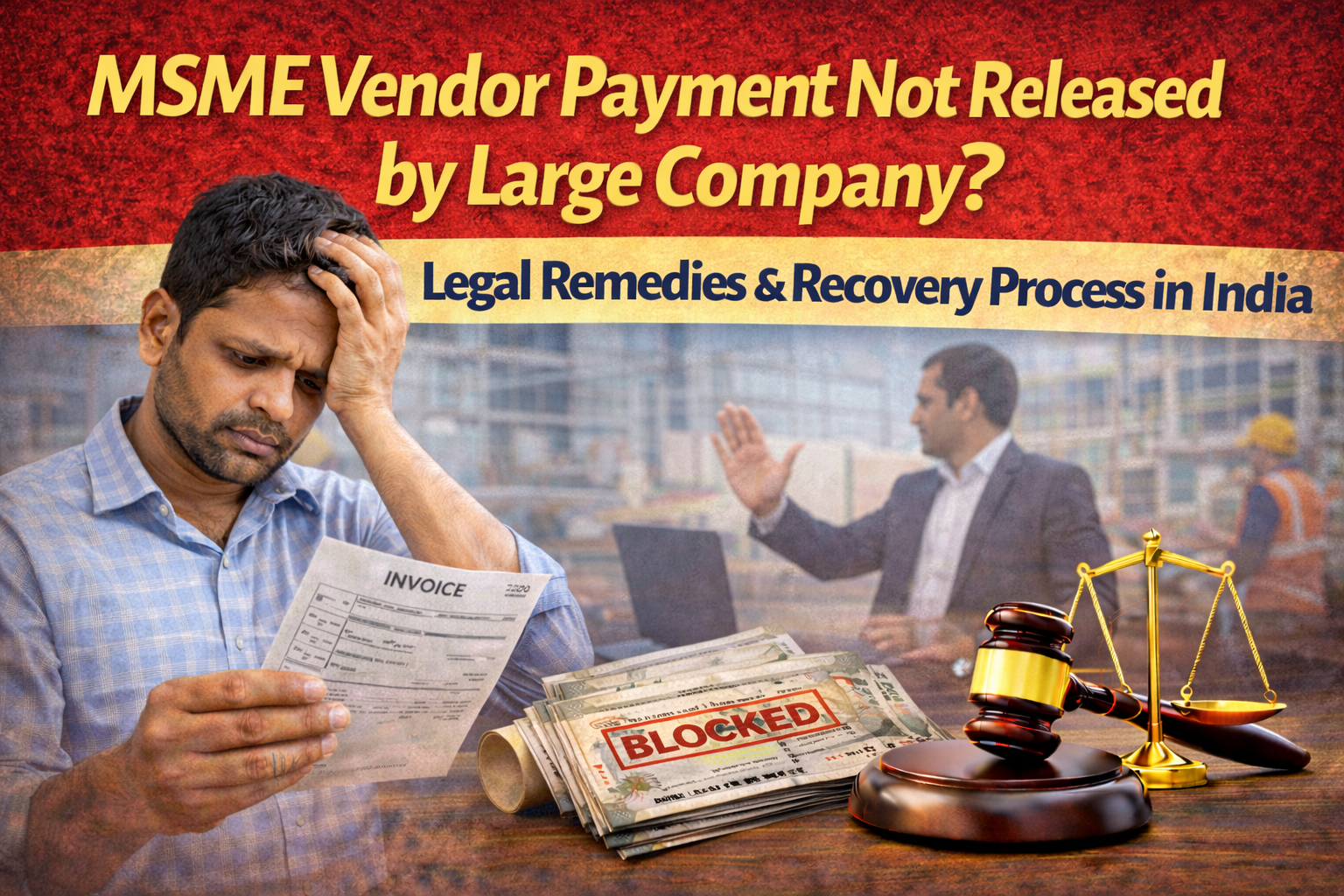
MSME Vendor Payment Not Released by Large Company – Legal Remedies & Recovery Process in India
This article is published by The Legal Warning India and written by Advocate Uday Singh.
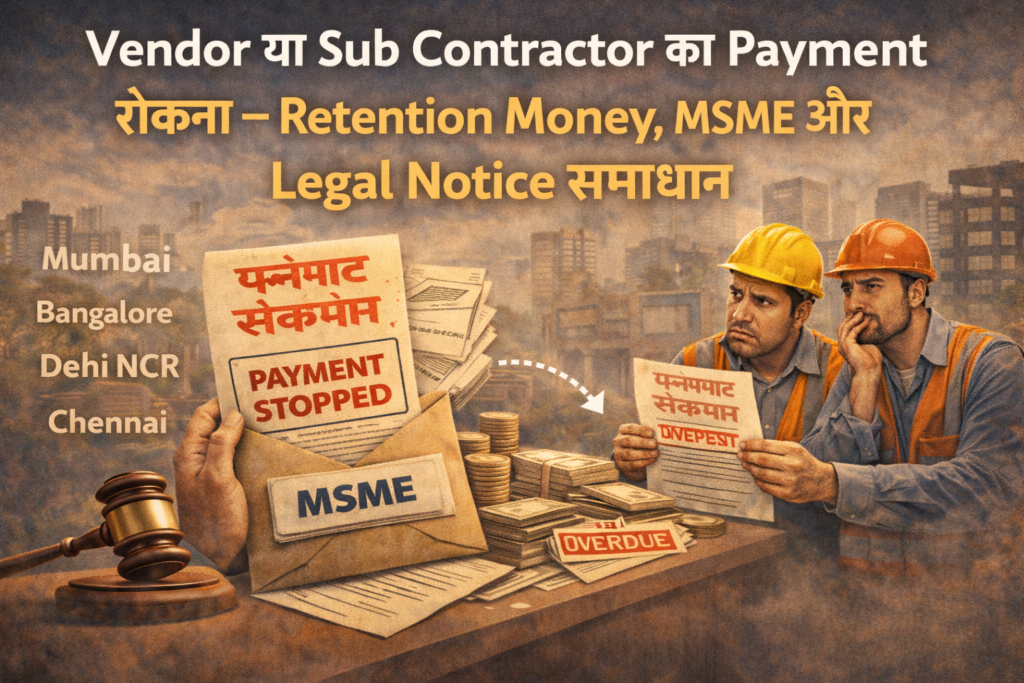
Across India, thousands of MSME vendors, small suppliers, service providers and sub-contractors work with large companies, EPC contractors, infrastructure firms, builders and corporates.
The work gets completed, invoices are submitted, and acceptance is given — yet the biggest problem remains: payment is not released.
Common excuses include:
- “Accounts approval pending”
- “Client has not released funds”
- “Finance department clearance awaited”
- “Next quarter payment plan”
For an MSME, delayed payment can choke cash flow, affect labour wages, GST compliance and even survival of the business.
The most common question vendors ask is:
“I am an MSME vendor. A big company is holding my payment. What legal action can I take?”
This article explains, in detail, the legal remedies available to MSME vendors in India for recovery of delayed or unpaid dues.
What Is an MSME Vendor Payment Dispute?
An MSME payment dispute arises when:
- Goods or services are supplied
- Invoice is raised and acknowledged
- Payment is delayed or denied without justification
This is one of the most common commercial disputes in India.
Why Do Large Companies Delay MSME Payments?
- Internal cash flow management
- Using MSMEs as interest-free credit
- Back-to-back payment dependency
- Power imbalance between corporate & MSME
- Intentional delay tactics
However, Indian law does not allow unfair exploitation of MSMEs.
Is Written Contract Mandatory to Recover MSME Payment?
No. A written agreement is helpful, but not mandatory.
Courts and authorities accept:
- Purchase Orders (PO)
- Invoices
- Email confirmations
- Delivery challans
- Work completion proof
- GST returns reflecting transaction
Actual supply of goods/services and acceptance is the strongest proof.
First Legal Step – Sending a Legal Notice
The most effective first step is issuing a legal notice through an advocate.
A strong legal notice:
- Details the transaction
- Mentions outstanding amount
- Demands time-bound payment
- Warns of legal consequences
In many cases, payments are released after receiving a proper legal notice.
Legal Remedies Available to MSME Vendors
1. Civil Suit for Recovery of Money
MSME vendors can file a civil recovery suit claiming:
- Principal outstanding amount
- Interest
- Compensation for delay
2. Commercial Court (High-Value Disputes)
Where the transaction value is high, commercial courts provide faster adjudication.
3. MSME Act Remedies (If Registered)
MSME registration gives additional legal leverage and statutory protection against delayed payments.
Can Interest Be Claimed on Delayed Payment?
Yes. Courts recognize that delayed payment causes financial hardship to MSMEs.
Depending on facts, interest and costs may be awarded.
Common Mistakes MSME Vendors Make
- Waiting endlessly without legal action
- Relying only on emails and calls
- Not issuing legal notice
- Fear of losing future business
- Accepting unfair settlements
How MSME Vendors Can Protect Themselves in Future
- Always raise invoices on time
- Keep written communication
- Maintain GST and delivery records
- Act legally at first sign of delay
Related Articles
- Sub Contractor Ka Paisa Atak Gaya? Legal Notice aur Court Solution
- Labour Thekedar Ka Bill Clear Nahi Ho Raha? Legal Rights aur Recovery Process
Frequently Asked Questions (FAQs)
Q. Can an MSME recover payment from a very large company?
Yes. Law protects MSMEs irrespective of company size.
Q. Is legal notice compulsory?
Not always mandatory, but highly recommended.
Q. How long does recovery take?
Depends on response and settlement.
This article is for general legal information and awareness purposes only. It does not constitute legal advice or solicitation. Communication is purely informational, in compliance with Bar Council of India Rule 36.