
This article is published by The Legal Warning India and written by Advocate Uday Singh.
Full & Final Settlement Withheld by Employer – Legal Rights & Action Explained
Introduction: Why Full & Final Settlement Disputes Are Increasing
After resignation or termination, employees expect timely release of their Full & Final (F&F) Settlement. However, many employers delay or completely withhold F&F amounts, citing vague reasons such as internal approval, handover issues, or policy clauses.
Withholding full and final settlement without valid legal grounds is not just unethical—it may also be legally challengeable under Indian law.
What Is Full & Final Settlement?
Full & Final Settlement refers to all dues payable to an employee at the time of exit, including:
- Pending salary
- Leave encashment
- Bonus or incentives (if applicable)
- Gratuity (if eligible)
- Reimbursements
- Notice period pay (if applicable)
Employers are expected to clear these dues within a reasonable time after the employee’s last working day.
Is Employer Legally Allowed to Withhold Full & Final Settlement?
The simple answer is: No, not arbitrarily.
An employer cannot withhold full and final settlement merely to pressure an employee or due to internal policy delays. Any deduction or withholding must be:
- Legally justified
- Supported by employment contract
- Communicated in writing
Unjustified withholding may amount to unfair labour practice or breach of contract.
Common Reasons Employers Give for Withholding F&F
- Incomplete handover
- Alleged misconduct without inquiry
- Bond agreement disputes
- Pending notice period recovery
- Internal audit or approval delays
Many of these reasons do not stand legal scrutiny unless supported by due process.
Legal Rights of Employee When F&F Is Withheld
Depending on the nature of employment, an employee may invoke:
- Labour laws (for workmen)
- Contract law (for managerial employees)
- Payment of Wages Act (where applicable)
- Industrial Disputes Act provisions
Courts and labour authorities have consistently held that earned wages and statutory dues cannot be withheld arbitrarily.
Legal Notice to Employer – First Step to Recovery
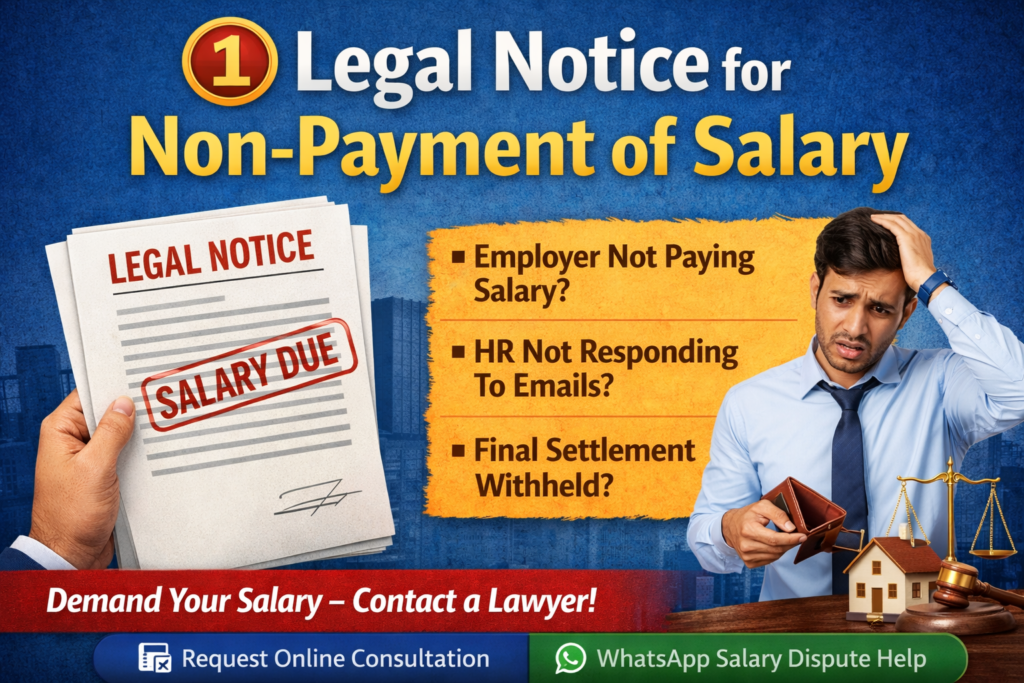
Sending a legal notice to the employer demanding release of full and final settlement is the most effective first step. A legal notice:
- Formally asserts employee’s rights
- Demands payment within a defined time
- Creates documentary evidence
- Often leads to settlement without litigation
A well-drafted legal notice should clearly specify the dues, legal violations, and consequences of non-compliance.
What Legal Action Can Be Taken If Employer Still Refuses?
If the employer ignores the legal notice, the employee may approach:
- Labour Commissioner / Labour Court
- Industrial Tribunal
- Civil Court for recovery
- High Court in limited service matters
The appropriate forum depends on designation, salary structure, and governing employment laws.
Time Limit to Claim Full & Final Settlement
Employees should not delay legal action. Limitation periods may apply depending on the forum and nature of claim. Delay may weaken the case or bar relief.
Conclusion: Withholding F&F Is Not Employer’s Discretion
Full and final settlement is a legal right, not a favour. Employers cannot use F&F as a tool to harass or coerce employees. Timely legal action, starting with a properly drafted legal notice, often results in faster recovery.
Employees should act promptly and strategically to safeguard their financial and professional interests.