This article is published by The Legal Warning India and written by Advocate Uday Singh.
The Yogi Model: Constitutional Governance, Rule of Law & India’s Emerging Administrative Doctrine
Introduction: From Political Leadership to Administrative Doctrine
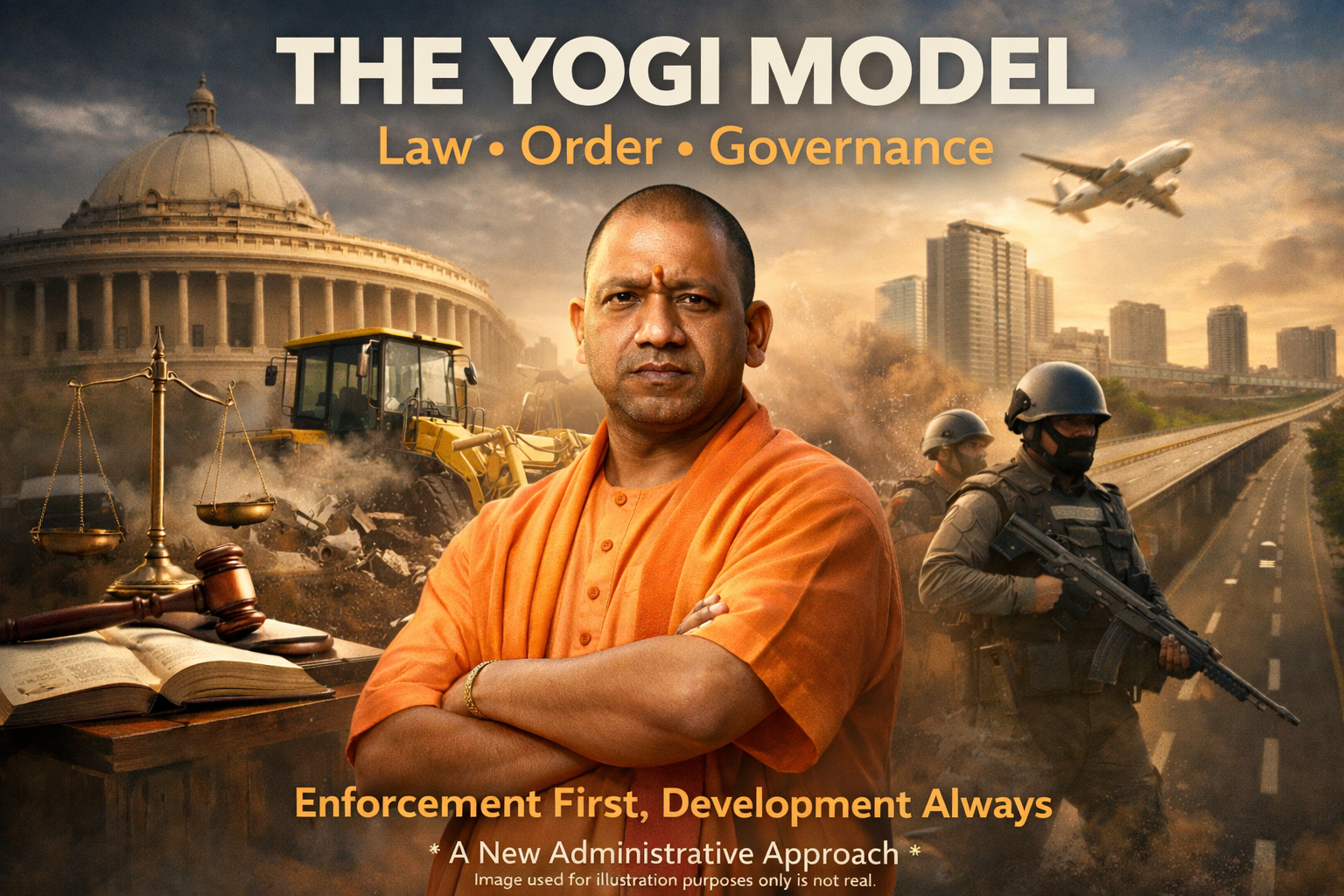
In contemporary Indian governance discourse, the term “Yogi Model” has gradually evolved from a political description into a subject of constitutional, administrative, and public law analysis. What distinguishes this model is not merely leadership style, but the conscious prioritisation of State authority, enforcement capacity, and administrative discipline within the constitutional framework.
Unlike traditional welfare-centric governance narratives, this model places law and order as foundational infrastructure—arguably treating enforcement mechanisms as prerequisites for economic development, investor confidence, and social stability.
Information discussed herein is based on publicly available data, government notifications, judicial observations, and news reports.
The Constitutional Backbone of the Yogi Model
From a constitutional perspective, governance in India operates within the limits of Articles 14, 19, 21, and 300A. The Yogi Model draws legitimacy by asserting that individual liberties cannot survive without collective security, and that the State is constitutionally empowered to act against illegality, encroachment, and criminal enterprise.
The emphasis remains on:
- Strengthening executive enforcement without formally diluting judicial oversight
- Invoking statutory mechanisms rather than extra-constitutional measures
- Projecting the State as a decisive but legally anchored authority
Law & Order as Economic Infrastructure
A notable departure from conventional policy thinking is the treatment of law and order as a form of economic infrastructure. The administrative thesis is straightforward: without predictable enforcement, contractual confidence collapses, investments stagnate, and governance credibility erodes.
Under this model:
- Organised crime is addressed as an economic disruptor, not merely a policing issue
- Asset seizure, recovery proceedings, and demolition actions are framed as restorative public law tools
- Public confidence is treated as a measurable governance outcome
The Bulldozer Narrative: Legal Authority vs Due Process Debate
The global discourse surrounding so-called “Bulldozer Justice” requires careful legal separation between metaphor and statutory action.
Administratively, such actions are justified under municipal laws, land revenue statutes, and recovery legislations dealing with illegal encroachments and proceeds of crime. The State’s position rests on the assertion that no property right under Article 300A survives without lawful title.
However, constitutional scrutiny demands:
- Prior notice and opportunity of hearing
- Documented administrative orders
- Availability of judicial remedies
Courts have repeatedly clarified that while executive decisiveness is permissible, procedural safeguards remain non-negotiable. Thus, the Yogi Model survives legally only to the extent that it operates within due process.
Federal Implications: A New Template for State Governance?
From a federalism standpoint, the Yogi Model represents a strong-state governance philosophy. It challenges the long-standing assumption that aggressive enforcement is politically unsustainable or constitutionally risky.
Several States now study this approach for:
- Crime control mechanisms
- Revenue recovery efficiency
- Public property protection
Whether this becomes a replicable national framework depends not on political popularity, but on judicial endurance and constitutional consistency.
2029 and Beyond: Governance Legacy Over Electoral Speculation
Speculation surrounding future national leadership often overshadows the more relevant legal question: can this governance model withstand constitutional stress over time?
From a purely legal-administrative lens, the endurance of the Yogi Model will depend upon:
- Judicial validation of enforcement actions
- Institutional continuity beyond individual leadership
- Balance between deterrence and constitutional morality
Governance models that mature into doctrine do so not through elections alone, but through sustained legal legitimacy.
Conclusion: An Emerging Doctrine of Enforcement-First Governance
The Yogi Model marks a discernible shift in Indian administrative thinking—where governance is measured by enforcement credibility as much as welfare delivery. For legal scholars, administrators, and policymakers, this model offers a case study in how constitutional power, when assertively exercised, reshapes public expectations of the State.
Whether history ultimately recognises this as a corrective phase or a permanent governance doctrine will depend on its continued adherence to constitutional discipline.