This article is published by The Legal Warning India and written by Advocate Uday Singh.
Supreme Court Questions Greater Noida Magistrate Notice to Student: What the BNSS Proceedings Mean
The Supreme Court on 9 September 2026 questioned the action of a Greater Noida Executive Magistrate who had issued a notice to a student in connection with participation in a Cockroach Janta Party (CJP) protest. The matter was mentioned before a Bench headed by Chief Justice of India Surya Kant, with Justice Joymalya Bagchi and Justice V. Mohana.
According to current reports, the notice had later been withdrawn. The Supreme Court indicated that it would seek an explanation from the concerned authority after the Court was told that the notice had been issued despite an earlier Supreme Court direction concerning students connected with the protests. citeturn1search15turn1search2
What Happened in the Greater Noida Matter?
Reports state that Gautam Buddha University student Akshat Tripathi was served a notice by the Greater Noida Executive Magistrate. The notice reportedly required him to show cause concerning a personal bond of ₹5 lakh for maintaining peace. The notice was subsequently withdrawn, according to reports. citeturn1search0turn1search14
The issue was brought to the Supreme Court’s attention during oral mentioning. The Court questioned how such a notice could have been issued when the Court had earlier directed that no penal or coercive action be taken against students in relation to the CJP protests. The Court indicated that the concerned authority would be asked to explain the action. citeturn1search15turn1search2
What BNSS Proceedings Were Reported?
Current reports identify the notice as arising from preventive proceedings under the Bharatiya Nagarik Suraksha Sanhita, 2023 (BNSS). LiveLaw reported that the notice was issued by the Executive Magistrate III, Greater Noida, under Sections 126 and 135 of the BNSS, after a police report alleged a possible breach of peace. The same report states that the order directed the student to show cause regarding a personal bond of ₹5 lakh and two sureties. citeturn1search15
Other current reports have referred to the procedural notice under Section 130 of the BNSS. Because the reports describe different procedural provisions at different stages, readers should rely on the actual notice and court record for the precise section invoked at each stage rather than treating a media summary as the complete legal record. citeturn1search2turn1search15
Why Did the Supreme Court Object?
The immediate concern reported from the hearing was the apparent conflict between the preventive proceedings and the Supreme Court’s earlier direction relating to students involved in the CJP protests. The Chief Justice questioned the authority’s action and indicated that an explanation would be sought. citeturn1search15turn1search13
This development should be understood carefully: the Supreme Court was questioning the issuance of the notice and seeking an explanation. The reports do not establish that the Court has, in this hearing, finally decided the validity of every preventive proceeding under the BNSS or declared every use of Sections 126/135 unlawful.
What Is the Practical Meaning for Students?
- A preventive notice under the BNSS should not simply be ignored.
- The exact notice, police report and statutory provision should be obtained and preserved.
- If there is an earlier court order protecting a person or a class of persons, its exact wording and scope should be checked.
- A student should not assume that a media report alone proves that a notice is illegal; the actual order and facts matter.
- Where proceedings are withdrawn, the record of the withdrawal should also be preserved.
What Should You Do If You Receive a BNSS Preventive Notice?
- Obtain a complete copy of the notice, including the date, issuing authority and sections mentioned.
- Ask for or obtain the police report or material referred to in the notice where legally available.
- Preserve photographs, videos, messages, attendance records and other evidence relevant to the allegations.
- Check whether any earlier court order applies to the same incident or class of persons.
- Record the date by which a reply or appearance is required.
- Take legal advice before giving a statement or signing a bond if the consequences are unclear.
Important Documents and Evidence
- BNSS notice and any annexures
- Police report or preventive-action report, where available
- Any earlier court order relevant to the protest or incident
- College ID, attendance records and academic records where relevant
- Travel records, photographs or videos showing the person’s location
- Messages, emails or social-media material relevant to the allegations
- Proof of withdrawal or cancellation of the notice, if applicable
Common Mistakes to Avoid
- Ignoring a preventive notice because it is not an FIR.
- Assuming every BNSS preventive proceeding is automatically unconstitutional.
- Assuming that withdrawal of a notice means no legal record remains.
- Deleting messages, videos or other evidence relevant to the incident.
- Relying on social-media posts instead of reading the actual notice and applicable court order.
- Confusing the legal requirements of preventive proceedings with the ingredients of a criminal offence.
Frequently Asked Questions
Did the Supreme Court cancel the Greater Noida notice?
Current reports state that the notice had already been withdrawn. The Supreme Court, on 9 September 2026, questioned the issuance of the notice and indicated that it would seek an explanation from the concerned authority. citeturn1search2turn1search15
Was the notice connected with the BNSS?
Yes. Current reporting states that the preventive proceedings were initiated under provisions of the BNSS, with reports identifying Sections 126 and 135 and describing the order as issued under Section 130 at the procedural stage. The exact provision should be verified from the original notice. citeturn1search15turn1search2
Does a BNSS preventive notice mean that a person has been convicted?
No. A preventive proceeding is not, by itself, a conviction. The legal effect depends on the precise provision, facts, notice and subsequent proceedings.
Can a student challenge a BNSS notice?
Possible remedies depend on the wording of the notice, the statutory provision used, the facts and the applicable procedural law. The person should first preserve the complete record and obtain advice on the appropriate remedy and time limit.
What is the significance of the Supreme Court’s intervention?
The immediate significance is that the Supreme Court has taken note of the reported notice and indicated that the authority will be asked to explain its action in light of the Court’s earlier directions concerning students connected with the protests. It should not yet be described as a final ruling on all BNSS preventive proceedings.
Received a BNSS notice?
Need help understanding a preventive proceeding?
Want to understand the next legal step?
Read Also
- Legal News & Case Analysis India
- The Legal Warning India – Legal News & Legal Awareness
- Contact / General Consultation
Sources and Verification
This article is based on current reporting of the Supreme Court proceedings on 9 September 2026, including reports from LiveLaw, India Today and The New Indian Express. The reports consistently state that the Supreme Court questioned the Greater Noida notice and indicated that an explanation would be sought. The exact statutory provision should be checked against the original notice and court record before taking legal action. citeturn1search15turn1search2turn1search0
Supreme Court of India – Official Website
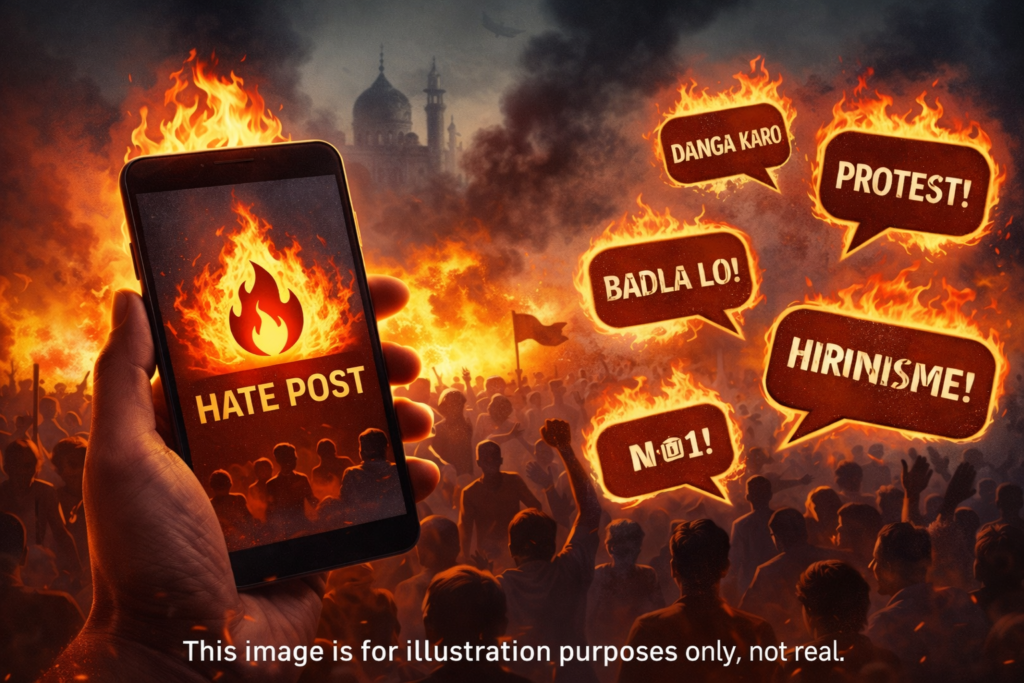
Image disclaimer: Any image used with this article is for illustration and legal-awareness purposes only. It does not depict the actual student, magistrate, police officer, protest, court hearing, notice or legal document unless expressly stated and lawfully sourced.
Disclaimer: This article is for general legal information and awareness purposes only. It does not constitute legal advice or solicitation. Communication is purely informational, in compliance with Bar Council of India Rule 36.