This article is published by The Legal Warning India and written by Advocate Uday Singh.
Refund Scam in India – Foreign Nationals & International Victims Losing Money to Fake Indian Companies, Traders & Online Sellers
In recent years, India has seen a sharp rise in refund scams, fake customer support frauds, payment reversal scams, crypto recovery frauds, fake investment refund promises, and online seller cheating cases. Many international clients from countries like the USA, UK, UAE, Canada, Australia, Singapore, and Europe have reportedly lost money after dealing with Indian entities online.
In several cases, victims were promised:
- Refund after payment verification
- Chargeback settlement
- Crypto recovery assistance
- Fake customer support refunds
- E-commerce product refunds
- Investment withdrawal clearance
- Courier/custom clearance refunds
- Tax refund release
However, after making payments, victims often face blocked communication, fake legal threats, disappearing websites, forged invoices, or manipulated WhatsApp chats.
Information is based on news reports, cyber fraud trends, and publicly available sources.
What Is a Refund Scam?
A refund scam is a fraudulent activity where a person or company falsely promises to return money, process compensation, or release blocked funds but instead extracts more payments from the victim.
These scams commonly operate through:
- WhatsApp business accounts
- Telegram channels
- Instagram advertisements
- Fake company websites
- International payment gateways
- Crypto wallets
- Fake legal notices
- Remote access software
Common Refund Scam Methods Used Against International Victims
1. Fake Customer Support Refund Scam
Victims searching online for support numbers of banks, airlines, e-commerce platforms, or payment services may unknowingly contact fraudsters pretending to be official representatives.
The victim is then asked to:
- Share banking details
- Install screen-sharing apps
- Pay “processing charges”
- Approve fake refund links
Instead of receiving a refund, money may be transferred out of the victim’s account.
2. Fake Crypto Recovery & Refund Agencies
After losing money in crypto scams, many victims are approached again by fake “recovery experts” claiming they can retrieve funds from India.
These entities often ask for:
- Legal fees
- Blockchain tracing fees
- Tax clearance
- Anti-money laundering certificates
- Wallet activation charges
After repeated payments, communication may stop completely.
3. E-Commerce Refund Fraud
International buyers purchasing products from unknown Indian sellers sometimes report:
- No delivery after payment
- Fake tracking IDs
- Counterfeit goods
- No refund after cancellation
- Repeated excuses and delays
Some fraudulent sellers continuously promise refunds to avoid legal complaints while never actually returning the money.
4. Investment Withdrawal & Refund Trap
Victims of forex trading apps, binary trading platforms, or fake investment portals are often informed that withdrawal is “approved” but additional deposits are required first.
Fraudsters may claim:
- International tax pending
- RBI clearance required
- Currency conversion charges
- Anti-fraud verification fee
- Reserve wallet balance requirement
These demands may continue repeatedly until the victim stops paying.
Can International Victims Take Legal Action in India?
Yes. If the fraud originated from India, used Indian bank accounts, Indian phone numbers, Indian companies, Indian payment gateways, or Indian IP activity, legal remedies may be available under Indian law.
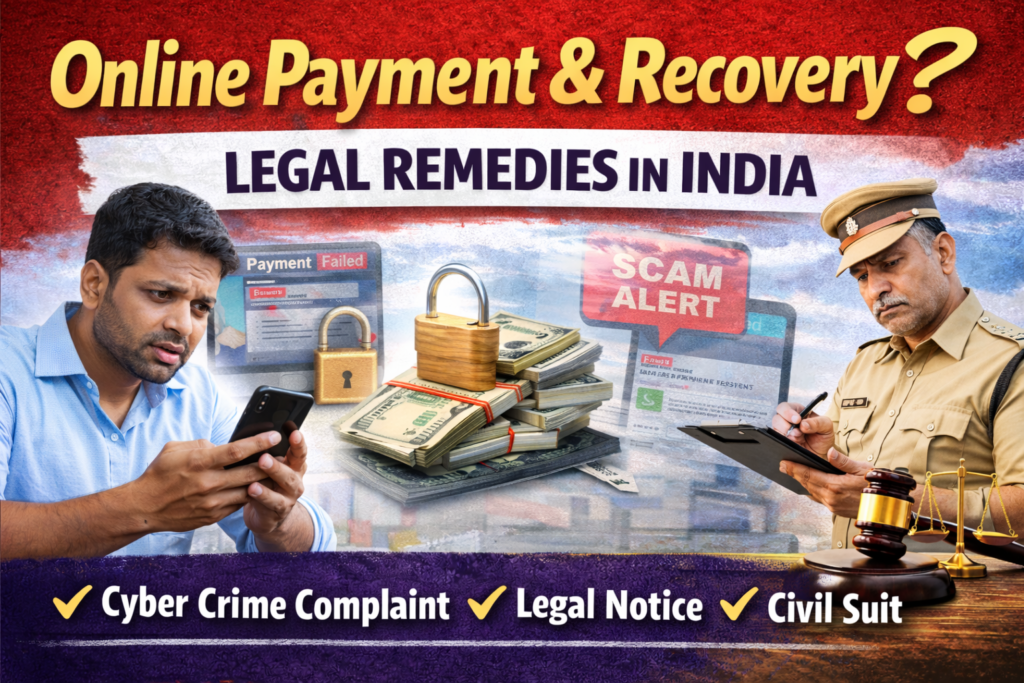
Depending on facts and evidence, complaints may involve:
- Cyber Crime Complaint
- Police FIR
- Legal Notice
- Consumer Complaint
- Banking dispute
- Digital evidence preservation request
- Intermediary/platform complaint
Relevant Indian Laws That May Apply
Bharatiya Nyaya Sanhita (BNS)
- Cheating and dishonestly inducing delivery of property
- Identity fraud
- Forgery and fake documents
- Criminal breach of trust
- Cyber-enabled deception
Information Technology Act, 2000
- Online impersonation
- Unauthorized access
- Data misuse
- Electronic fraud
- Digital identity misuse
What Evidence Should Victims Preserve?
International victims should avoid deleting any communication or transaction history.
Important evidence may include:
- WhatsApp chats
- Email communication
- Bank transfer receipts
- Crypto transaction IDs
- UPI screenshots
- Payment gateway invoices
- Website URLs
- Domain details
- Call recordings
- Fake legal notices
- Identity documents shared by scammers
- Social media profiles
Why Many Victims Delay Legal Action
Many international victims reportedly delay reporting due to:
- Embarrassment
- Fear of losing more money
- Lack of knowledge about Indian legal systems
- False promises by scammers
- Hope of refund recovery
However, delay may create problems in tracing bank transactions, preserving digital evidence, and identifying operators.
What Happens If the Matter Is Ignored?
Ignoring refund scams may result in:
- Further financial losses
- Identity misuse
- Repeated targeting by recovery scammers
- Misuse of banking details
- Data leakage
- Unauthorized transactions
- International money laundering risks
Fraudsters often circulate victim information to other scam networks.
Can a Legal Notice Help?
In certain commercial or seller-related disputes, a properly drafted legal notice may help establish a documented legal demand and preserve records before further proceedings.
A legal notice may sometimes be relevant where:
- A company accepted payment but failed to deliver
- Refund promises were repeatedly made
- Business communication exists
- Written contracts or invoices exist
- False assurances caused financial loss
However, each case depends on evidence, jurisdiction, and applicable law.
International Clients Should Be Careful About “Guaranteed Recovery” Claims
Victims should exercise caution if anyone promises:
- 100% recovery guarantee
- Instant refund release
- Secret RBI approval process
- Direct crypto reversal promise
- Guaranteed police action
- “Pay first, refund later” recovery schemes
No legitimate legal professional can guarantee outcomes in legal disputes or cyber fraud matters.
Preventive Measures for Foreign Nationals Dealing with Indian Online Businesses
- Verify company registration details
- Check GST and business identity
- Use secure payment methods
- Avoid unknown crypto transfers
- Do not share remote access
- Preserve written contracts
- Avoid advance “clearance fees”
- Research online reviews carefully
- Verify official customer support channels
Digital Evidence Is Extremely Important
In cyber-enabled refund disputes, digital evidence often becomes the foundation of any legal or investigative process.
Even deleted chats, fake websites, payment screenshots, and wallet trails may become relevant during investigation.
Conclusion
Refund scams connected to India have become a growing concern for many international victims dealing with online sellers, fake support agencies, investment operators, and digital fraud networks.
Victims should remain cautious, preserve evidence, avoid panic payments, and seek proper legal awareness before taking further steps.
Every matter depends on its own facts, documents, jurisdiction, and digital evidence trail.
Read Also
- Cyber Fraud Legal Blogs
- WhatsApp Evidence & Digital Proof Cases
- Online Scam Recovery Awareness
- Cheque Bounce & Financial Fraud Articles
Disclaimer: This article is for general legal information and awareness purposes only. It does not constitute legal advice or solicitation. Communication is purely informational, in compliance with Bar Council of India Rule 36.