This article is published by The Legal Warning India and written by Advocate Uday Singh.
Risk of World War from the Iran–Israel–USA Conflict – Deep Geopolitical Analysis
Origins of the Present Conflict
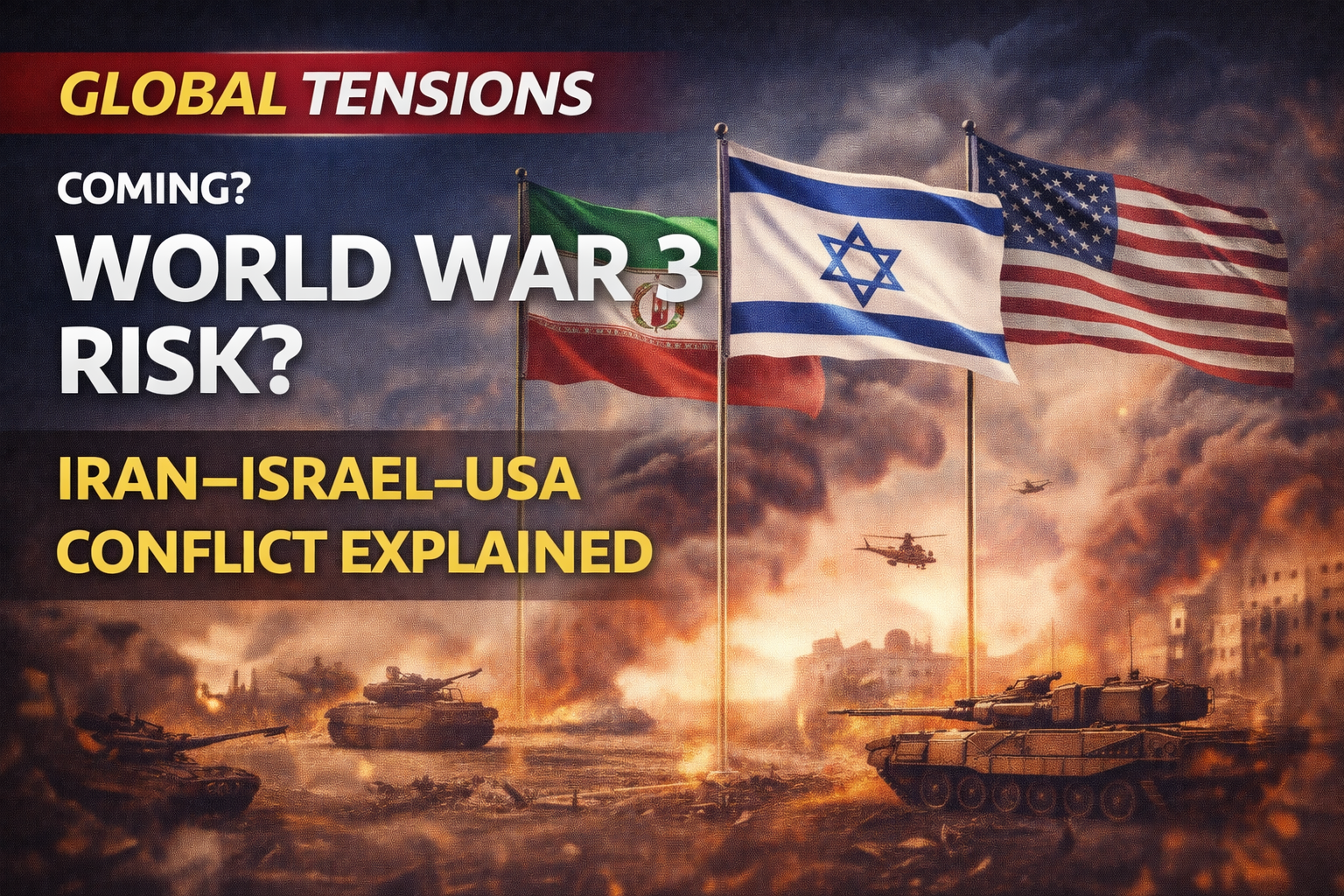
Tensions between Iran, Israel, and the United States have been simmering for decades, rooted in disputes over nuclear ambitions, regional influence, and military proxies. The conflict escalated sharply in **early 2026** when the United States and Israel conducted coordinated military strikes inside Iran, including reported strikes on key military facilities. Iran responded with widespread missile, drone, and proxy attacks against Israeli and U.S. interests in the region. 0
This offensive was dubbed **“Operation Lion’s Roar.”** The strikes targeted Iranian leadership, military, and nuclear sites, triggering immediate, widespread retaliation from Tehran and allied groups such as Hezbollah. 1
—
Why This Conflict Could Escalate
Several factors contribute to fears of a broader war:
- Regional alliances: Iran’s retaliation has involved missile launches across the Gulf and attacks by allied proxy forces in Lebanon and Yemen. 2
- Involvement of external powers: The U.S. is fully engaged militarily alongside Israel, while Russia has condemned the U.S. and Israel for destabilizing actions. 3
- Proxy networks: Groups like Hezbollah, Houthis, and Iran-aligned militias have opened multiple fronts beyond Israel and Iran. 4
—
Can This Become World War III?
**No credible evidence currently suggests an outright global war is imminent**, but the risk of wider escalation remains significant. Analysts and experts emphasize that:
- Strategic nuclear powers are extremely cautious about direct confrontation, because nuclear escalation would be catastrophic. 5
- While global fears (including speculative predictions) circulate online, there is no substantive confirmation of a global nuclear conflict. 6
- Diplomatic pressures and economic interests — including oil market stability and fear of global recession — act as constraints on full-scale global war. 7
Experts state that the conflict could widen regionally if more states are drawn in, but escalation to a formalized World War involving NATO, China, Russia, and all major powers remains unlikely given current diplomatic pressures. 8
—
Regional Fallout: Gulf, Middle East & Beyond
The conflict has already provoked multiple regional consequences:
- Multiple Gulf states targeted: Iran has launched missiles not only at Israel and U.S. bases but also at several Gulf states including UAE, Saudi Arabia, Kuwait, Bahrain, Qatar, and Jordan. 9
- Diplomatic upheaval: Saudi Arabia recently summoned the Iranian ambassador as tensions spread. 10
- Internet and cyber warfare: Iran experienced widespread internet outages amidst cyberattack reports. 11
This expansion of conflict beyond direct Israel-Iran exchanges increases the risk of broader regional war, although not yet global war. 12
—
Economic and Strategic Consequences
One immediate concern has been the disruptive impact on global energy markets. The **Strait of Hormuz**, through which roughly 15–20% of the world’s oil supplies flow, has partly closed due to hostilities, prompting fears of sustained price spikes above $100 per barrel. 13
Market volatility is growing, with oil, gold, and safe-haven assets rising while equities and sensitive industries (airlines, transport, banks) suffer losses. 14
—
Internal Iranian Dynamics
The Iran conflict is not just about foreign powers; internal political and power struggles shape decision-making. This adds a layer of unpredictability: hardliners may push for retaliation, while pragmatists may seek de-escalation depending on domestic pressures. 15
—
Why World War III Remains Unlikely — For Now
Despite fears and dramatic speculation circulating online:
- Established nuclear powers have strong deterrents against direct confrontation. 16
- Major global players are focused on avoiding humanitarian catastrophe. 17
- International diplomatic channels — including the UN — increasingly push for ceasefire and negotiation. 18
The conflict could remain regionally volatile without evolving into a global confrontation involving the world’s largest military alliances. 19
—
Connection to Previous Legal-Political Scenarios
This geopolitical flashpoint also highlights the importance of legal clarity and conflict resolution mechanisms — similar to how legal frameworks govern **administrative disputes and complaints** in domestic settings such as the IGRS Portal. Learn more about structured dispute resolution here:
IGRS UP Portal Par Galat Report Lagakar Complaint Nistarit? Kya Kare
—
Conclusion: A Precipice, Not a Global War Yet
The Iran–Israel–USA war is one of the most serious geopolitical crises in recent history. It combines direct military confrontation, proxy warfare, energy security risks, and regional instability.
While fears of **World War III** capture public attention, current expert analysis suggests that global war remains unlikely — but not impossible — unless the conflict draws in additional major powers or nuclear escalation occurs. Continued diplomatic engagement, careful economic management, and crisis-control mechanisms will be vital to preventing further escalation.