This article is published by The Legal Warning India and written by Advocate Uday Singh.
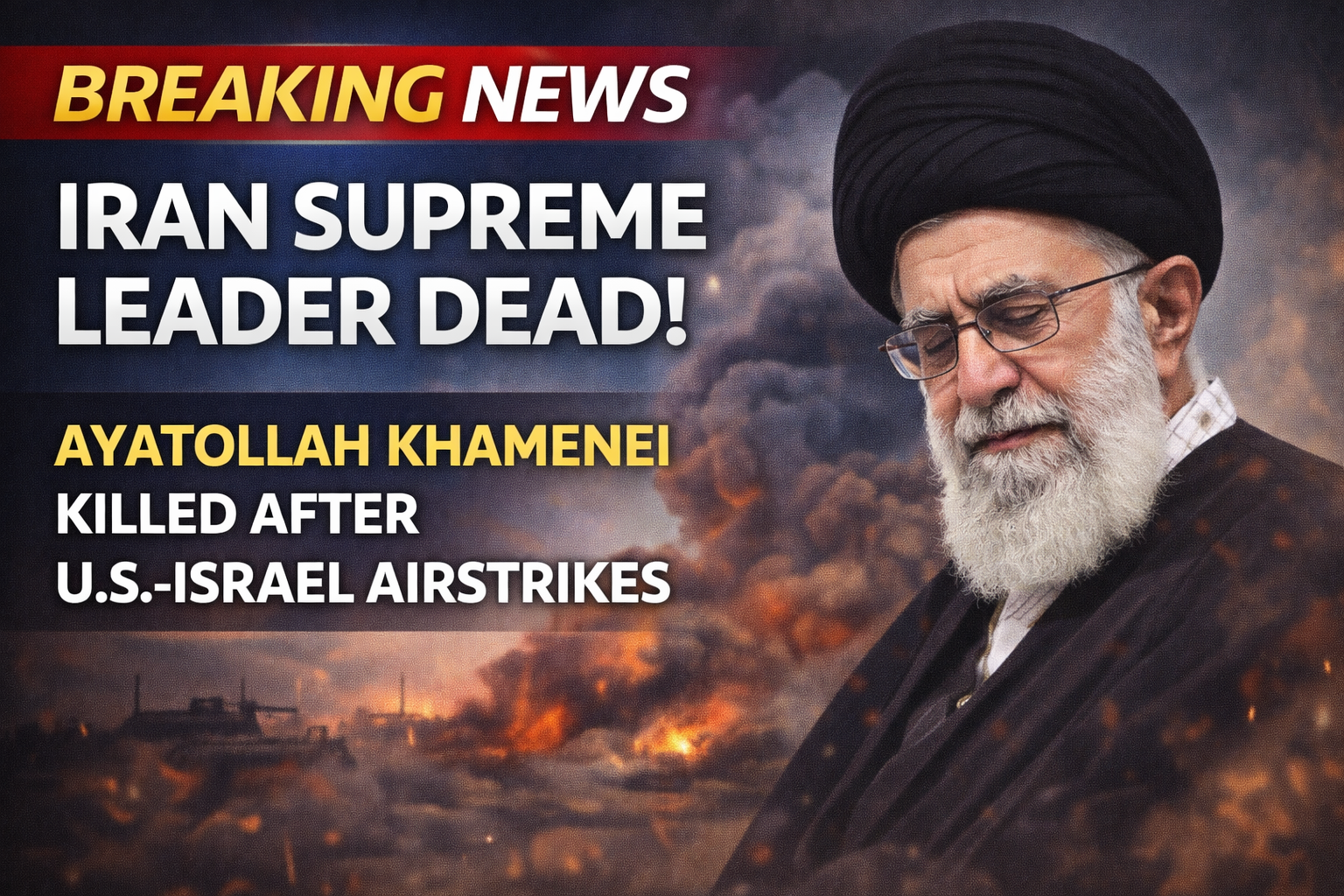
Iran Leader Death Confirmed – Ayatollah Ali Khamenei Killed After US-Israel Air Strikes: Deep Analysis
Confirmed by Iranian State Media
Iran’s Supreme Leader Ayatollah Ali Khamenei, aged 86, has been confirmed dead by Iranian state television, following a series of intense airstrikes conducted jointly by the United States and Israel. Khamenei had led the Islamic Republic since 1989 and was widely regarded as one of the most influential political and religious figures in Iran’s modern history. 0
State media announced that the strike targeted the leader’s compound in Tehran and also resulted in the deaths of multiple senior officials. He is being mourned nationwide with a 40-day official mourning period declared by the government. 1
Role & Historical Influence of Khamenei
Khamenei succeeded Ayatollah Ruhollah Khomeini and served as Iran’s Supreme Leader for nearly four decades. His tenure was marked by:
- A highly centralized system of authority combining political and religious power.
- A firm anti-American, anti-Israeli foreign policy stance.
- Support to proxy groups such as Hezbollah, Hamas, and the Houthis.
- Crackdowns on internal dissent, including responses to mass protests.
Under his leadership, Iran expanded its nuclear program, resisting multiple rounds of international pressure and sanctions. His death now marks a historic shift in the political landscape of the Middle East. 2
How Did He Die? Joint Military Strikes
According to news reports, the fatal strike occurred as part of a coordinated air campaign between the United States and Israel. US President Donald Trump took credit for the operation, describing it as targeting what he called one of history’s “most evil figures.” 3
The strikes reportedly targeted military and government sites in Tehran, leading to high casualties, including Khamenei and other officials. Iran condemned the attack as a flagrant violation of its sovereignty and pledged retaliation. 4
Immediate Domestic Reaction in Iran
Iranian state television broadcast emotional scenes of grief, with anchors visibly distressed as the news was announced. Many citizens gathered in public squares to mourn, while in some areas, small celebrations were also reported, reflecting a divided public sentiment. 5
Share market impact by this situation
Officially, the Iranian government declared a period of formal mourning for 40 days and a week of public holidays. At the same time, President Masoud Pezeshkian called the killing a “great crime” and reiterated the country’s intent to retaliate. 6
Leadership Vacuum & Succession
With the Supreme Leader gone, Iran has appointed an interim leadership council including Alireza Arafi, the President and Chief Justice, to oversee state duties until the Assembly of Experts elects a new Supreme Leader. This transitional period is critical and fraught with uncertainty. 7
The Assembly of Experts, a powerful clerical body, will decide the next leader, but the process may provoke internal power struggles between hardliners, moderates and the influential Islamic Revolutionary Guard Corps (IRGC). 8
Geopolitical Implications
Khamenei’s death has significant implications for regional stability. The Middle East is already witnessing a widening conflict, with reciprocal military actions taking place across the Gulf and beyond. 9
Iran has vowed retaliation against the US and Israel, indicating an escalation in hostilities that could have far-reaching effects on global politics, energy markets, and international security alliances. 10
Public Sentiment: Mourning and Celebration
Within Iran, reactions are mixed. The state narrative emphasizes national grief, while independent observers and some citizens have responded differently — with celebrations in certain quarters signaling discontent with decades of authoritarian rule. 11
Economic & Security Outlook
The death of Khamenei adds complexity to already volatile oil markets and international energy politics. Sanctions, supply disruptions, and risk premiums could influence global prices, while military escalation threatens commercial shipping lanes around the Strait of Hormuz. 12
Additionally, heightened global security alerts and travel advisories have been issued by multiple governments, signaling elevated risk levels. 13
Legal and International Law Considerations
Targeted killings of state leaders remain highly controversial under international law. Debate continues among scholars, governments and international institutions about legality, justifications and long-term consequences of such operations. There is no universally accepted interpretation when actions are framed as pre-emptive defense against alleged threats. This controversy is likely to evolve through diplomatic channels and international legal discourse in the months ahead.
Conclusion: Turning Point in Middle East Politics
The verified death of Ayatollah Ali Khamenei represents one of the most consequential geopolitical events of the 21st century. It not only marks the end of an era in Iranian leadership, but also threatens to accelerate conflict dynamics across the Middle East and beyond.
How Iran navigates its succession, whether retaliatory actions escalate into wider war, and how global powers respond will define security, economics and diplomacy for years to come.