This article is published by The Legal Warning India and written by Advocate Uday Singh.
Galgotias University AI Summit Robodog Controversy – Legal, Ethical & Institutional Accountability Analysis
Background: What Happened at the AI Impact Summit?
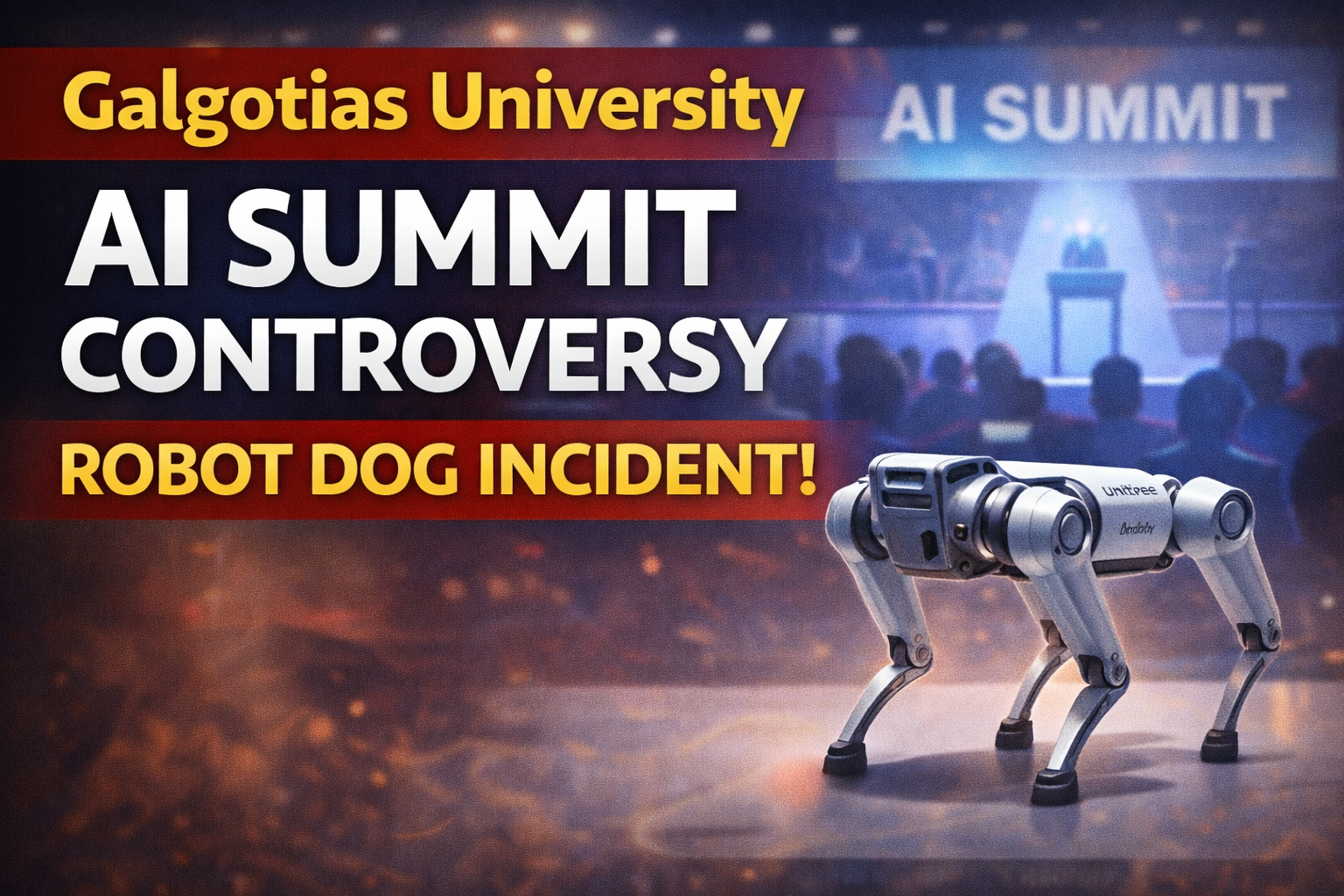
During the India AI Impact Summit held in New Delhi, a controversy emerged involving Galgotias University after a robotic dog was showcased at its exhibition booth. The robot, identified online as a commercially available Unitree robotic dog, was allegedly presented in a manner that created confusion regarding its origin and development.
A video clip circulated on social media suggesting that the robot was being described as an in-house innovation. Soon after, tech observers pointed out that the hardware resembled a widely available Chinese-manufactured robotic system.
The incident quickly became a subject of national debate, raising questions about academic transparency, representation of innovation, and institutional accountability.
Was It Misrepresentation or Miscommunication?
From a legal standpoint, two key questions arise:
- Was there an intentional false claim of ownership?
- Or was it a case of miscommunication during public demonstration?
Universities often use commercially procured hardware for research, training, and student experimentation. However, ethical standards require clear differentiation between:
- Original research output
- Integration projects using purchased hardware
- Purely commercial products
If a product is not originally developed by the institution, transparent attribution becomes crucial.
Legal Perspective: Could There Be Liability?
1️⃣ Academic Integrity & Regulatory Oversight
Private universities in Uttar Pradesh operate under the Uttar Pradesh Private University Act. Any misleading representation at a public or government-recognized forum may attract administrative scrutiny.
2️⃣ Consumer & Public Misrepresentation Angle
If a claim of innovation is made publicly and later found incorrect, it may fall under principles of misrepresentation. However, liability depends on:
- Proof of intent
- Actual claim made
- Documented statements
3️⃣ Government Event Compliance
Since the AI Summit was a high-level national event, organizers may enforce exhibition guidelines. Any ambiguity in claims could justify corrective administrative action.
Institutional Response
Galgotias University reportedly clarified that the robotic dog was procured for educational and learning purposes and that it was not claimed as manufactured by the university.
Such clarification reduces the scope of direct legal exposure but does not eliminate reputational impact.
Reputational Risk in the Digital Era
This controversy demonstrates how:
- Short viral clips can shape public perception
- Social media amplifies institutional controversies rapidly
- Clarifications often receive less visibility than allegations
Educational institutions must now manage both legal compliance and digital reputation management.
Broader Lessons for Universities & Startups
- Always clearly label third-party hardware
- Avoid ambiguous language in demonstrations
- Maintain documentation of project contributions
- Train faculty on public presentation compliance
How This Connects to Larger Legal Awareness
Public controversies often escalate into legal disputes, whether through defamation claims, regulatory notices, or institutional inquiries.
Understanding legal remedies and compliance procedures becomes essential — similar to cases where administrative actions require structured response, as discussed in:
IGRS UP Portal Par Galat Report Lagakar Complaint Nistarit? Kya Kare
Both scenarios underline one principle: documentation, transparency, and timely clarification are key.
Conclusion: A Cautionary Moment in India’s AI Journey
The Galgotias AI Summit Robodog controversy may ultimately prove to be more reputational than legal. However, it highlights the importance of:
- Academic credibility
- Clear attribution
- Ethical representation
- Regulatory awareness
As India positions itself as a global AI leader, institutional transparency will remain central to long-term credibility.