
This article is published by The Legal Warning India and written by Advocate Uday Singh.
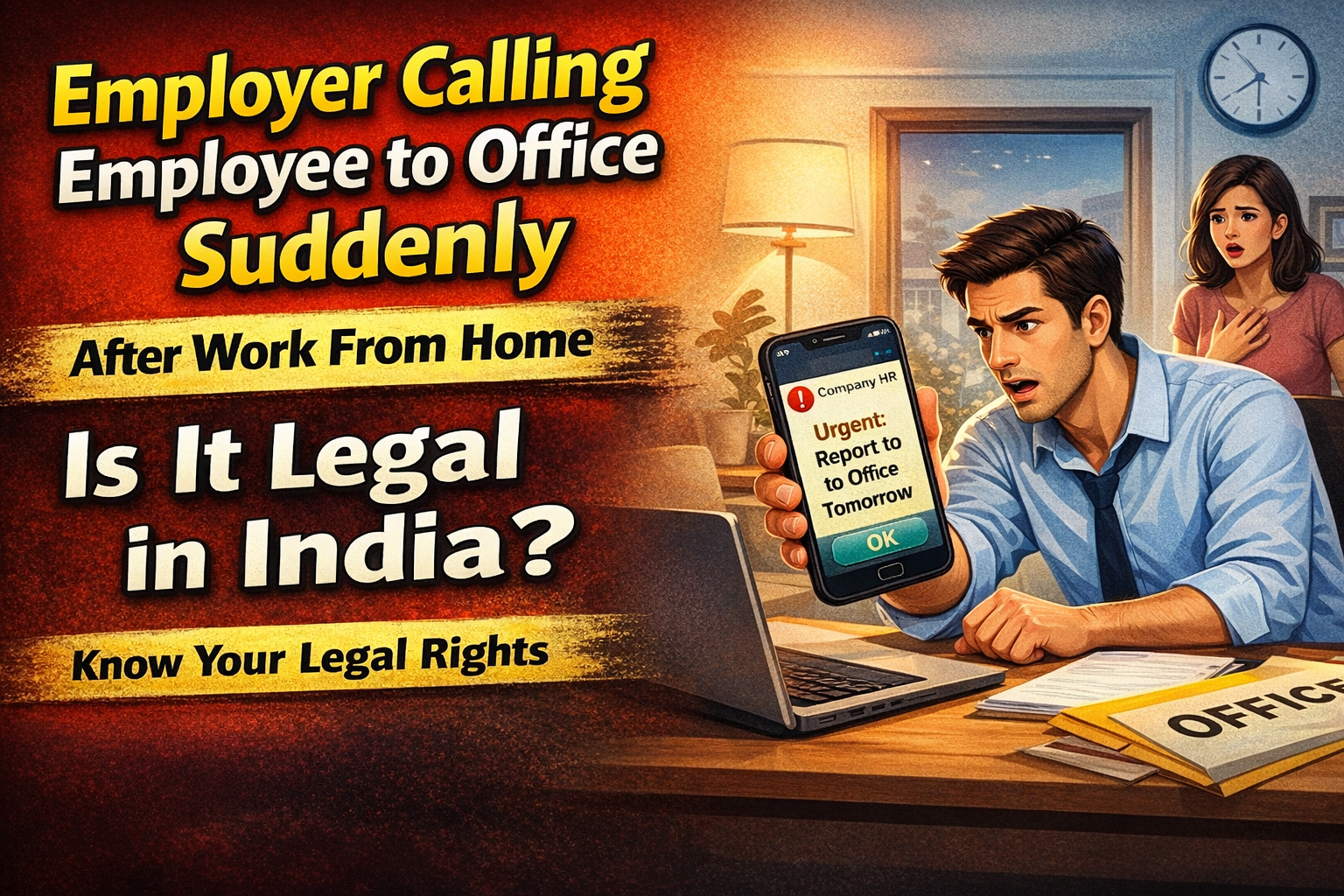
Employer Calling Employee to Office Suddenly After Work From Home – Is It Legal in India?
During and after the COVID period, Work From Home (WFH) became a standard working arrangement in India.
However, many employees now face a serious issue:
“Employer ne achanak bola – kal se office aao, warna job risk me hai.”
This sudden recall creates panic, especially for employees who:
- Shifted to another city or hometown
- Have medical or family issues
- Were promised long-term or permanent WFH
- Joined the company only because of WFH
Let us understand the legal position, employee rights, consequences, and next steps.
Is Work From Home a Legal Right in India?
No. There is no absolute legal right to Work From Home under Indian labour laws.
But that does NOT mean an employer can act arbitrarily.
WFH becomes legally relevant when it is:
- Mentioned in appointment letter
- Part of written HR policy
- Agreed via email or official communication
- Promised at the time of joining
Once WFH becomes a service condition, sudden change can be legally challenged.
Can Employer Suddenly Call Employee to Office?
Short Answer:
Yes, but with conditions.
Employer Action Is LEGAL If:
- Appointment letter allows location change
- WFH was temporary or discretionary
- Reasonable notice is given
- No personal hardship is ignored
Employer Action Becomes ILLEGAL If:
- No notice or extremely short notice is given
- WFH was promised long-term
- Employee shifted city relying on WFH
- Recall is used to force resignation
- Threats of termination are given
Sudden recall without consideration may amount to unfair labour practice.
What If Employee Is Living in Another City?
This is one of the most common disputes.
If employee relocated due to WFH and employer:
- Calls to office overnight
- Does not give relocation time
- Ignores medical or family constraints
Then such recall can be challenged as:
- Unreasonable service condition change
- Constructive harassment
- Indirect forced resignation
Can Employer Terminate Employee for Not Reporting to Office?
Direct termination is risky for employer.
If employee has valid reasons and documented proof, termination may be:
- Illegal termination
- Violation of natural justice
- Retaliatory action
Employer must:
- Give notice
- Provide reasoned communication
- Follow due process
Termination without this can be legally challenged.
Is This Considered Mental Harassment?
It can become harassment if:
- Threats are used (“Office aao ya resign karo”)
- Daily pressure messages are sent
- Employee is humiliated for WFH
- Medical conditions are ignored
Such conduct may attract:
- Labour law violation
- Mental harassment claims
- Compensation exposure for employer
What Evidence Should Employee Collect?
Evidence is crucial.
Important Proof Includes:
- Appointment letter mentioning WFH
- Emails confirming WFH arrangement
- HR policy documents
- WhatsApp or Teams messages
- Medical certificates (if applicable)
Tip: Always reply in writing. Avoid verbal-only communication.
What Happens If Employee Ignores Sudden Recall?
Ignoring employer communication may lead to:
- Absconding remarks
- Disciplinary action
- Background verification issues
Never ignore. Always respond politely with reasons.
Legal Remedies Available to Employee
Step 1: Written Representation
Reply with facts, hardships, and request reasonable time.
Step 2: Internal Escalation
Email HR or senior management.
Step 3: Legal Notice
A legal notice often stops coercive recall tactics.
Step 4: Labour Commissioner Complaint
For unfair labour practice or harassment.
Step 5: Legal Action
In case of termination, compensation claims may arise.
Prevention Tips for Employees
- Get WFH terms in writing
- Clarify relocation clauses
- Save all HR communications
- Do not resign under pressure
Read Also
- Employer Not Paying Salary for Months
- Legal Notice for Salary Recovery
- Using WhatsApp Evidence in Legal Cases
Image used for illustration purposes only.
Information is based on news reports and publicly available sources.
Need legal guidance? You may choose to connect for general consultation and information.
▶ WhatsApp Consultation Request
Disclaimer:
This article is for general legal information and awareness purposes only. It does not constitute legal advice or solicitation. Communication is purely informational, in compliance with Bar Council of India Rule 36.