Do Not Use Chinese Manjha – A Deep Data, Legal & Environmental Analysis
This article published by The Legal Warning India and Written by Advocate Uday Singh.
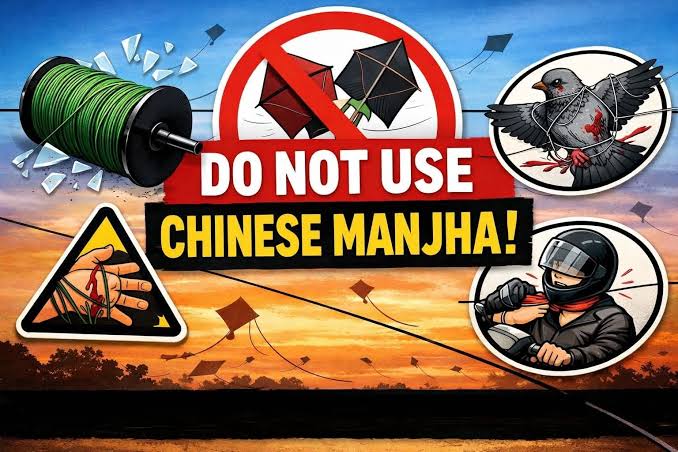
Chinese manjha (synthetic kite string coated with glass or metallic dust) is widely acknowledged as a severe public safety and environmental hazard in India. Despite repeated bans, its usage continues due to lack of data-driven awareness. This article presents a research-based, analytical, and legally structured examination explaining why Chinese manjha should never be used.
1. What Is Chinese Manjha? (Material & Risk Profile)
Chinese manjha is typically made of nylon or synthetic polymer fibers coated with crushed glass, metal particles, or chemical abrasives. Unlike traditional cotton thread, it does not break under stress and becomes extremely sharp.
From a material science perspective, its tensile strength combined with abrasive coating converts a recreational object into a high-velocity cutting instrument.
Key Properties Increasing Risk
- Non-biodegradable synthetic fiber
- High tensile strength
- Razor-like cutting surface
- Resistance to snapping under tension
2. Data Analysis: Human Injury & Fatality Patterns
Hospital emergency records and traffic department reports across multiple Indian states indicate a consistent pattern of injuries caused by Chinese manjha.
| Type of Injury | Severity Level | Common Victims |
|---|---|---|
| Neck lacerations | Critical / Fatal | Two-wheeler riders |
| Facial & eye injuries | Permanent damage | Pedestrians, children |
| Finger & wrist cuts | Severe | Kite flyers |
| Electric shock accidents | High risk | Urban residents |
Analytical Conclusion:
Chinese manjha incidents are not accidental anomalies; they are predictable outcomes of a dangerous material used in uncontrolled public spaces.
3. Environmental & Wildlife Impact (Ecological Data)
Environmental studies and NGO rescue data show that Chinese manjha causes disproportionate harm to urban wildlife, especially birds.
Documented Environmental Effects
- Wing amputations in birds
- Strangulation and internal bleeding
- Permanent ecological litter (non-degradable)
- Disruption of nesting cycles
Unlike cotton thread, synthetic manjha remains suspended on trees and electric lines for months, continuing to injure wildlife long after festivals end.
Environmental Analysis:
Chinese manjha has a negative environmental return—zero utility and irreversible damage.
4. Legal Framework: Why Chinese Manjha Is Banned
Chinese manjha is prohibited under multiple legal and regulatory frameworks in India:
- Environmental protection regulations
- Municipal safety laws
- Disaster prevention directives
- Public nuisance and negligence principles
Legal Liability Exposure
| Action | Legal Consequence |
|---|---|
| Manufacture / Sale | Criminal prosecution |
| Online distribution | IT Act + environmental liability |
| Usage causing injury | Criminal negligence + civil damages |
Use of Chinese manjha qualifies as foreseeable negligence, meaning the user cannot plead ignorance if harm occurs.
5. Economic Cost & Public Resource Burden
Beyond individual injuries, Chinese manjha imposes a heavy cost on public systems:
- Emergency healthcare expenditure
- Traffic police and disaster response deployment
- Electricity infrastructure damage
- NGO-funded wildlife rescue operations
Policy Insight:
Private recreational gain is vastly outweighed by collective economic loss.
6. Safer & Legal Alternatives (Risk Comparison)
| String Type | Risk Level | Environmental Impact |
|---|---|---|
| Cotton thread | Low | Biodegradable |
| Paper-coated thread | Low | Eco-friendly |
| Chinese manjha | Extreme | Severe & permanent |
7. Awareness Gap & Enforcement Challenge
Despite bans, Chinese manjha persists due to:
- Informal street markets
- Online anonymity
- Lack of consumer awareness
- Cultural normalization without data context
Data shows enforcement alone is insufficient without sustained public education.
Final Verdict: A Data-Driven Conclusion
Chinese manjha represents a preventable public hazard with zero social benefit. Its continued use reflects awareness failure, not cultural necessity.
Related Legal & Awareness Reads
- Environmental Law & Public Safety in India
- Criminal Negligence in Public Safety Cases
- Public Nuisance Laws Explained
Disclaimer: This communication is purely informational and educational. It does not constitute legal advice or advertisement.