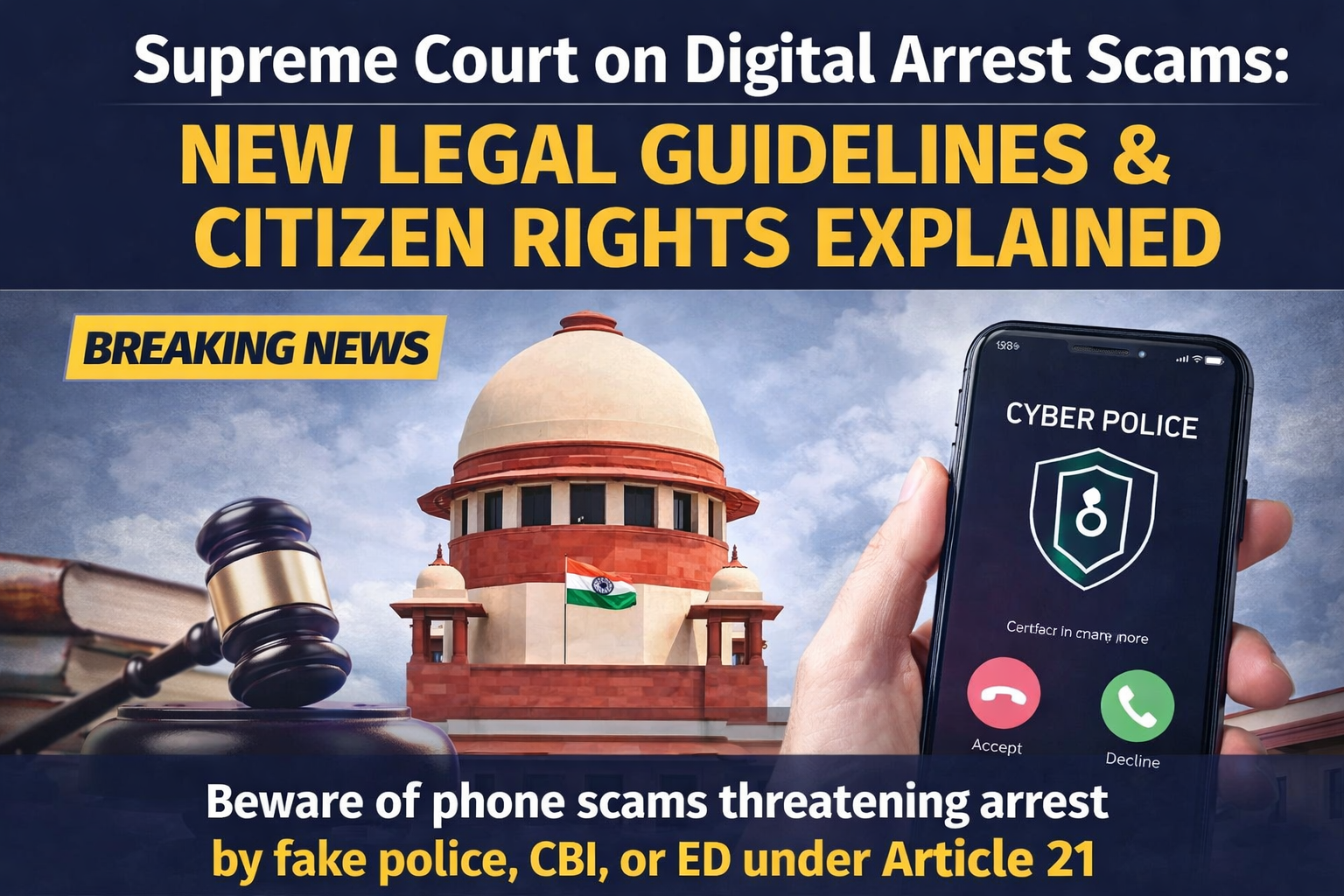
Supreme Court on Digital Arrest Scams: New Legal Guidelines & Citizen Rights Explained
This article is published by The Legal Warning India and written by Advocate Uday Singh.
Communication is purely informational and not solicitation.
Breaking News: Supreme Court Takes Serious Note of Digital Arrest Scams
In a major development aimed at protecting citizens from rising cyber fraud, the
Supreme Court of India
has strongly condemned the increasing incidents of so-called “Digital Arrest Scams”.
These scams involve fraudsters impersonating police officers, CBI, ED, or cyber crime officials and threatening innocent citizens with arrest over phone calls or video calls.
The Court observed that such scams are not only financial crimes but also violate the
fundamental rights to life, liberty, and dignity under Article 21 of the Constitution.
What Is a Digital Arrest Scam?
A digital arrest scam is a cyber fraud technique where criminals falsely claim that a person is:
- Involved in money laundering
- Linked to narcotics or illegal parcels
- Under investigation by police, CBI, ED, or cyber crime unit
Victims are threatened with immediate arrest unless they transfer money or share sensitive details.
No such “digital arrest” exists under Indian law.
Supreme Court’s Legal Observations
The Supreme Court clarified important legal points:
- No arrest can be made without following due process of law
- Police cannot arrest someone through WhatsApp, Zoom, or video calls
- Any demand for money to “close a case” is a clear criminal offence
- Impersonation of law enforcement attracts strict punishment
Applicable Laws in Digital Arrest Scam Cases
Such acts attract punishment under multiple laws, including:
- Cheating and fraud under Bharatiya Nyaya Sanhita (BNS)
- Criminal intimidation
- Identity theft and impersonation
- Cyber offences under the Information Technology Act, 2000
Citizen Rights Explained by the Supreme Court
The Court emphasized that citizens have the following rights:
- Right to verify any police notice physically
- Right to remain silent until legally summoned
- Right to consult a lawyer before any statement
- Right to file an FIR against cyber fraudsters
How to Take Legal Action Against Digital Arrest Scams
If you or someone you know receives such a call:
- Do not panic or transfer money
- Disconnect the call immediately
- Preserve call recordings, numbers, screenshots
- File an FIR at the nearest police station
- Report the incident on cyber crime portal
Legal Awareness Is the Best Protection
The Supreme Court’s intervention highlights the urgent need for public legal awareness.
Digital arrest scams thrive on fear and misinformation.
Knowing your rights is the strongest legal shield.
Related Legal Guidance