This article is published by The Legal Warning India and written by Advocate Uday Singh.Disclaimer: This article is for general legal information and awareness purposes only. It does not constitute legal advice or solicitation. Communication is purely informational, in compliance with Bar Council of India Rule 36.
Cyber Fraud and Refund Abuse: Legal Action in India – A Complete Guide for Individuals, Businesses, and International Victims
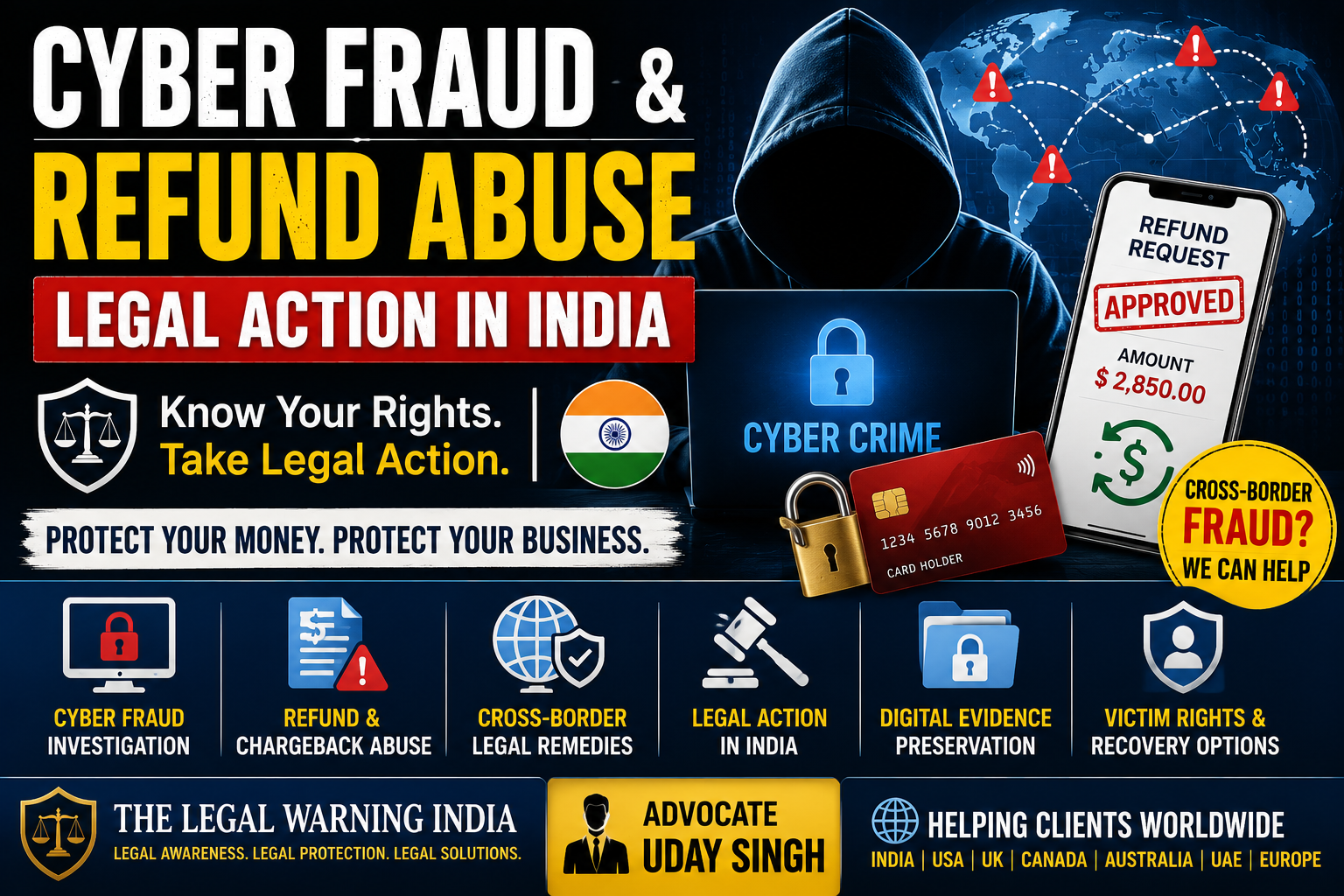
Cyber fraud has evolved into one of the fastest-growing financial crimes worldwide. Alongside traditional online scams, a new challenge has emerged—refund abuse. Fraudsters exploit online payment systems, e-commerce platforms, digital wallets, and international banking networks to obtain unauthorized refunds or deceive victims into transferring money.India has witnessed a significant increase in cyber-enabled financial crimes, affecting individuals, startups, exporters, online sellers, freelancers, software companies, and multinational businesses.If you have become a victim of an online scam, payment fraud, unauthorized refund, chargeback abuse, or cross-border cyber fraud involving India, understanding the available legal remedies is essential.
What Is Cyber Fraud?
Cyber fraud refers to deceptive activities committed through computers, mobile devices, online platforms, banking systems, or digital communication with the intention of causing financial loss or obtaining unlawful gains.Common examples include:
- Business Email Compromise (BEC)
- Online Banking Fraud
- Investment Fraud
- Cryptocurrency Scams
- Refund Fraud
- Chargeback Fraud
- Identity Theft
- Marketplace Fraud
- UPI Payment Fraud
- Remote Access Scams
- Social Media Impersonation
- Invoice Fraud
Understanding Refund Abuse
Refund abuse occurs when an individual intentionally manipulates refund policies for financial gain.This may involve false claims, fake delivery disputes, fraudulent chargebacks, manipulated payment reversals, or misuse of return policies.Businesses operating globally increasingly report losses arising from organized refund abuse schemes.
Who Is Commonly Targeted?
- International e-commerce sellers
- Amazon merchants
- Shopify store owners
- SaaS companies
- Freelancers
- Export businesses
- Payment gateway users
- Digital agencies
- Forex traders
- Crypto investors
- Consultants
- Online educators
How Refund Fraud Usually Works
Fraudsters often exploit trust, payment systems, and platform policies.Common techniques include:
- False “Item Not Received” claims
- Friendly fraud chargebacks
- Identity manipulation
- Fake customer support
- Refund phishing emails
- QR Code scams
- Remote desktop access
- Payment confirmation manipulation
- Fake banking alerts
Legal Framework in India
Depending on the facts of each case, cyber fraud investigations in India may involve provisions under the Bharatiya Nyaya Sanhita (BNS), the Information Technology Act, 2000, procedural laws, banking regulations, and other applicable legal provisions.The exact legal approach depends on the nature of the transaction, digital evidence, jurisdiction, and investigation.
Cross-Border Cyber Fraud
International cyber fraud cases frequently involve:
- Foreign bank accounts
- International payment gateways
- Cryptocurrency wallets
- Multiple jurisdictions
- Anonymous online identities
- International marketplaces
These investigations may require digital evidence preservation, transaction tracing, regulatory coordination, and compliance with applicable legal procedures.
Immediate Steps After Discovering Cyber Fraud
- Secure your online accounts.
- Notify your financial institution immediately.
- Preserve digital evidence.
- Save emails, invoices, chats, and payment receipts.
- Document transaction references.
- Report the incident to the appropriate authorities where applicable.
- Avoid deleting communication records.
Why Digital Evidence Matters
Digital evidence often plays a significant role during investigations.Useful evidence may include:
- Bank statements
- Wire transfer records
- Payment gateway logs
- Email headers
- IP addresses (where available)
- WhatsApp conversations
- Screenshots
- Invoices
- Contracts
- Delivery records
- Blockchain transaction hashes (if applicable)
Business Risks of Refund Abuse
Refund abuse may result in:
- Financial losses
- Merchant account restrictions
- Payment gateway penalties
- Chargeback increases
- Negative customer experience
- Compliance concerns
- Operational disruption
Preventive Measures
- Implement strong KYC procedures.
- Maintain proper invoices.
- Verify high-value transactions.
- Monitor unusual payment activity.
- Maintain delivery documentation.
- Use secure payment platforms.
- Educate employees regarding cyber threats.
- Retain transaction records.
Frequently Asked Questions
Can foreign individuals report cyber fraud involving India?
Depending on the circumstances, cross-border legal and regulatory mechanisms may be available. Jurisdiction varies based on the facts of each case.
Can refund abuse result in legal consequences?
Intentional fraudulent conduct may attract civil or criminal consequences depending upon the applicable law and available evidence.
Can businesses preserve digital evidence before initiating legal action?
Yes. Proper documentation and preservation of digital records may assist during investigations or legal proceedings.
Conclusion
Cyber fraud and refund abuse are no longer isolated incidents. They affect consumers, businesses, fintech companies, merchants, and international organizations alike.Prompt reporting, preservation of digital evidence, regulatory compliance, and awareness of available legal remedies are important steps when responding to cyber-enabled financial fraud.
Read Also
Information is based on publicly available sources and general legal principles. Image used for illustration purposes only.