How Long Does a Cyber Crime Investigation Take? Bank Account Freeze and Unfreeze Process in India
This article is published by The Legal Warning India and written by Advocate Uday Singh.
If you have filed a cyber fraud complaint, your bank account has been frozen because of a cyber complaint, or the police/cyber cell has asked you to explain a transaction, one of the first questions is: “How long will the cyber crime investigation take, and when will my bank account be unfrozen?”
The important answer is that there is no universal 7-day, 30-day or 90-day deadline for completing every cyber crime investigation in India. The time can depend on the nature of the offence, transaction trail, bank/payment intermediary responses, digital evidence, number of accounts involved and whether multiple jurisdictions are involved.
▶ WhatsApp – Discuss Your Cyber Crime Query
When Does a Cyber Crime Investigation Start?
A cyber crime investigation may begin after:
- A cyber fraud complaint is filed.
- A complaint is submitted through the National Cyber Crime Reporting Portal.
- Financial cyber fraud is reported through 1930.
- A bank or payment intermediary identifies a suspicious transaction.
- Your bank account appears in a suspected fraud money trail.
- Your mobile number, UPI ID, bank account or digital device becomes relevant to an investigation.
An important point is that the appearance of your bank account in a fraud transaction does not automatically prove that you participated in the fraud. However, you may still have to explain the transaction and source of funds.
How Long Does a Cyber Crime Investigation Take?
There is no single fixed timeline for every cyber crime investigation.
A straightforward transaction verification may be completed relatively quickly, while a complex case involving multiple UPI transfers, mule accounts, cryptocurrency, different States or foreign platforms may take considerably longer.
Under the current criminal procedure framework, Section 193 of the Bharatiya Nagarik Suraksha Sanhita, 2023 (BNSS) requires investigation to be completed without unnecessary delay. However, this does not create a universal 90-day completion deadline for every cyber fraud investigation.
Section 193 also contains a provision concerning communication of investigation progress to the informant or victim within the prescribed period. This should not be confused with a rule that every investigation must finish within 90 days.
Why Is a Bank Account Frozen After a Cyber Complaint?
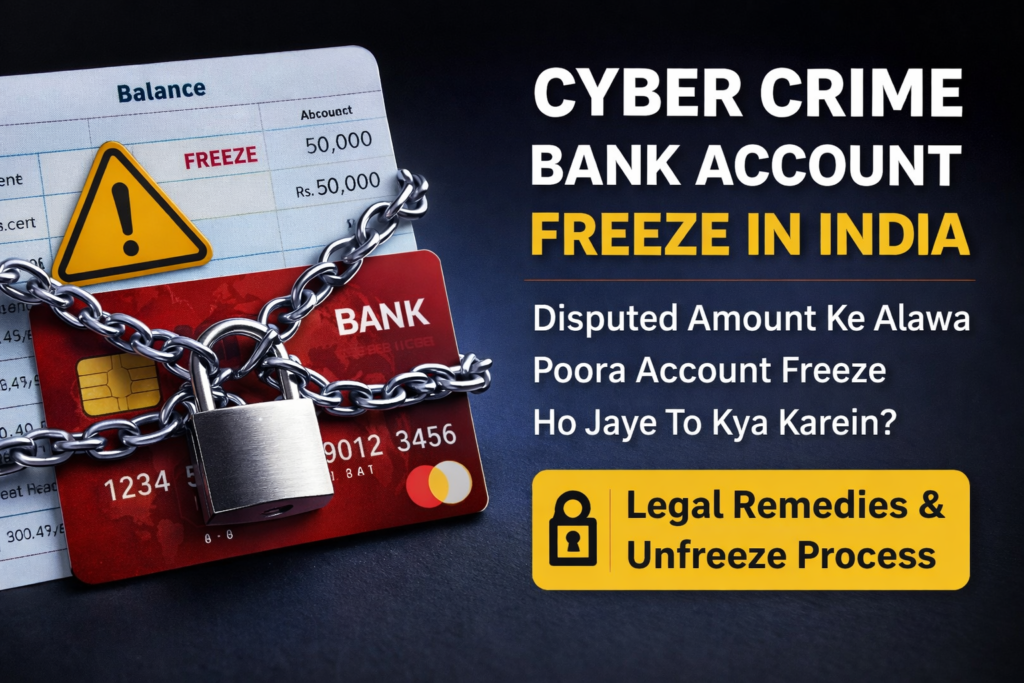
If suspected fraud money has entered an account, the transaction may be examined and a debit freeze, lien or other restriction may be placed depending on the circumstances and applicable procedure.
Sometimes the account holder may have no connection with the original fraud. For example, the account may have received money through:
- A genuine sale or service transaction
- A marketplace transaction
- A third-party payment
- A P2P transaction
- A cryptocurrency-related transaction
- A mistaken UPI transfer
- An intermediary or broker
Therefore, after a freeze, the first practical step is to identify which transaction, complaint or authority caused the restriction.
Bank Account Frozen Because of Cyber Crime? What Should You Do?
- Ask the bank for available details regarding the freeze or lien.
- Obtain your bank statement.
- Identify the disputed transaction.
- Collect the UTR, UPI ID and transaction records.
- Note the police/cyber complaint or reference number, if available.
- Prepare documents explaining the source and purpose of the transaction.
- Submit a factual written explanation to the concerned authority where appropriate.
- Evaluate the appropriate legal/procedural remedy if the restriction continues.
Do not rely only on verbal conversations with the bank or investigating officer. Keep written records of important communications.
▶ WhatsApp – Request General Cyber Legal Guidance
Can the Bank Unfreeze the Account?
It depends on the nature of the restriction.
If the restriction is an internal bank compliance action, the bank’s own review process may be relevant. If the restriction was imposed pursuant to a police or cyber-investigation direction, simply submitting an application at the bank branch may not be sufficient.
First determine whether the account has a:
- Debit freeze
- Lien
- Partial restriction
- Complete account restriction
- Restriction based on a police/cyber authority request
The appropriate remedy can then be considered based on the actual basis of the restriction.
How Long Does It Take to Unfreeze a Bank Account?
There is no universal legal timeline for every account-freeze situation.
If the disputed transaction is quickly verified and the investigating authority is satisfied with the account holder’s explanation, the restriction may be removed sooner. If the account is connected with several disputed transactions or the investigation involves multiple jurisdictions, it may take longer.
Therefore, claims such as “your account will definitely be unfrozen in 7 days” or “every cyber freeze automatically expires after 90 days” should be treated with caution.
Cyber Police Has Called or Sent a Notice. What Should You Do?
Do not automatically ignore a notice or call. First verify that the communication is genuine and identify the complaint or investigation involved.
Prepare:
- Relevant bank statements
- Transaction details
- Invoices or receipts
- Agreements or contracts, where applicable
- UPI records
- WhatsApp/email communications
- Documents showing the legitimate source of funds
Avoid giving false, speculative or incomplete explanations. Provide information that you can support with genuine documents.
What If You Are an Innocent Account Holder?
If your account is involved only because a fraudster transferred money to you or your account appears somewhere in the transaction chain, do not panic—but do not ignore the issue either.
Your practical objective should be to establish:
- Why the transaction occurred.
- Who sent the money.
- What goods, services or consideration were involved, if any.
- Whether you knowingly participated in any fraudulent activity.
- What documentary evidence supports your explanation.
Simply stating “I am innocent” may not be enough. A clear documentary transaction trail can be much more useful.
P2P or Cryptocurrency Transaction Caused the Freeze?
P2P and cryptocurrency transactions can involve multiple bank accounts and payment layers. If an upstream transaction is linked to cyber fraud, a downstream recipient may also come under investigation.
Preserve:
- Order ID
- Platform information
- Wallet transaction details
- Buyer/seller communication
- Bank transaction records
- Payment confirmation
- Trade history
Do not delete or alter the original transaction records.
Does Reporting to 1930 Automatically Recover the Money?
No. Reporting financial cyber fraud through 1930 is important, but money recovery is not guaranteed.
Immediate reporting can help authorities act on the transaction trail while funds may still be traceable or available. The final outcome depends on the circumstances, transaction chain, investigation and applicable legal process.
What Documents Are Needed for a Cyber Crime Complaint?
For financial cyber fraud, keep the following information ready:
- Bank or wallet details
- Transaction ID/UTR
- Transaction date and time
- Fraud amount
- Bank statement
- Transaction screenshots
- Suspect mobile number
- UPI ID or bank account details, if available
- WhatsApp chats
- Email communications
- Relevant invoices, agreements or other documents
Preserve the original electronic evidence. Do not delete, edit or manipulate messages, files or transaction records.
What Happens During a Cyber Crime Investigation?
Every investigation is different, but depending on the case, investigators may:
- Examine the complaint and transaction details.
- Obtain information from banks and payment intermediaries.
- Trace the money trail.
- Identify linked accounts.
- Verify mobile numbers and digital identifiers.
- Collect relevant electronic evidence.
- Coordinate with other States or agencies.
- Question relevant persons.
- Examine devices or documents where legally appropriate.
- Complete the investigation and submit the appropriate police report or take other lawful action.
Can Cyber Police Visit Your Home?
If your address, documents, device or statement is relevant to an investigation, police may take lawful investigative steps. However, never provide money, OTP, PIN, CVV or remote access merely because an unknown caller claims to be a police or cyber officer.
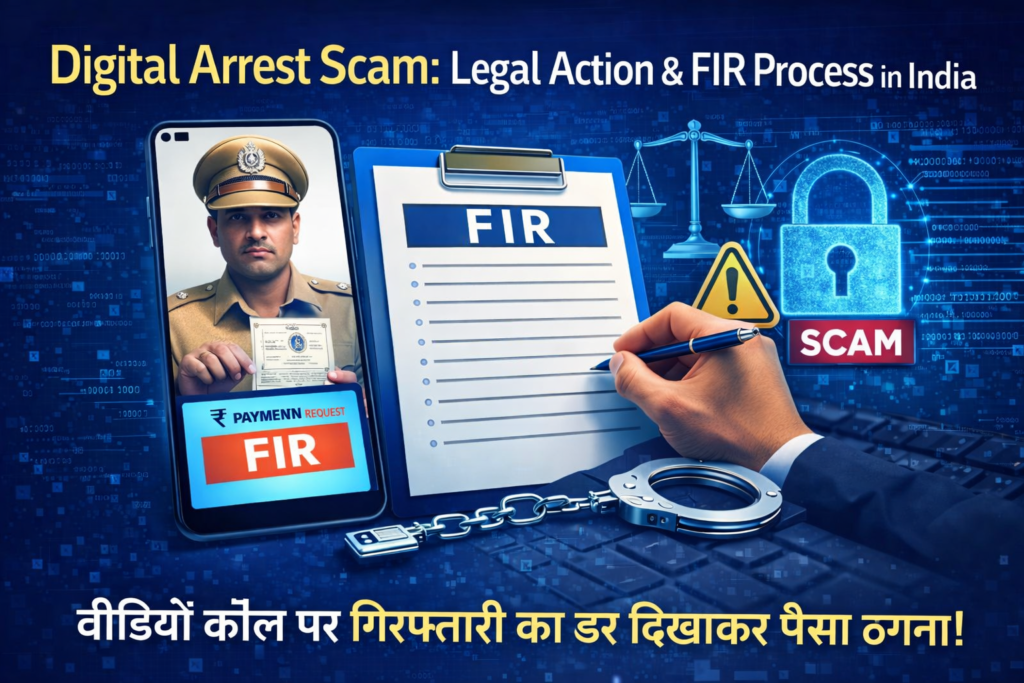
If someone threatens you with “digital arrest”, “account release fees”, “case settlement fees” or immediate arrest unless you transfer money, independently verify the identity of the caller. Such demands can themselves be part of a scam.
Can a Cyber Investigation Continue for More Than 90 Days?
Yes. A general cyber fraud investigation does not automatically end merely because 90 days have passed.
The 90-day provision relating to communication of investigation progress should not be confused with a universal deadline for completing every cybercrime investigation.
The complexity of the investigation, evidence collection, bank responses, multiple transactions and other legal/procedural factors can affect the duration.
▶ WhatsApp – Request Procedural Information
What If There Is No Progress in the Investigation?
If your cyber complaint has been pending for a considerable period, keep the complaint/reference number and submit a written status request where appropriate.
The National Cyber Crime Reporting Portal provides mechanisms for reporting and tracking cybercrime complaints and information concerning grievance handling. If there is a serious delay or legal dispute, the available procedural remedies can be evaluated based on the facts.
Bank Account Frozen and Salary Is Also Blocked?
This can create serious financial difficulties, particularly when the account is used for salary or business transactions.
In such a situation:
- Obtain details of the freeze/lien.
- Identify the disputed transaction.
- Prepare salary/business source documents.
- Keep records of communication with the bank and investigating authority.
- Evaluate the appropriate de-freezing or legal remedy.
The appropriate procedure depends on why and by whom the restriction was imposed.
Common Mistakes to Avoid
- Ignoring a cyber police notice.
- Giving incomplete information to the bank.
- Providing a false explanation.
- Deleting transaction history.
- Deleting WhatsApp chats or emails.
- Paying an unknown “account unfreeze agent”.
- Paying someone claiming to be a police officer.
- Sharing OTP, PIN or CVV.
- Installing remote-access applications at the request of strangers.
- Giving contradictory explanations during the investigation.
What Should You Do During a Cyber Crime Investigation?
- Preserve all evidence.
- Create a transaction chronology.
- Download and preserve your bank statements.
- Keep all police/cyber communications.
- Verify facts before submitting a written explanation.
- Report financial cyber fraud promptly through 1930 and the official cybercrime reporting mechanism.
- Identify the legal basis of any bank restriction.
- Consider case-specific legal guidance where the matter is complex.
If You Are the Victim of Cyber Fraud
If money has been fraudulently taken from your bank account, do not delay reporting it. Financial cyber fraud can be reported through 1930 and the official National Cyber Crime Reporting Portal.
Keep the transaction ID/UTR, bank details, amount involved and available evidence ready.
If Fraud Money Has Been Received in Your Account
If you discover that a disputed payment has entered your bank account, do not ignore it.
If the transaction was legitimate, preserve evidence explaining its purpose. If you cannot explain the source of a payment, do not attempt to hide, transfer or manipulate the money or records.
If investigators contact you, a factual response supported by genuine documents can help clarify your position.
Read Also
- Bank Account Frozen After Cyber Fraud or Police Complaint? How to Unfreeze It
- Business Bank Account Frozen Because of Cyber Complaint – Legal Remedy
- Bank Account Frozen Due to Crypto/P2P Transaction – Legal Remedy
- More Legal Awareness Articles
Frequently Asked Questions
1. How many days does a cyber crime investigation take in India?
There is no fixed timeline for every cybercrime investigation. The duration depends on the complexity of the offence, transaction trail, evidence and agencies involved.
2. Does every cyber investigation finish within 90 days?
No. The 90-day provision concerning communication of investigation progress should not be treated as a universal deadline for completing every cybercrime investigation.
3. My bank account is frozen because of a cyber complaint. What should I do?
Identify the disputed transaction and the authority/reference behind the restriction. Obtain the relevant bank details, prepare supporting documents and consider the appropriate de-freezing or legal remedy.
4. Can an innocent person’s bank account be frozen?
An account may come under investigation or restriction because it appears in a suspected fraud transaction chain. A freeze by itself does not establish guilt.
5. Will reporting to 1930 guarantee recovery of my money?
No. Immediate reporting is important in financial cyber fraud, but recovery is not guaranteed.
6. Should I ignore a cyber police notice?
No. Verify the authenticity of the communication and respond appropriately with relevant documents and factual information.
7. How can I check the status of my cybercrime complaint?
Keep your complaint/reference number and use the available tracking and grievance mechanisms of the National Cyber Crime Reporting Portal. For prolonged or serious disputes, appropriate legal remedies may also be considered.
If Your Bank Account Is Currently Frozen
First identify the transaction, complaint and authority responsible for the restriction. Then prepare your bank statement, UTR/UPI records, invoices, agreements, receipts and other documents explaining the transaction.
If you genuinely had no involvement in the alleged fraud, do not rely only on a verbal statement that you are innocent. A clear and documented transaction trail can be much more useful in explaining your position.
Conclusion
There is no universal 7-day, 30-day or 90-day completion period for every cyber crime investigation in India. The current BNSS framework requires investigation to be completed without unnecessary delay, while also providing for communication regarding investigation progress in the prescribed manner.
Whether you are a cyber fraud victim, an innocent account holder, or someone whose bank account has been frozen, the practical priorities are the same: preserve evidence, identify the disputed transaction, maintain written communication and understand the legal basis of the restriction.
If your account remains frozen, a cyber police notice has been received, disputed money has entered your account, or the investigation has remained pending for a long period, consider obtaining case-specific legal guidance based on the actual documents and transaction history.
Need legal guidance? You may choose to connect for general consultation and information.
Disclaimer: This article is for general legal information and awareness purposes only. It does not constitute legal advice or solicitation. Communication is purely informational, in compliance with Bar Council of India Rule 36.
Image used for illustration purposes only.