Maintenance Order Granted but Payment Not Received? How to Recover Maintenance Arrears Through Execution
This article is published by The Legal Warning India and written by Advocate Uday Singh.
If a Court has already passed a maintenance order in your favour but the husband or other person is not paying the ordered amount, keeps delaying payment, or substantial arrears have accumulated, you do not necessarily have to keep waiting for voluntary payment.
The next important question is often: How can an existing maintenance order actually be enforced?
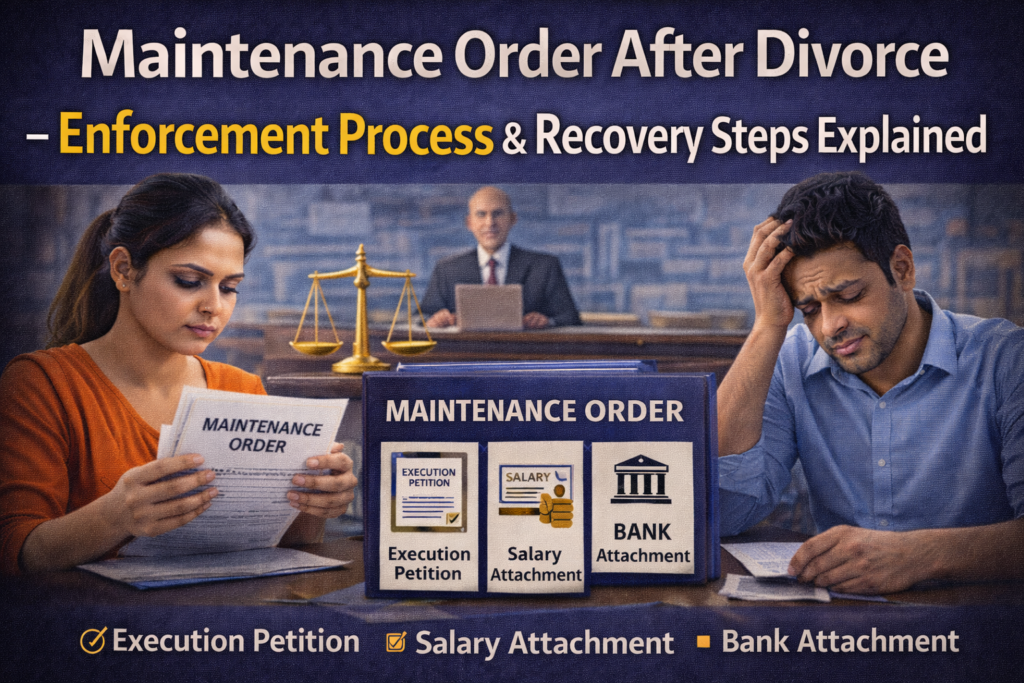
Depending on the law under which the order was passed, the nature of the order and the facts of the case, appropriate execution or enforcement proceedings may be available.
A maintenance order and actual recovery of money are two different stages. If the order is being ignored, maintaining a proper record of monthly dues, payments received, arrears and the opposite party’s available financial information can become extremely important.
▶ WhatsApp – Discuss Your Maintenance Recovery Query
Maintenance Order Passed but Husband Is Not Paying – What Should You Do?
Start by checking the exact Court order:
- How much monthly maintenance was awarded?
- From which date is it payable?
- Is it interim maintenance or final relief?
- Has the Court directed payment of arrears?
- How much has actually been paid?
- How much remains outstanding?
After that, prepare a month-wise arrears statement. This simple document can make the enforcement issue much clearer.
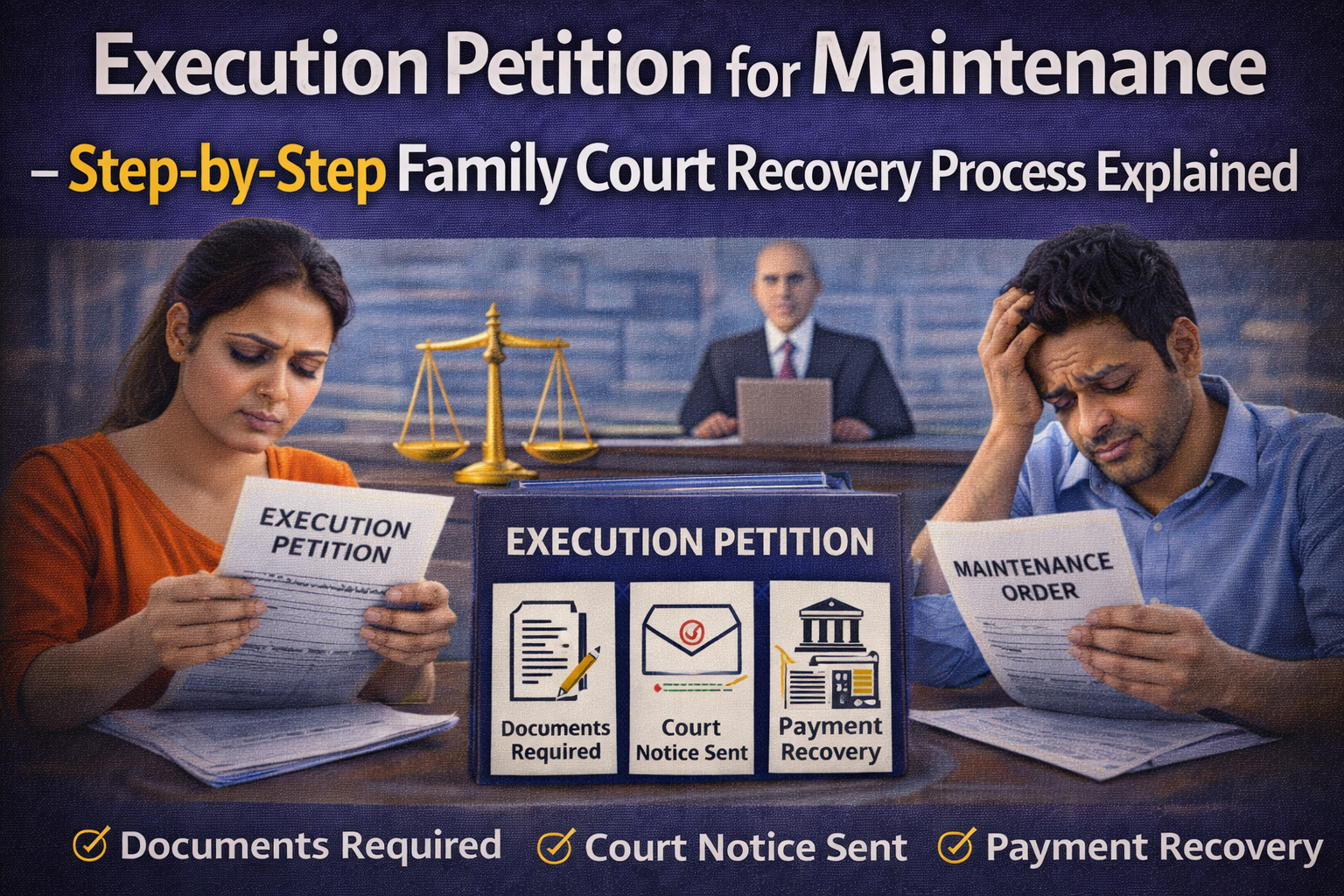
What Is an Execution or Enforcement Proceeding?
In simple terms, an execution or enforcement proceeding is a legal mechanism used to seek compliance with an existing Court order.
It is different from starting an entirely new maintenance claim. Where an existing order is not being complied with, the appropriate Court or authority may be approached for enforcement according to the applicable law.
The exact procedure depends on which law the maintenance order was passed under.
Current Law: BNSS and Maintenance Enforcement
For new criminal procedural matters, the Bharatiya Nagarik Suraksha Sanhita, 2023 (BNSS) has been in force since 1 July 2024.
BNSS Section 144 deals with maintenance of wives, children and parents, while BNSS Section 147 deals with enforcement of maintenance orders. The statute provides for enforcement of an order in the circumstances specified by law. India Code – BNSS
BNSS Section 144(3) also contains a recovery mechanism for breach of a maintenance order, subject to the statutory conditions. The Court may issue appropriate recovery process and, where the statutory requirements are satisfied, imprisonment may also arise. This should not be understood as an automatic arrest merely because one instalment is unpaid.
If your order was passed under the Protection of Women from Domestic Violence Act, Hindu Marriage Act or another statute, the enforcement route may be different. The exact order should therefore be examined before deciding the procedure.
How to Calculate Maintenance Arrears
Before filing an enforcement application, prepare a clear calculation.
| Month | Amount Due | Amount Received | Outstanding |
|---|---|---|---|
| April | ₹20,000 | ₹0 | ₹20,000 |
| May | ₹20,000 | ₹10,000 | ₹10,000 |
Continue this calculation for every month and verify it against your bank statement.
Do not inflate or incorrectly calculate the arrears. The calculation should match the Court order and actual payments received.
What Documents Should You Keep for Maintenance Recovery?
- Copy of the maintenance order
- Relevant previous Court orders
- Bank statements
- Payment receipts or transaction records
- Month-wise arrears calculation
- Relevant communication regarding unpaid maintenance
- Employment or income information of the defaulting party, if lawfully available
- Previous execution/enforcement applications, if any
The exact documents required can vary according to the Court and the statutory basis of the order.
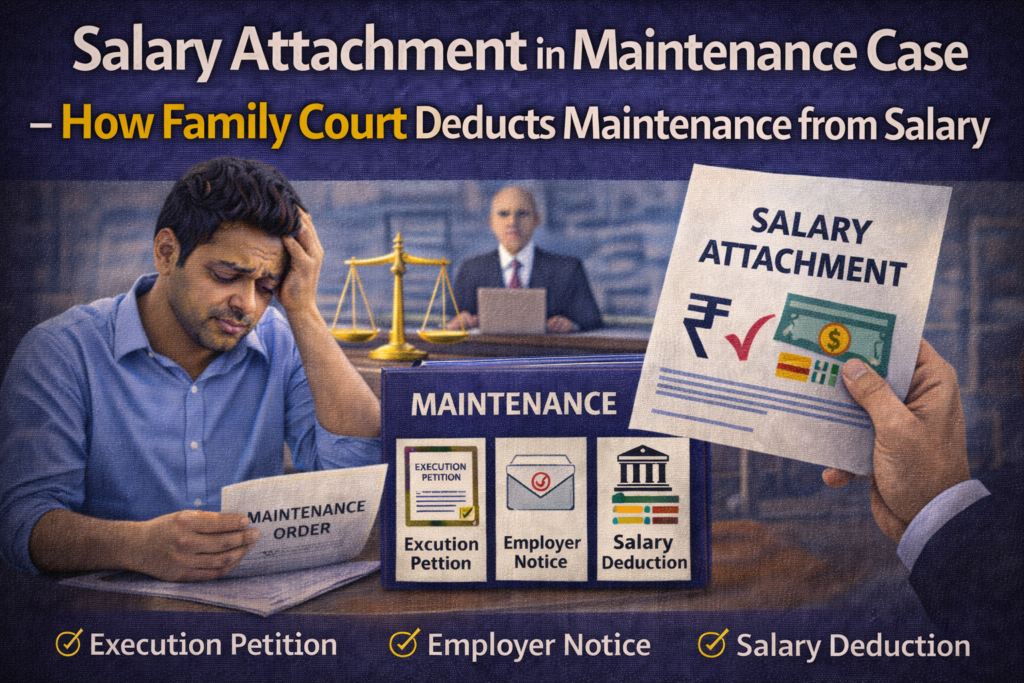
Can Maintenance Be Recovered From Salary?
In appropriate circumstances, the Court may consider available enforcement mechanisms relating to salary or other assets, subject to the applicable law and procedure.
If you know that the person against whom the order was passed is employed by a company or government department, genuine information about that employment may be relevant to the enforcement application.
However, salary attachment is not an automatic consequence of every maintenance default. The Court must consider the applicable legal mechanism and circumstances.
Can Bank Accounts or Property Be Used for Recovery?
Depending on the nature of the order and applicable execution mechanism, attachment or other recovery measures may be considered by the Court.
The Supreme Court in Rajnesh v. Neha discussed mechanisms for effective enforcement of maintenance orders and recognised the importance of ensuring that maintenance orders are capable of being implemented. Supreme Court judgment
However, attachment or sale of assets is not an automatic first step in every maintenance case. The applicable statute, Court order, arrears and facts must be considered.
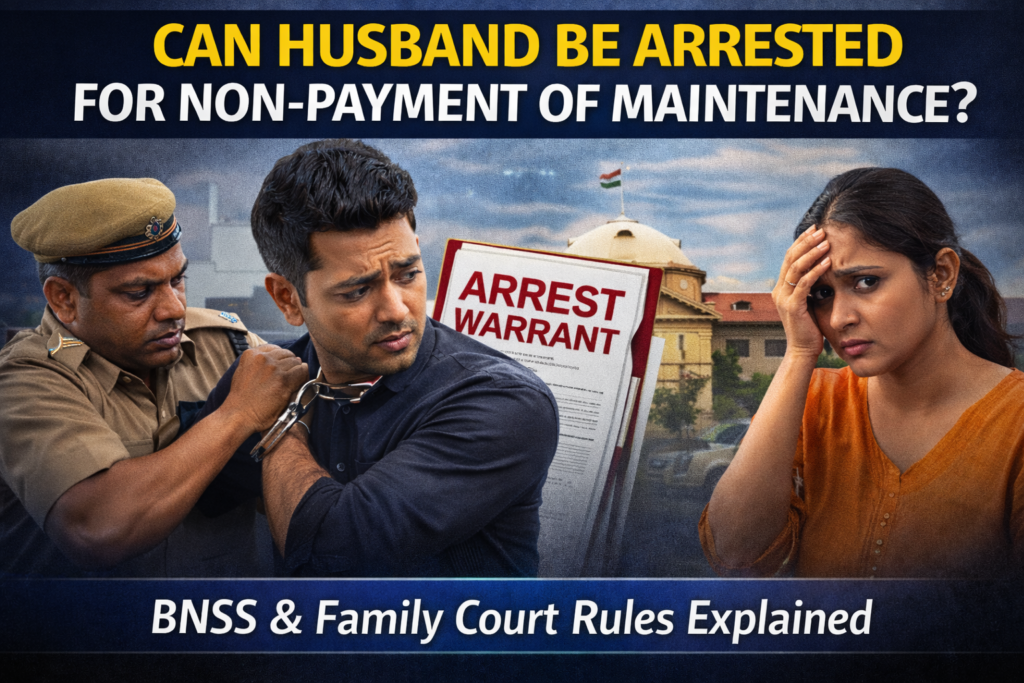
Can a Person Be Sent to Jail for Not Paying Maintenance?
It is important not to treat maintenance default as an automatic “arrest” situation.
Where the applicable statute contains a coercive enforcement mechanism, the Court may take appropriate action subject to the statutory requirements and facts of the case.
For example, BNSS Section 144(3) provides a statutory mechanism concerning recovery of amounts due and imprisonment subject to specified conditions.
The actual action will depend on the Court’s order, the nature of the default and the applicable legal procedure.
What If the Husband Says He Has No Money?
A statement such as “I have no money” does not automatically cancel an existing maintenance order.
If the person’s financial circumstances have genuinely changed, the appropriate legal remedy for modification or reduction of maintenance may be considered under the applicable law.
Until an existing order is modified, stayed or otherwise dealt with by a competent Court, simply ignoring it can create further legal complications.
What If the Husband Is Hiding His Income?
If there are genuine reasons to believe that the opposite party is concealing income, employment or assets, relevant and lawfully obtained information may be placed before the Court.
Depending on the case, this may include:
- Employment information
- Business details
- Publicly available professional information
- Previous income disclosures
- Income affidavits filed before the Court
- Lawfully available property-related information
Do not hack accounts, unlawfully obtain private information or manipulate documents.
Maintenance Order Is Already There – Why Is Execution Still Important?
A common practical mistake is to continue making informal requests for months after a Court order has already been passed.
If the default is continuing, consider:
- Obtaining the latest copy of the order.
- Preparing the complete payment history.
- Calculating arrears month by month.
- Collecting bank statements and payment records.
- Identifying the applicable enforcement provision.
- Considering the appropriate execution/enforcement application.
▶ WhatsApp – Execution Petition Drafting Information
What Relief Can Be Requested in an Enforcement Application?
The prayer should be based on the existing order and the applicable law. Depending on the circumstances, the applicant may seek appropriate directions regarding:
- Recovery of outstanding maintenance arrears
- Compliance with future maintenance payments
- Statutory recovery mechanisms
- Appropriate action for continued non-compliance
- Other legally available relief
The exact relief should not be copied blindly from another case. It should correspond to the order, statute, arrears and facts of your case.
Does the Execution Petition Always Go Before the Same Court?
Not necessarily.
The proper forum and procedure can depend on the statute under which the maintenance order was passed, the Court that issued the order and the applicable enforcement provision.
For example, BNSS Section 147 contains provisions concerning enforcement of maintenance orders in specified circumstances. Therefore, it is not always correct to assume that every maintenance order must be enforced through exactly the same procedure.
What If the Maintenance Order Was Passed Under the Domestic Violence Act?
If maintenance or monetary relief was granted under the Protection of Women from Domestic Violence Act, 2005, the enforcement question must be examined under that statutory framework and the wording of the order.
Do not automatically apply BNSS Section 144 procedure to every maintenance order.
What If Maintenance Was Granted in a Divorce or Matrimonial Case?
If maintenance or alimony was granted under the Hindu Marriage Act or another matrimonial proceeding, the applicable enforcement mechanism depends on the statute, nature of the order and circumstances.
The Supreme Court’s decision in Rajnesh v. Neha is important background authority on maintenance proceedings, disclosure and enforcement.
Common Mistakes in Maintenance Recovery
- Not maintaining a month-wise arrears calculation.
- Failing to preserve bank statements.
- Not keeping a copy of the Court order.
- Relying only on verbal promises.
- Ignoring partial payments while calculating arrears.
- Making unsupported allegations about hidden income.
- Seeking relief that is not available under the applicable law.
- Waiting indefinitely despite repeated default.
Is a Legal Notice Mandatory Before Maintenance Execution?
Not in every case.
If you already have a valid maintenance order and the other party is defaulting, an applicable enforcement mechanism may be available without first sending a separate Legal Notice.
A formal demand may sometimes be useful, but it should not be treated as a compulsory step in every maintenance matter.
Want to Get a Maintenance Execution Petition Drafted?
If a Court has already ordered maintenance but you are facing months of non-payment, increasing arrears, repeated excuses or continued non-compliance, it may be useful to examine the enforcement options rather than relying only on informal requests.
You may contact us with your Maintenance Order, previous Court orders, bank statement and month-wise payment details to obtain general information regarding applicable procedural options and execution/enforcement drafting.
▶ WhatsApp – Discuss Maintenance Recovery
Documents Checklist for Maintenance Execution
- Maintenance Order
- Certified copy, where required
- Case number and Court details
- Month-wise arrears statement
- Bank statement
- Details of payments received
- Previous execution/enforcement applications
- Employment/business information, if lawfully available
- Relevant communication
Practical Action Plan
- Read the maintenance order carefully.
- Identify the statute under which the order was passed.
- Calculate every month’s due and received amount.
- Verify the calculation against your bank records.
- Prepare documentary proof of default.
- Identify the applicable enforcement mechanism.
- Prepare the application with the correct facts, documents and prayer.
FAQs
Maintenance order passed but payment is not being made. What can I do?
Depending on the statute and nature of the order, an appropriate execution or enforcement proceeding may be considered. Start by preparing the order and a complete arrears statement.
Can I file an Execution Petition for maintenance?
Yes, where the applicable law provides an enforcement mechanism. The exact procedure depends on the legal basis of the maintenance order.
Which BNSS sections deal with maintenance?
BNSS Section 144 deals with maintenance of wives, children and parents, while Section 147 deals with enforcement of maintenance orders in the circumstances specified by the law.
Can the husband be jailed for not paying maintenance?
Where the applicable statute provides such a coercive mechanism and the statutory conditions are satisfied, the Court may take appropriate action. It is not an automatic arrest for every payment default.
Can maintenance be recovered from salary?
In appropriate cases, the Court may consider salary-related or other recovery mechanisms under the applicable law. Such relief is not automatic and depends on the facts and procedure.
Can old maintenance arrears also be recovered?
The answer depends on the Court order, dates, applicable statute, limitation and enforcement procedure. The arrears period should therefore be specifically examined.
Do I need to send a Legal Notice before execution?
Not necessarily. A separate Legal Notice is not mandatory in every maintenance enforcement matter. The existing order and applicable enforcement procedure should be examined first.
Maintenance Ordered but Money Still Not Received?
If a Court has already passed a maintenance order and payments are still not being made, do not treat the matter as merely a verbal dispute.
Prepare a clear record of the Court order, monthly dues, payments received, outstanding arrears and available financial information of the defaulting party.
The appropriate enforcement route can then be assessed according to the law under which your order was passed.
▶ WhatsApp – Discuss Your Execution Application
Maintenance Arrears Are Pending?
If you have the Maintenance Order, arrears details, bank statements and previous Court documents, you may contact us for general information regarding procedural options and Execution/Enforcement drafting based on your facts and documents.
Disclaimer: This article is for general legal information, awareness and educational purposes only. It does not constitute legal advice, legal opinion or solicitation. The appropriate enforcement or execution procedure depends on the statute under which the maintenance order was passed, the wording of the order, the relevant dates, limitation and the facts and documents of the individual matter. No particular recovery, arrest, attachment or other outcome is guaranteed. This communication is informational in nature and is intended to comply with Bar Council of India Rule 36.
Image used for illustration purposes only.