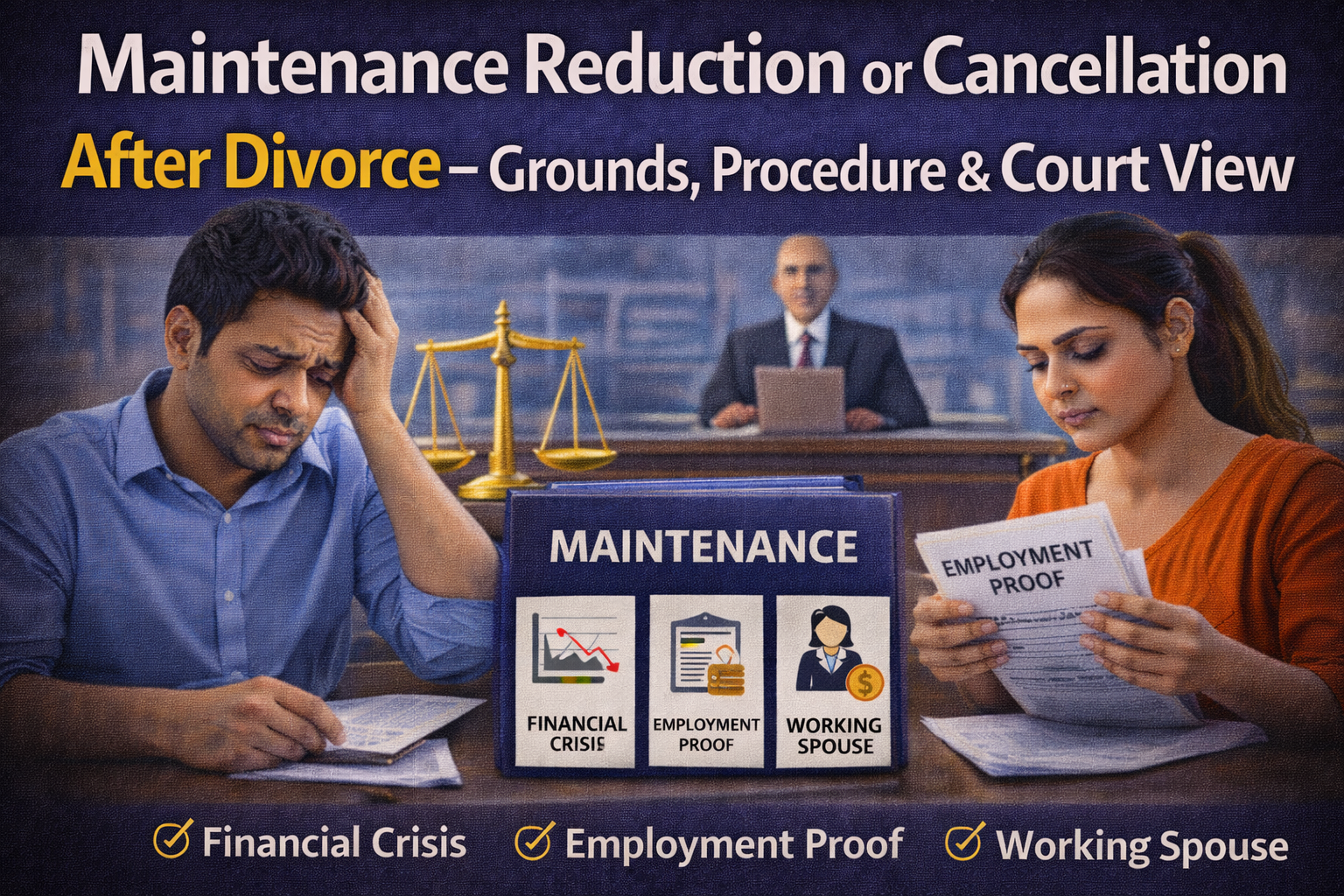
Maintenance Reduction or Cancellation After Divorce – When Is It Allowed? (Court View Explained)
This article is published by The Legal Warning India and written by Advocate Uday Singh.
Information is based on statutory provisions, family court practice, and publicly available judicial principles.
Why People Seek Reduction or Cancellation of Maintenance
After divorce, maintenance or permanent alimony is often ordered by the family court. Over time, circumstances may change. The paying spouse may face financial hardship, or the receiving spouse may become financially independent.
This leads to a common legal question:
👉 Can maintenance be reduced or cancelled after divorce?
The answer is yes — but only through court process and only on valid legal grounds.
Legal Provision for Modification of Maintenance
Maintenance after divorce is commonly governed by Section 25 of the Hindu Marriage Act.
This provision allows the court to:
- Increase maintenance
- Reduce maintenance
- Cancel maintenance
But this can be done only if there is a material change in circumstances.
What Counts as “Change in Circumstances”?
Courts do not modify maintenance lightly. The change must be substantial and genuine.
Valid Grounds for Reduction or Cancellation
- Loss of employment or drastic income reduction
- Serious illness or disability affecting earning capacity
- Retirement with reduced income
- Receiving spouse becoming financially independent
- Remarriage of the spouse receiving maintenance (in applicable cases)
Mere inconvenience or temporary hardship is usually not enough.
Working Spouse & Maintenance Reduction
If the spouse receiving maintenance starts earning a sufficient income after divorce, the paying spouse may seek reduction or cancellation.
Courts examine:
- Actual income of the recipient
- Standard of living during marriage
- Whether income is stable and sufficient
Related analysis:
Working Wife & Husband with Higher Income – Maintenance Law Explained
What If the Paying Spouse Faces Financial Crisis?
Courts expect genuine proof of hardship.
- Salary reduction letters
- Medical records
- Bank statements showing reduced income
Simply stopping payment without court permission is risky.
Procedure to Apply for Maintenance Reduction or Cancellation
Step 1: File a Modification Application
An application must be filed before the same family court that passed the maintenance order.
Step 2: File Updated Income & Expense Affidavit
The applicant must disclose current financial position honestly.
To understand affidavit requirements, read:
Family Court Maintenance Affidavit – Income Disclosure Rules
Step 3: Serve Notice & Hearing
The other party gets a chance to reply and contest the claimed change in circumstances.
Step 4: Court Decision
The court may reduce, cancel, or continue maintenance based on evidence.
What If Maintenance Is Stopped Without Court Order?
Unilateral stoppage of maintenance is treated as default.
Consequences may include:
- Execution proceedings
- Recovery of arrears
- Coercive enforcement steps
Read enforcement process here:
Maintenance Order After Divorce – Enforcement Process Explained
Can Interim Maintenance Also Be Modified?
Yes. Interim maintenance can be modified during divorce proceedings if circumstances change.
Filing process explained here:
How to File Interim Maintenance Application in a Divorce Case
Common Mistakes to Avoid
- Stopping payment without court order
- Hiding income or exaggerating hardship
- Filing modification without documents
- Delaying legal action
Conclusion
Maintenance can be reduced or cancelled after divorce, but only through proper legal procedure and proof of genuine change in circumstances. Courts balance fairness with financial realities.
Legal modification is always safer than unilateral non-payment.
This article is for general legal information and awareness purposes only. It does not constitute legal advice or solicitation. Communication is purely informational, in compliance with Bar Council of India Rule 36.