This article is published by The Legal Warning India and written by Advocate Uday Singh.
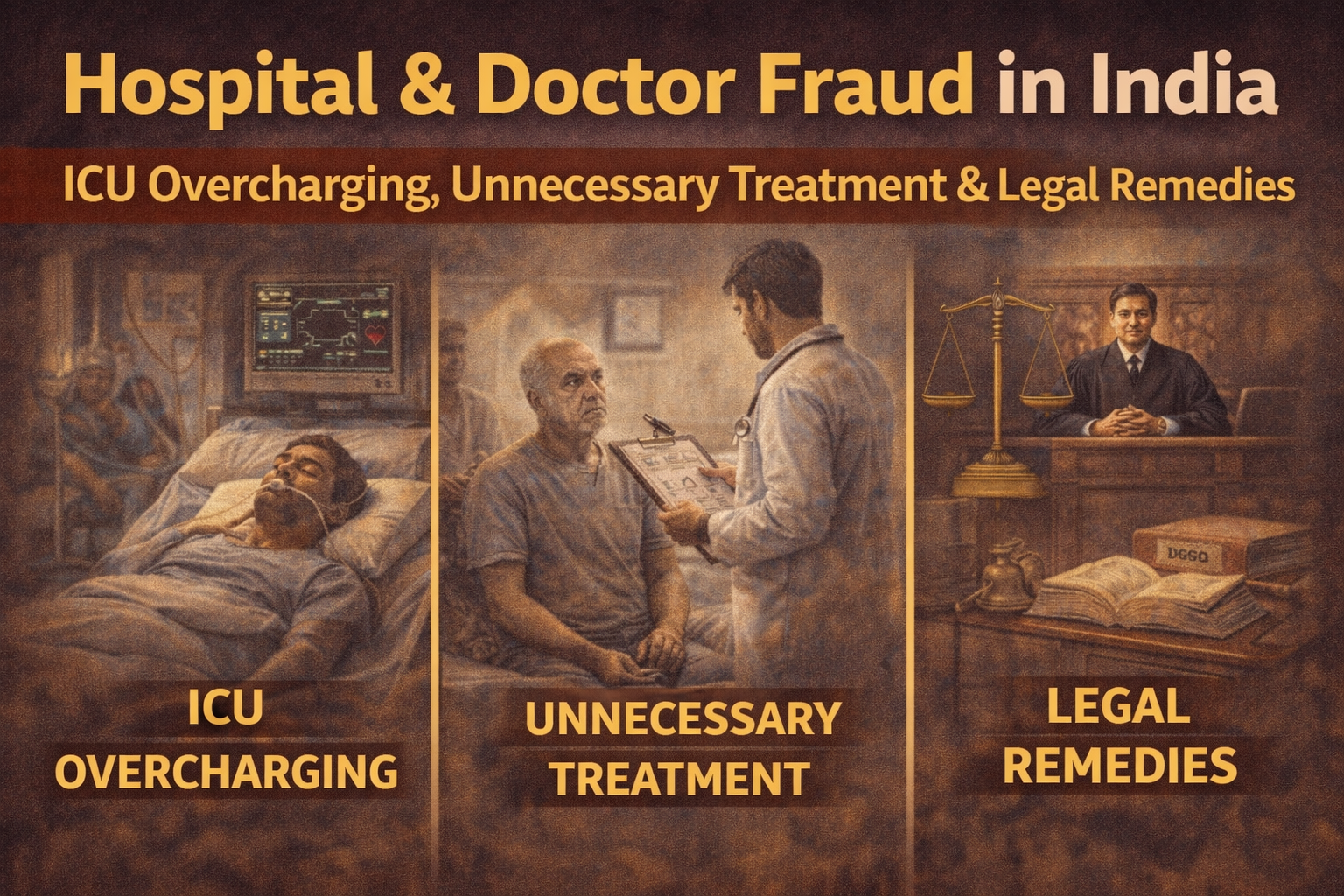
Hospital & Doctor Fraud in India – Overcharging, ICU Misuse and Patient Legal Remedies
Many patients and families realise only after discharge that something went seriously wrong during hospital treatment.
Common complaints include:
- Unnecessary tests and procedures advised
- Fear-based treatment escalation
- ICU stay extended without clear medical justification
- Sudden and unexplained bill inflation
- Consent taken casually or not taken at all
Such situations are not merely “hospital practices” — in many cases, they raise serious legal concerns under medical law, consumer protection law, and in extreme cases, criminal law.
This article explains when hospital or doctor conduct becomes illegal, what rights patients have, and what legal remedies are available in India.
Information is based on the Consumer Protection Act, medical ethics rules, and publicly reported legal principles.
When Does Hospital Overcharging Become Illegal?
Hospital billing becomes legally objectionable when:
- Charges are raised for services not actually provided
- Unnecessary diagnostic tests are routinely advised
- Patients are shifted to ICU without medical necessity
- Treatment plans are changed without explanation
- Break-up of bills is refused or unclear
Such practices may amount to unfair trade practice or deficiency in medical service under consumer law.
ICU Misuse – A High-Risk Area for Abuse
ICU cases generate the highest number of disputes because:
- Family members are emotionally vulnerable
- Consent is often rushed or implied
- Daily ICU bills escalate rapidly
Emergency does not mean unlimited authority.
Except in life-saving situations, informed consent and medical justification remain mandatory.
Doctor’s Legal Duties Towards Patients
Doctors and hospitals are legally required to:
- Explain diagnosis and treatment options
- Take informed consent for procedures
- Avoid unnecessary or profit-driven treatment
- Maintain transparency in billing
Failure to follow these duties may lead to legal consequences.
Is Every Medical Dispute a Criminal Case?
No. Every hospital dispute does not automatically become a police case.
However, criminal law may apply if there is:
- Deliberate misrepresentation of medical condition
- Fabrication or manipulation of records
- Charging for non-existent procedures
- Intentional cheating or fraud
Each case depends on facts and evidence.
What Legal Remedies Are Available to Patients?
- Consumer Complaint – For overcharging, deficiency in service, unfair trade practice
- Medical Council Complaint – For ethical misconduct by doctors
- Civil Claim – For recovery of excess amount paid
- Criminal Complaint – Only in cases involving clear fraud or forgery
Choosing the correct legal forum is crucial.
What Evidence Should Patients and Families Preserve?
- Hospital bills and payment receipts
- Prescriptions, test reports, discharge summary
- Consent forms signed during treatment
- Any written or recorded communication (lawfully obtained)
Documentation plays a decisive role in medical disputes.
Common Mistakes Patients Should Avoid
- Relying only on verbal assurances
- Discarding medical papers after discharge
- Assuming all hospital actions are legally justified
- Approaching the police without understanding jurisdiction
Incorrect steps can weaken an otherwise valid case.
Related Legal Awareness Guides
When Is Legal Guidance Important?
Legal guidance may become important when:
- Hospital refuses to justify billing
- Large sums were extracted under pressure
- Treatment decisions appear commercially motivated
- Patient or family feels misled or deceived
Early understanding of legal options helps prevent further loss.
Need legal guidance? You may choose to connect for general consultation and information.
▶ Request Online Consultation
▶ Request WhatsApp Consultation
Disclaimer: This article is for general legal information and awareness purposes only. It does not constitute legal advice or solicitation. Communication is purely informational, in compliance with Bar Council of India Rule 36.