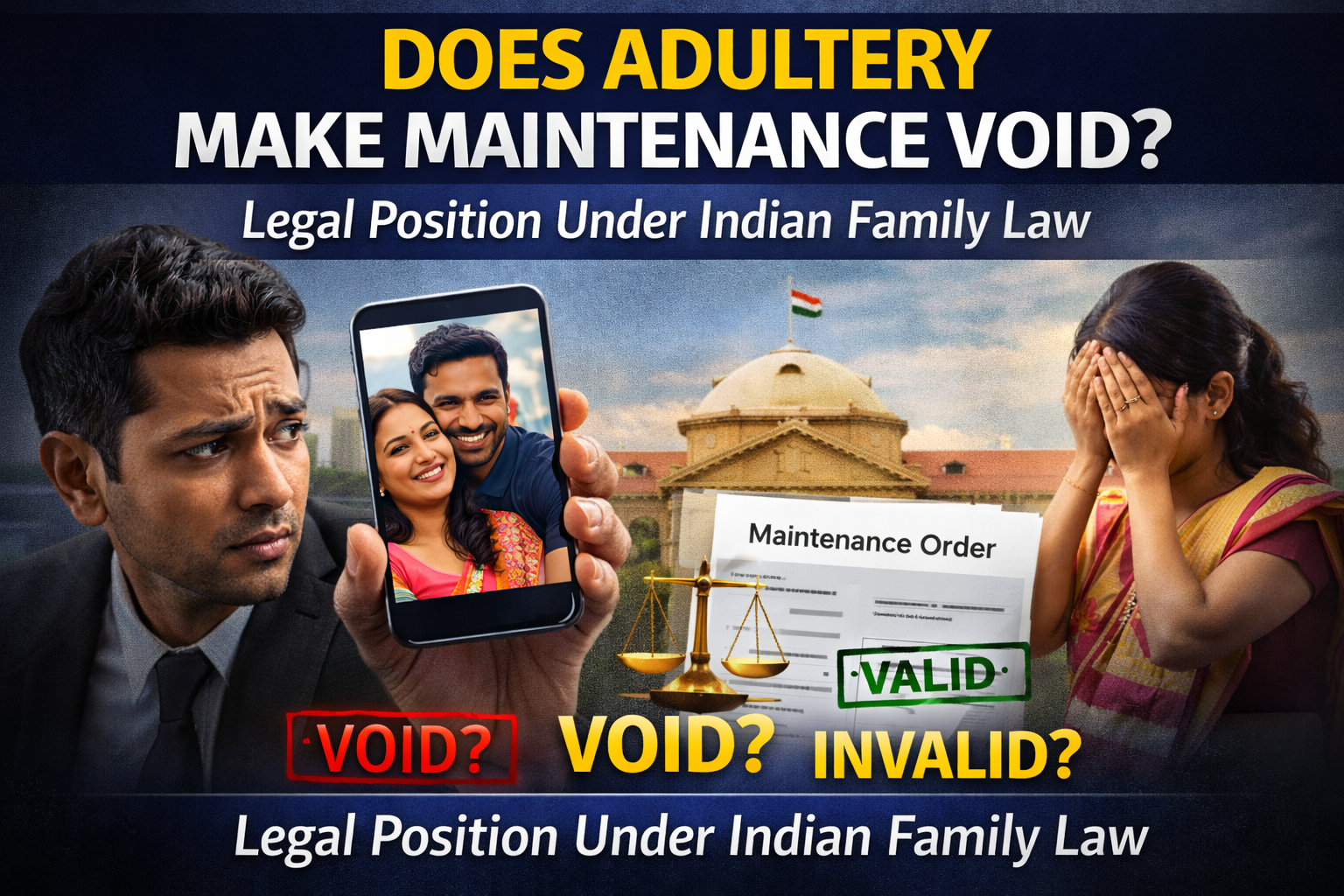
Does Adultery Make Maintenance Void or Invalid? Legal Position Under Indian Family Law
This article is published by The Legal Warning India and written by Advocate Uday Singh.
Information is based on publicly available laws, court interpretations, and reported judicial principles.
The Core Question
One of the most sensitive and frequently asked questions in matrimonial disputes is:
“If a wife is involved in adultery or an extramarital relationship, does her right to maintenance become void or invalid?”
This issue arises regularly in maintenance cases filed under Section 125 of the Criminal Procedure Code (CrPC), as well as under personal laws such as the Hindu Marriage Act.
The answer is not as simple as yes or no. Indian courts look at adultery very carefully, based on evidence, timing, and conduct.
Understanding Maintenance Under Indian Law
Maintenance is not a punishment or reward. Its purpose is:
- To prevent destitution and financial hardship
- To ensure basic dignity and survival
- To protect a dependent spouse from neglect
Because of this objective, courts do not automatically cancel maintenance merely on allegations of immoral conduct.
Section 125 CrPC – Adultery as a Legal Bar
Section 125(4) CrPC clearly states:
A wife shall not be entitled to receive maintenance if she is living in adultery.
This provision is often misunderstood.
Important Legal Interpretation
- The law uses the words “living in adultery”, not “committed adultery once”
- It refers to a continuous adulterous relationship
- Mere suspicion, allegation, or past relationship is not enough
Therefore, maintenance does not become automatically void just because adultery is alleged.
What Does “Living in Adultery” Actually Mean?
Courts have consistently held that:
- There must be clear, reliable evidence of an ongoing adulterous relationship
- The relationship should be of a nature similar to a live-in arrangement
- Occasional meetings or unproven allegations are insufficient
The burden of proof lies on the husband who is claiming that maintenance should be denied.
Does Adultery Make Maintenance Void or Only Deniable?
This distinction is crucial.
- Maintenance is not void automatically
- It can be denied or stopped only after judicial determination
- Court must record findings based on evidence
Until such a finding is given by the court, maintenance orders remain valid and enforceable.
Adultery Under Hindu Marriage Act vs Maintenance Law
Adultery can be a ground for divorce under the Hindu Marriage Act. However:
- Divorce grounds and maintenance rights operate independently
- A spouse may lose divorce protection but still claim maintenance
- Only “living in adultery” affects Section 125 CrPC
This legal separation ensures that financial support is not denied solely on moral accusations.
Common Myths About Adultery and Maintenance
- Myth: One WhatsApp chat proves adultery
Reality: Courts require strong, corroborative evidence - Myth: Adultery allegation cancels maintenance immediately
Reality: Only a court order can modify or cancel maintenance - Myth: Past relationship before separation bars maintenance
Reality: Timing and continuity matter
What Happens If Adultery Is Proven?
If the court is satisfied that the wife is living in adultery:
- Maintenance under Section 125 CrPC may be denied or withdrawn
- Existing maintenance order can be modified or cancelled
- Each case is decided on its own facts
What If Allegation Is False or Unproven?
If adultery allegations are:
- Based on suspicion
- Filed as a pressure tactic
- Not supported by evidence
Then maintenance cannot be denied, and false allegations may even weaken the defence.
Practical Advice for Both Sides
For Husband
- Do not rely on assumptions or rumours
- Evidence must be lawful and credible
- Legal strategy matters more than accusations
For Wife
- Do not panic due to allegations
- Focus on financial dependency and conduct
- Respond through proper legal representation
Conclusion
Adultery does not automatically make maintenance void or invalid. Under Indian law, maintenance can be denied only if it is conclusively proved that the wife is living in adultery, as interpreted strictly by courts.
Each case depends on facts, evidence, and judicial satisfaction. Moral allegations alone are not enough to defeat a statutory right meant to prevent financial hardship.
Read Also:
This article is for general legal information and awareness purposes only. It does not constitute legal advice or solicitation. Communication is purely informational, in compliance with Bar Council of India Rule 36.